Short answer: 3-day potty training can work for children who are already ready, but no study has tested the branded 3-day method itself. It’s a modern version of intensive, parent-led training first studied by Foxx and Azrin in the 1970s, and the research on any toilet training method is limited. Readiness matters more than the method: the AAP says children show signs of bladder and bowel control between 18 and 24 months, and the average US child starts training between 2 and 3. Expect three focused days to lay a foundation, followed by weeks of practice and some accidents.
Key takeaways
- No trial of the 3-day method: the branded program hasn’t been studied. Its roots, intensive Foxx and Azrin-style training, were tested in small studies.
- No method is proven best: reviews find low-quality evidence for every approach, including child-led ones.
- Readiness is the key: starting before a child is ready tends to make training take longer overall, not finish sooner.
- “Trained in 3 days” means started: most children still have accidents for weeks; nighttime dryness comes later.
- Keep it positive: the AAP advises praise, consistency, and no punishment for accidents.
Does 3-day potty training work?
It can, for a child who is ready, but there’s no research on the branded method itself. The “3-day” approach, popularized by author Lora Jensen and others, is an intensive, parent-led method: you clear your schedule, put away the diapers, keep your child close, and watch for every cue for three days. Many families report success; others find their child wasn’t ready and stop.
The idea of very fast training goes back to psychologists Richard Foxx and Nathan Azrin. In a 1973 study, they trained 34 children who’d had toilet training problems, using a structured program with extra drinks, practice trips to the potty, and lots of praise. All 34 were trained, in an average of about 4 hours, and children older than 26 months needed about 2 hours. Accidents dropped to near zero over four months of follow-up.
Those results sound impressive, but the study was small, had no comparison group, and was run by the method’s creators with trainers following a detailed protocol. A 2012 review in the Canadian Medical Association Journal noted that the 2006 US government (AHRQ) review found only three trials of toilet training methods in healthy children, and concluded there is no high-level evidence that any method is best.
What the research says: evidence on toilet training methods is thin. Intensive training was tested in small studies in the 1970s; child-oriented training (the approach the AAP favors) is mostly based on expert opinion and observational research. We found no peer-reviewed trial of the branded 3-day method, and no study supporting a specific “ideal” start age such as 22 months. Both intensive and gradual methods seem to work for children who are ready.
How is 3-day training different from a gradual approach?
Mainly in pace and who leads. Here’s how the two compare:
| Feature | Intensive (3-day style) | Gradual (child-oriented) |
|---|---|---|
| Who leads | Parent sets the pace | Child’s interest sets the pace |
| Diapers | Gone during the day from day 1 | Phased out over weeks or months |
| Time commitment | Several fully cleared days at home | Fits into normal routines |
| Evidence | Small 1970s studies of the original method; none of the brand | Mostly expert opinion; endorsed by the AAP and Canadian Paediatric Society |
| Best suited to | Ready children, parents who can focus for a few days | Children who are hesitant or showing early signs |
| Main risk | Stress and power struggles if the child isn’t ready | Can drag on without a clear plan |
The AAP and the Canadian Paediatric Society both recommend a child-oriented approach that begins when a child shows interest and readiness. That doesn’t rule out a focused few days, as long as your child is ready and the tone stays positive.
How do I know if my toddler is ready?
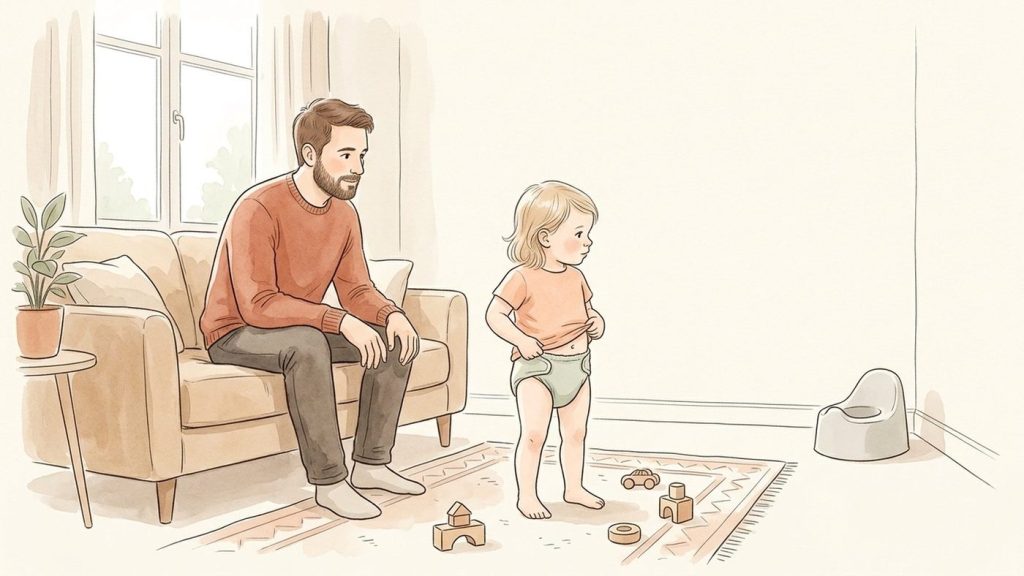
Look for a cluster of signs rather than a birthday. The AAP says children show signs of bladder and bowel control between 18 and 24 months, and the average US child starts training between 2 and 3. Signs from the AAP and the Canadian Paediatric Society include:
- staying dry for at least 2 hours at a time during the day, or waking dry after naps
- showing signs they’re about to pee or poop, such as grunting, freezing, or squatting
- following simple instructions
- sitting steadily on a potty and wanting to do things independently
- showing interest in the potty, such as watching you or enjoying potty books
- being able to tell you, in words or gestures, that they need to go
Starting early doesn’t usually mean finishing early. In a 2003 Pediatrics study that followed 378 children from 17 to 19 months, those who started intensive training earlier took longer to finish. For children who began before about 27 months, an earlier start didn’t lead to an earlier finish. Encouragingly, earlier training wasn’t linked to constipation or stool withholding in that study.
The AAP also suggests waiting during big upheavals, such as a move or a new baby. If a sibling is on the way, our posts on preparing a toddler for a new baby and potty regression after a new baby may help you time it.
Free download
Free: milestone checklist, 2 to 12 months
The CDC milestones on one page, to tick off as your baby grows. Part of our free 7-page printables pack.
How do I do 3-day potty training?
Versions vary, but most follow the same core steps. If you decide to try it, this outline keeps it in line with AAP advice on staying positive:
- Prepare ahead. Read potty books, let your child sit on the potty clothed, and pick three days at home with no outings or visitors.
- Make the switch. On day 1, explain that diapers are for babies and put on underwear (or let your child go bare-bottomed at home). Many families keep a diaper or pull-up for naps and nights.
- Stay close and watch. Keep the potty nearby and watch for wiggling, squatting, or stopping mid-play. Take your child to the potty at those moments and at regular times, such as after waking and after meals.
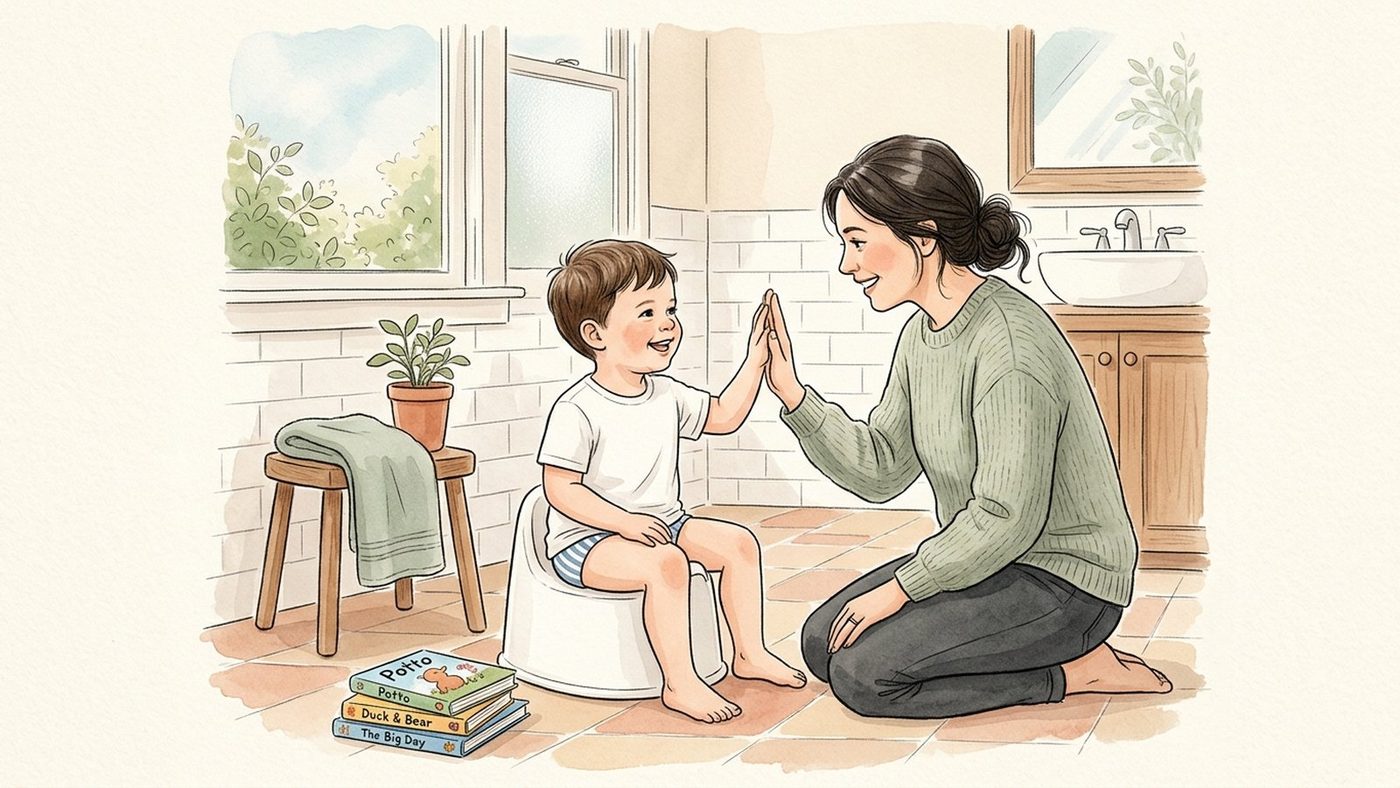
- Celebrate successes. Specific praise (“You peed in the potty!”) works well. Small rewards are optional; the AAP says children learn best when praised for progress.
- Handle accidents calmly. Say “Pee goes in the potty,” move to the potty, and have your child help clean up, without scolding.
- Keep going after day 3. Use the same words and routine at daycare and with other caregivers. Short outings come next, with a potty or spare clothes in tow.
One caution about fluids: the original Foxx and Azrin method gave children extra drinks to create more practice. Don’t push large amounts of water on a toddler. Normal drinks spread through the day are enough.
What if 3-day potty training isn’t working?
Pause and try again later; the Canadian Paediatric Society suggests a break of 1 to 3 months. If your child is having constant accidents, showing no awareness of needing to go, crying or resisting every trip to the potty, or holding in poop, it usually means they’re not ready yet. Going back to diapers for a while isn’t a failure. The AAP warns against power struggles and says nearly every child learns to use the toilet sooner or later.
It’s also normal for training to look “done” by day 3 and then wobble. Pooping on the potty often takes longer than peeing, and staying dry at night is a separate stage that depends on bladder maturity. See night-time potty training age for when that typically happens. If your child is holding in poop, toddler withholding poop covers what helps.
Never punish, shame, or force a child to sit on the potty. Accidents can be frustrating; if you feel yourself losing your temper, step away and take a break. A potty seat on an adult toilet needs a stable step stool and an adult close by.
Talk to your pediatrician if:
- peeing seems painful or burns, or your child suddenly needs to go much more often
- poops are hard, painful, or rare, or your child is holding them in
- your child is constantly damp or dribbling, even between potty trips
- there’s blood in the urine or stool, or a fever with urinary symptoms
- your child isn’t showing any signs of readiness by around age 3, or was trained and has had accidents for weeks with no clear reason
Frequently asked questions
Is 22 months the best age for 3-day potty training?
We found no study supporting 22 months as an ideal age. Some children are ready then; many aren’t until well after their second birthday. Readiness signs are a better guide than a set age.
Should I use pull-ups during 3-day training?
Most intensive methods skip pull-ups during the day so children feel when they’re wet. Many families still use them for naps and nights, which is separate from daytime training.
Can daycare do 3-day potty training?
Usually the intensive days happen at home, then daycare continues the routine. Tell caregivers the words you use and how you handle accidents so your child gets the same message everywhere.
How many accidents are normal after 3-day training?
Several a day at first is common, and occasional accidents can continue for weeks or months, especially when children are busy playing, tired, or unwell. A steady downward trend is what matters.
By what age are most children potty trained?
The AAP says most children in the US are bowel and bladder trained by 4 years of age. Staying dry at night often takes longer.
Sources
- American Academy of Pediatrics, HealthyChildren.org. The Right Age to Potty Train. healthychildren.org
- American Academy of Pediatrics, HealthyChildren.org. Creating a Toilet Training Plan. healthychildren.org
- American Academy of Pediatrics, HealthyChildren.org. Potty Training: 12 Tips to Keep the Process Positive. healthychildren.org
- Foxx RM, Azrin NH (1973). Dry pants: a rapid method of toilet training children. Behaviour Research and Therapy. doi.org
- Kiddoo DA (2012). Toilet training children: when to start and how to train. CMAJ. pmc.ncbi.nlm.nih.gov
- Blum NJ, Taubman B, Nemeth N (2003). Relationship between age at initiation of toilet training and duration of training: a prospective study. Pediatrics. pubmed.ncbi.nlm.nih.gov
- Canadian Paediatric Society, Caring for Kids. Toilet learning. caringforkids.cps.ca