Short answer: Container baby syndrome is not an official medical diagnosis. It’s a term, mostly used by physical therapists, for problems such as flat head, tight neck muscles, and delayed motor skills that can show up when babies spend a lot of their awake time in car seats, bouncers, swings, and other devices. The research linking containers to these problems is mostly correlational, so it can’t prove cause. The practical advice is reasonable either way: use containers when you need them, keep stretches short (the WHO says no more than 1 hour at a time), and give your baby plenty of floor and tummy time.
Key takeaways
- Not a diagnosis: researchers describe it as a recent term for a cluster of symptoms, not a recognized medical condition.
- The evidence is associations: more container time has been linked with slower motor development in some studies, but no study shows containers cause it.
- Total time is what matters: occasional bouncer or stroller use isn’t the concern. Long, repeated stretches every day are.
- Simple rule: the WHO advises that babies not be restrained for more than 1 hour at a time and get at least 30 minutes of tummy time a day.
- Car seats are still essential: always use one for car travel. Just take your baby out once you arrive.
What is container baby syndrome?
It’s a name for a group of problems that can develop when a baby spends much of the day in devices that hold them in one position. The American Physical Therapy Association’s consumer site, ChoosePT, describes it as the various conditions caused when a baby spends too much time in devices. A 2024 study from the University of Delaware describes it as a relatively recent term for a collection of symptoms, such as developmental delay, head shape changes, and obesity, and states plainly that it does not represent an official diagnosis.
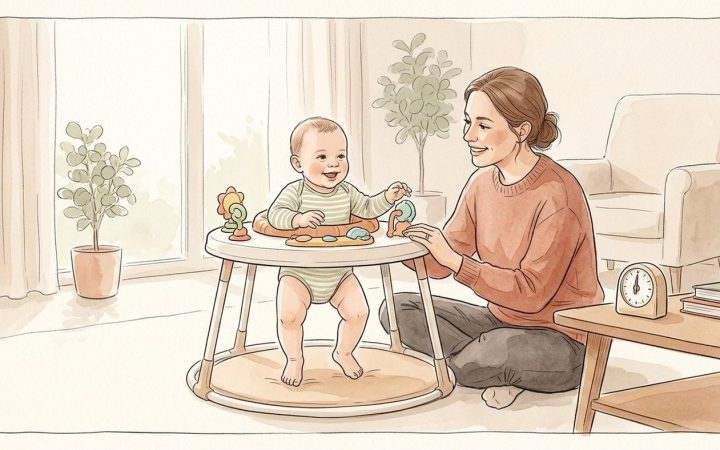
“Containers” means any baby gear that holds a baby in place. ChoosePT lists car seats used outside the car, strollers, bouncers and swings, rockers, molded floor seats, nursing pillows, high chairs used outside meals, jumpers, activity centers, and sit-in walkers.
The problems most often linked to heavy container use are:
- Flat head (positional plagiocephaly). Constant pressure on one part of a soft skull can flatten it.
- Tight neck muscles (torticollis). A baby who always looks one way can develop a head tilt or a preference for turning to one side.
- Slower motor skills. Less time moving freely means less practice at lifting the head, rolling, sitting, and crawling.
Is container baby syndrome real?
The individual problems are real; the “syndrome” as a single condition is not established. Here’s what the research does and doesn’t show:
| Claim | What the evidence shows | How strong |
|---|---|---|
| More container time goes with slower motor development | Cross-sectional studies found this in typically developing babies, though not in babies born preterm | Moderate to limited (associations only) |
| Container time early on predicts later walking | A Canadian study of 411 babies linked more restrained time at 2 to 6 months with later supported walking | Limited (one longitudinal study, parent reports) |
| Tummy time helps motor skills | The same study, and a 2020 systematic review, linked more tummy time with better motor development | Moderate |
| Lying in one position can flatten the head | Accepted by the AAP; prevention includes tummy time and varying position | Strong |
| Containers cause a distinct syndrome | No study has shown this; researchers note a lack of causal evidence | Not established |
The main problem with the research is that babies who spend a lot of time in containers may differ in other ways, such as health conditions, temperament, home space, or childcare setup. The University of Delaware team notes there is a lack of causal evidence, partly because it’s hard to run a trial that limits products families depend on.
What the research says: the link between heavy container use and slower motor development comes from observational studies, mostly with parent-reported time. That’s enough to support sensible limits, but not enough to say containers cause lasting harm, or to set an exact safe number of minutes. Specific time limits you see online (such as 10 to 20 minutes at a time) are expert opinion, and even PT sources don’t agree on one figure.
How long can a baby be in a bouncer, swing, or car seat?
There’s no exact limit backed by research, but the WHO’s 2019 guidelines are a useful anchor: babies under 1 should not be restrained for more than 1 hour at a time, whether in a stroller, high chair, or carrier on a caregiver’s back. The same applies to children aged 1 to 2.
Some physical therapists suggest much shorter stretches. ChoosePT, for example, suggests 10 to 15 minutes at a time followed by floor time. Treat these as starting points rather than strict rules. What matters most is the pattern across the whole day: a baby who spends most waking hours moving from car seat to swing to bouncer gets very little practice moving on their own.
One firm rule applies to every container: none of them is a place for sleep. If your baby falls asleep in a swing, bouncer, or car seat outside the car, move them onto their back in a crib or bassinet. Our post on baby sleep in a swing or car seat explains why.
Free download
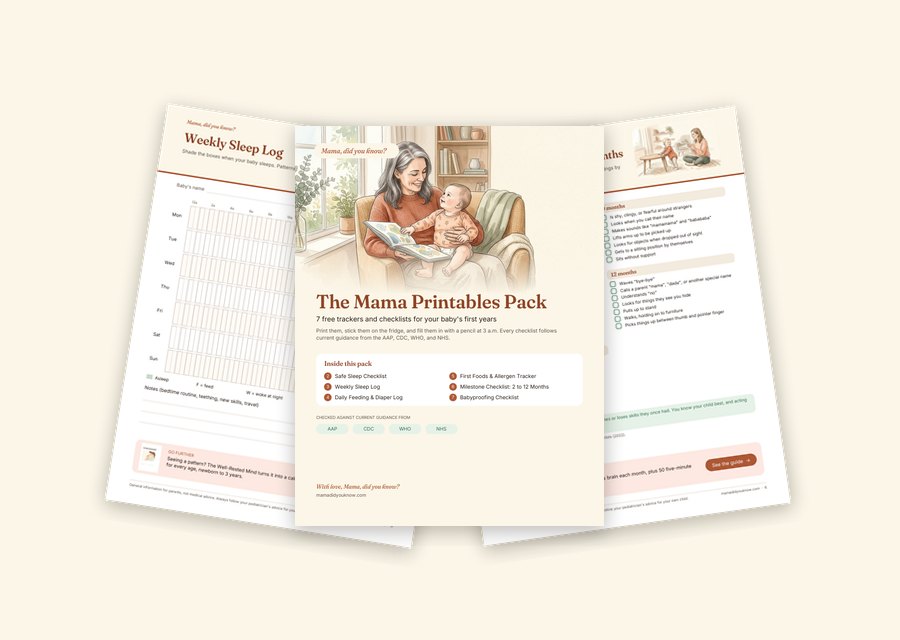
Free: milestone checklist, 2 to 12 months
The CDC milestones on one page, to tick off as your baby grows. Part of our free 7-page printables pack.
How can I prevent container baby syndrome?
By trading some container time for floor time. These steps fit easily into a normal day:
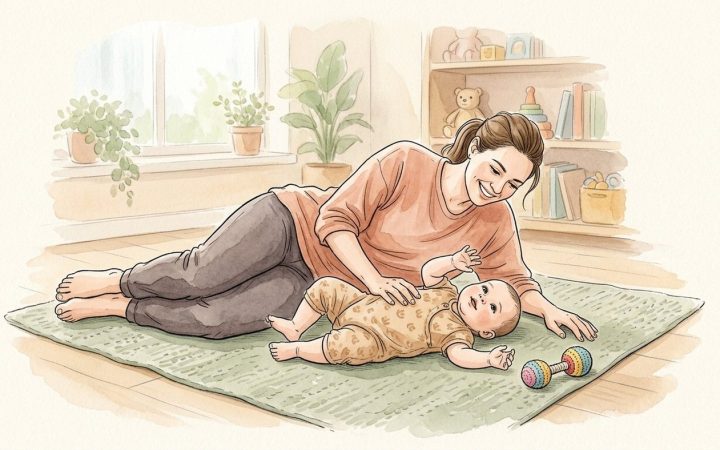
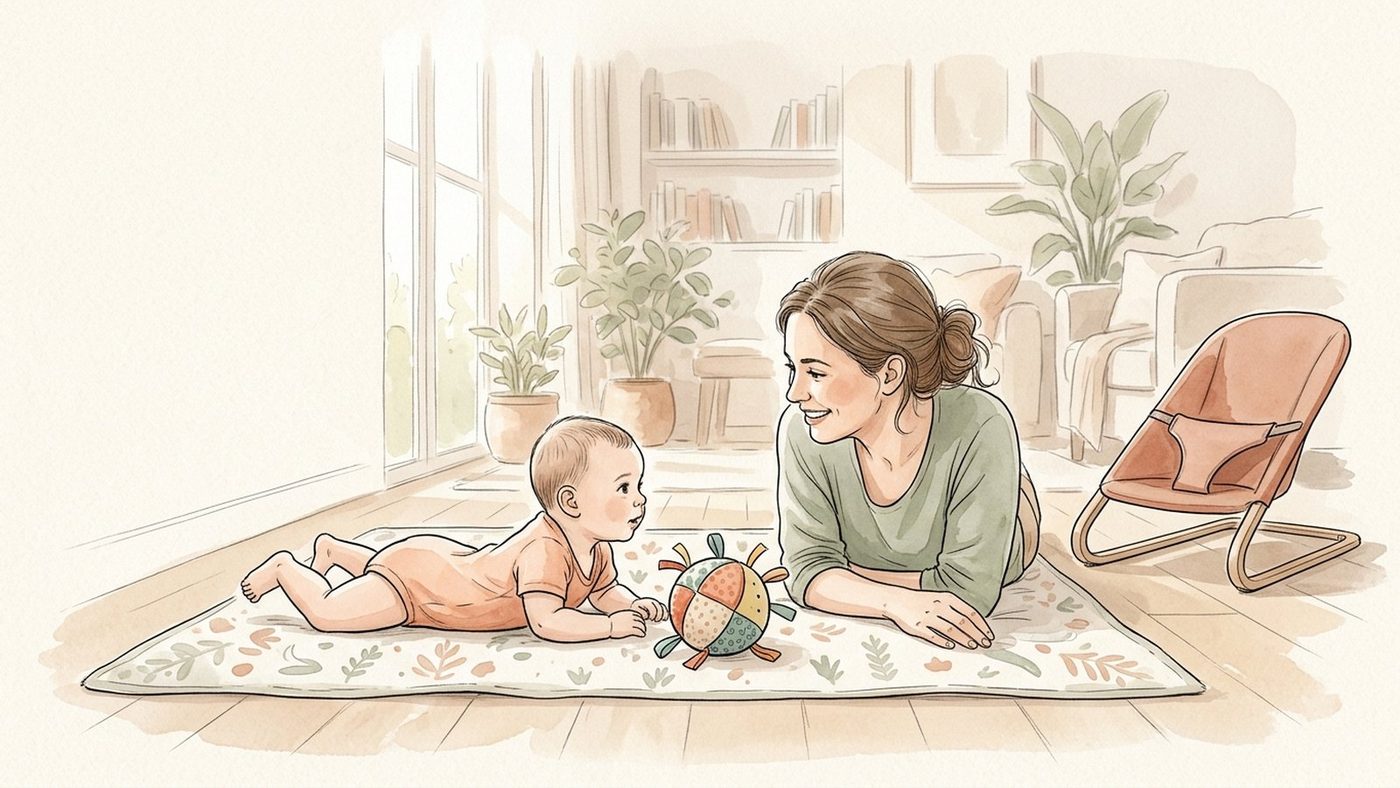
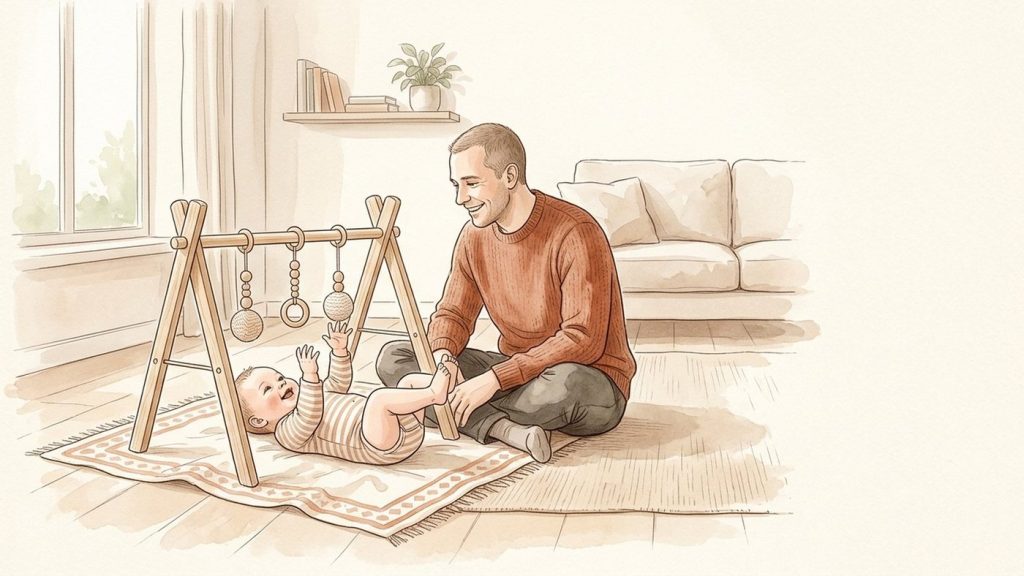
- Make the floor the default. A clean blanket or play mat on the floor is the best “seat” for a baby who’s awake and supervised.
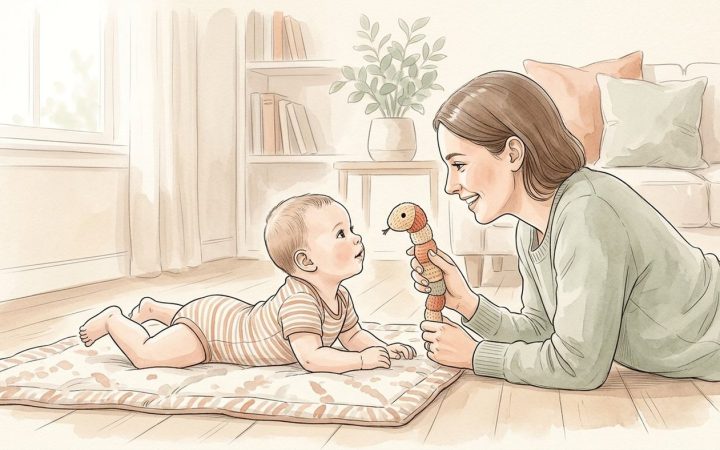
- Do tummy time every day. The WHO recommends at least 30 minutes a day spread through waking time for babies who aren’t yet mobile. Start with a few minutes at a time from the first weeks. See how much tummy time a baby needs for amounts by age.
- Use car seats for the car. When you arrive, lift your baby out instead of carrying the seat around with them in it, when it’s practical.
- Change position often. Alternate which way your baby faces in the crib and on your lap, and offer toys on both sides to encourage turning both ways.
- Hold and carry. Being held, including in a carrier, gives a baby more varied movement than a fixed seat. Just keep the WHO’s 1-hour guide in mind for long walks.
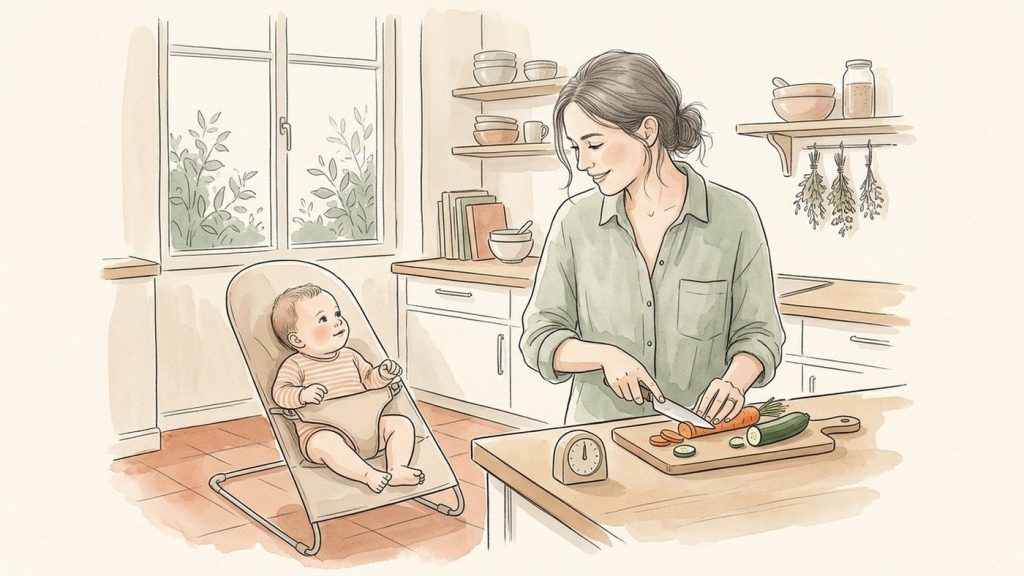
- Save devices for when you need them. A bouncer while you shower or cook is fine. Try not to let it become the place your baby spends most of the day.
Are some containers worse than others?
Possibly, but the research is only starting to look at this. The 2024 University of Delaware study analyzed 460 baby containers sold online and found that most kept babies lying back or reclined, restricted trunk movement, didn’t let babies hold up their own head and trunk, and didn’t allow them to move around. Products with built-in toys often claimed developmental benefits, which the researchers noted may not match the evidence. They concluded that advice may need to be specific to each type of container rather than one rule for all.
Two categories have their own concerns. Sit-in baby walkers cause injuries, and the AAP has called for a ban on their sale; see are baby walkers safe? Stationary jumpers and activity centers are safer but hold babies upright before they can stand on their own; are baby jumpers bad? covers those.
Limiting container time never means skipping the car seat. Every car trip needs a properly installed car seat with a snug harness. Use bouncers and swings only on the floor, never on a table or counter, always with the straps fastened and an adult nearby, and never for sleep.
What are the signs my baby needs a check?
Signs worth mentioning to your pediatrician include a flat spot on the head, a constant head tilt, and slower progress on motor milestones. The AAP says positional skull flattening is generally benign and reversible, and that back sleeping remains the right choice despite it. Early help is easier, though: physical therapy for tight neck muscles and repositioning work best when started young.
Talk to your pediatrician if your baby:
- has a flat area on the back or side of the head, or one ear or side of the face looks further forward
- almost always turns or tilts their head to one side, or has trouble turning both ways
- strongly dislikes tummy time and can’t lift their head well by around 3 to 4 months
- isn’t rolling by about 6 months, or isn’t sitting without support by around 9 months (both are on the CDC’s milestone checklists)
- seems unusually stiff or floppy, or uses one side of the body much more than the other
Your pediatrician can check whether a referral to a pediatric physical therapist would help. If rolling is your worry, see baby not rolling over at 6 months.
Frequently asked questions
Is container baby syndrome a real diagnosis?
No. It isn’t an official medical diagnosis. It’s a descriptive term for problems such as flat head, torticollis, and motor delays that can be linked to heavy container use. Each of those problems can be diagnosed and treated on its own.
Is a baby carrier a container?
Carriers hold a baby in place, so the WHO includes being strapped to a caregiver in its 1-hour guide. But being carried involves more movement and interaction than a fixed seat, and carriers aren’t usually the focus of container concerns.
My baby spends long car rides in a car seat. Is that a problem?
Safety in the car comes first, so keep your baby buckled for the whole drive. On long trips, plan breaks where you take your baby out for a stretch and some floor time, and avoid using the car seat outside the car.
Can container baby syndrome be reversed?
The problems linked with it usually improve with more floor time and, when needed, physical therapy. The AAP describes positional flat head as generally benign and reversible. Earlier action tends to work faster.
What should my baby do instead of sitting in a bouncer?
Floor play: tummy time, lying on their back reaching for toys, rolling, and later sitting and crawling practice. Activities for a 6-month-old has easy ideas.
Sources
- Alghamdi ZS, Orlando JM, Lobo MA (2024). Evaluation of the Movement and Play Opportunities and Constraints Associated With Containers for Infants. Pediatric Physical Therapy. doi.org
- Carson V, Zhang Z, Predy M, Pritchard L, Hesketh KD (2022). Longitudinal associations between infant movement behaviours and development. International Journal of Behavioral Nutrition and Physical Activity. pubmed.ncbi.nlm.nih.gov
- Avruskin A. Physical Therapy Guide to Container Baby Syndrome. ChoosePT, American Physical Therapy Association. choosept.com
- Michalska A, Połatyńska K, Gładyś-Jakubczyk A, et al. (2023). Container baby syndrome: has infant equipment overuse an impact on motor skill development? Pediatria Polska. doi.org
- World Health Organization (2019). To grow up healthy, children need to sit less and play more. who.int
- Hewitt L, Kerr E, Stanley RM, Okely AD (2020). Tummy time and infant health outcomes: a systematic review. Pediatrics. doi.org
- Laughlin J, Luerssen TG, Dias MS; AAP Committee on Practice and Ambulatory Medicine, Section on Neurological Surgery (2011). Prevention and management of positional skull deformities in infants. Pediatrics. pubmed.ncbi.nlm.nih.gov
- Moon RY, Carlin RF, Hand I, et al. (2022). Sleep-Related Infant Deaths: Updated 2022 Recommendations for Reducing Infant Deaths in the Sleep Environment. Pediatrics. pubmed.ncbi.nlm.nih.gov