Short answer: No. The American Academy of Pediatrics calls for a ban on baby walkers with wheels, and the CDC advises against them. Walkers led to an estimated 230,676 emergency room visits for US babies between 1990 and 2014, mostly from falls down stairs, and they don’t help babies learn to walk.
A friend offered us her old baby walker for Adam, and I almost said yes. Then I read what pediatricians say about them.
Key takeaways
- An estimated 230,676 children under 15 months were treated in US emergency departments for walker injuries from 1990 to 2014.
- 90.6% of those injuries were to the head or neck, and 74.1% happened when a baby fell down stairs in a walker.
- Safety standards cut injuries a lot, from 20,650 in 1990 to 2,001 in 2014, but didn’t end them. Canada has banned walkers since 2004.
- Floor play, push toys, and sturdy furniture to cruise along are safer and build real walking skills.
Are baby walkers safe?
Pediatricians say no: walkers with wheels let a baby move fast and reach danger before an adult can react.
A baby in a walker can move faster than you’d expect, roll toward stairs, or reach things that were safely out of reach, like a hot drink or a dangling cord. The AAP also warns that walkers present a serious tipping hazard when a child bumps into an obstacle. The AAP notes that most walker injuries happen while an adult is watching. That’s not a parenting failure. It’s simply how fast these accidents are.
Since 2001, the AAP has called for a ban on the manufacture and sale of mobile infant walkers in the United States, and it has repeated that call since. The CDC’s 12-month milestone page also advises parents not to use them.
How many babies are hurt in walkers?
Far fewer than in the 1990s, but still about 2,000 a year in US emergency rooms by 2014.
The best data comes from a 2018 study in Pediatrics that analyzed 25 years of national emergency department records.
| Finding | Number |
|---|---|
| Children under 15 months treated in US emergency departments, 1990–2014 | An estimated 230,676 |
| Injuries to the head or neck | 90.6% |
| Injuries from falling down stairs in a walker | 74.1% |
| Children admitted to the hospital | 4.5%, and 37.8% of those had a skull fracture |
| Injuries per year | 20,650 in 1990, down to 2,001 in 2014 |
| Change after the 2010 federal safety standard | 22.7% fewer injuries per year in the 4 years after, compared with the 4 years before |
Most of the drop came from fewer stair falls, after a voluntary industry standard and a mandatory US Consumer Product Safety Commission standard in 2010 that added a stair-fall test and a parking brake test. The authors note that fewer families using walkers probably helped too. Even so, they concluded that walkers “remain an important and preventable source of injury” and supported the AAP’s call for a ban.
What the research says: the injury risk is well established. The 2018 study used the National Electronic Injury Surveillance System, a nationally representative sample of US emergency departments, over 25 years. The AAP and CDC agree on the advice, and Canada went further with a full ban.
Do baby walkers help babies walk sooner?
No. The AAP says walkers don’t help children learn to walk and can actually delay it.
“Contrary to what the name suggests, these devices do not help children learn to walk,” the AAP writes. Walking takes balance, leg strength, and lots of practice falling and getting back up. In a walker, the frame does the balancing, so a baby can get around without learning to hold themselves up. Babies build walking skills by pulling up on furniture, cruising along it, and taking wobbly steps on their own. The CDC lists “Pulls up to stand” and “Walks, holding on to furniture” as milestones by 12 months, and “Takes a few steps on his own” by 15 months. You can see the full list in Baby milestones by month.
In Canada, baby walkers have been banned since 2004. It’s illegal to sell, import, or advertise them there, even second-hand at a garage sale.
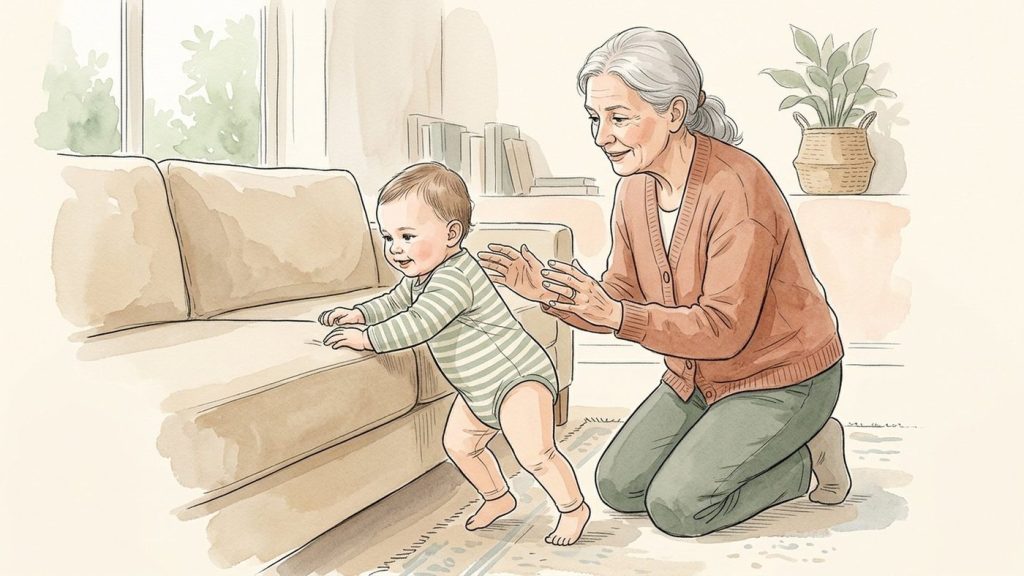
What are safer alternatives to a baby walker?
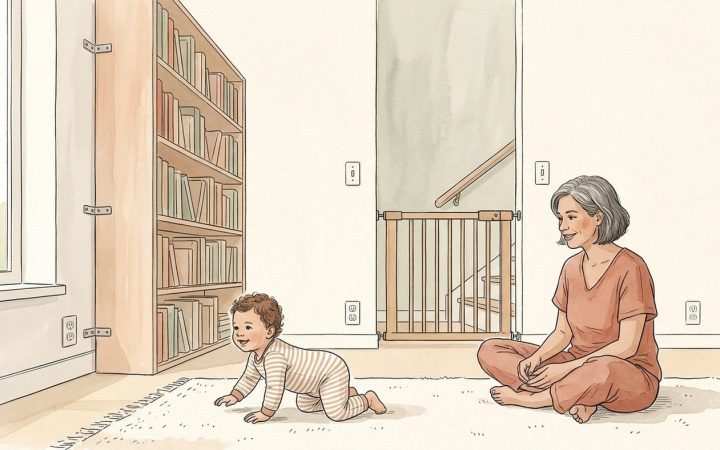
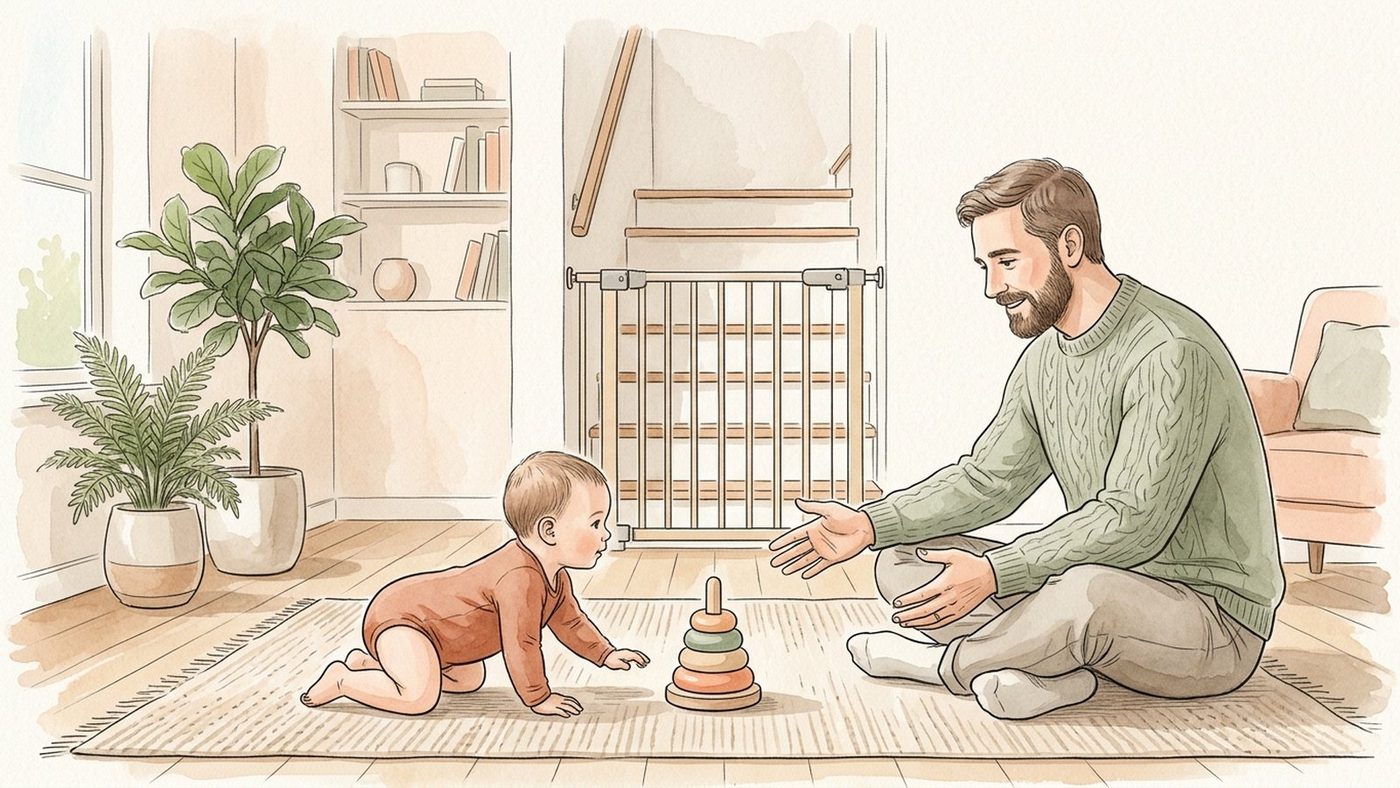
Floor time is the best one, with a few safe “parking spots” for when you need your hands free.
- Floor play. A clear, safe patch of floor lets your baby roll, sit, crawl, and pull up. Put a toy just out of reach to give them a reason to move.
- Push toys or a sturdy box. Around 1 year, the CDC suggests letting your baby push boxes or push toys to practice walking. Choose one that’s stable and won’t tip forward.
- Furniture to cruise along. Make sure anything your baby pulls up on is sturdy, anchored, and free of sharp edges.
- A play yard. The AAP calls play yards “great safety zones for children as they learn to sit, crawl, or walk.”
- A stationary activity center. These look like walkers but have no wheels, so they can’t roll toward stairs. Use them for short stretches: the WHO suggests babies not be strapped into a seat or carrier for more than 1 hour at a time.
- A high chair with toys on the tray, which the AAP suggests for babies who enjoy sitting up and watching the action.
Floor games are at the heart of our book The First-Year Mind: 50 activities, 10 for each stage of the first year, with printable CDC milestone checklists for 2 to 12 months. For more on early movement, see When do babies crawl? and How much tummy time does a baby need?

What if we already have a walker?
The safest choice is to stop using it; if that isn’t possible right away, keep your baby far from stairs and hazards and stay within arm’s reach.
Many families were given a walker as a gift or used one with an older child. That’s OK. Now that you know the risks, you can choose differently. If you’re not ready to give it up, take the wheels out of the equation: use it only in a room with no stairs, gate every staircase, and keep hot drinks, cords, and anything heavy out of reach. Don’t pass it on to another family.
Gate stairs at the top and bottom as soon as your baby starts to move, and keep the gates closed. If your baby has a fall, especially down stairs or onto their head, call your doctor for advice.
Frequently asked questions
Are baby walkers banned in the US?
No. They’re still sold in the US, but since 2010 they must meet a mandatory federal safety standard. The AAP continues to call for a ban. Canada banned them in 2004.
Are push walkers safe?
Push toys that your baby walks behind are a different thing from sit-in walkers. The CDC suggests push toys for practicing walking around 1 year. Pick a sturdy one that won’t tip, and use it on a flat floor away from stairs.
Are stationary activity centers OK?
The AAP suggests them as an alternative because they have no wheels. They still keep your baby in one position, so use them for short stretches and give plenty of free floor time too.
Is a walker safe if I’m right there watching?
Watching helps, but it isn’t enough. The AAP notes that most walker injuries happen while an adult is supervising, because a baby can roll out of reach in seconds.
Sources
- Sims A, Chounthirath T, Yang J, et al. (2018). Infant walker-related injuries in the United States. Pediatrics, 142(4), e20174332. doi.org
- Nationwide Children’s Hospital (2018). Injuries associated with infant walkers still sending children to the emergency department. nationwidechildrens.org
- American Academy of Pediatrics (2001). Injuries associated with infant walkers. Pediatrics, 108(3), 790. doi.org
- American Academy of Pediatrics. Baby walkers: a dangerous choice. HealthyChildren.org. healthychildren.org
- American Academy of Pediatrics. Movement: 8 to 12 months. HealthyChildren.org. healthychildren.org
- CDC. Learn the Signs. Act Early.: milestones by 1 year. cdc.gov
- Health Canada. Consumer product advisories on baby walkers, which are prohibited in Canada. recalls-rappels.canada.ca