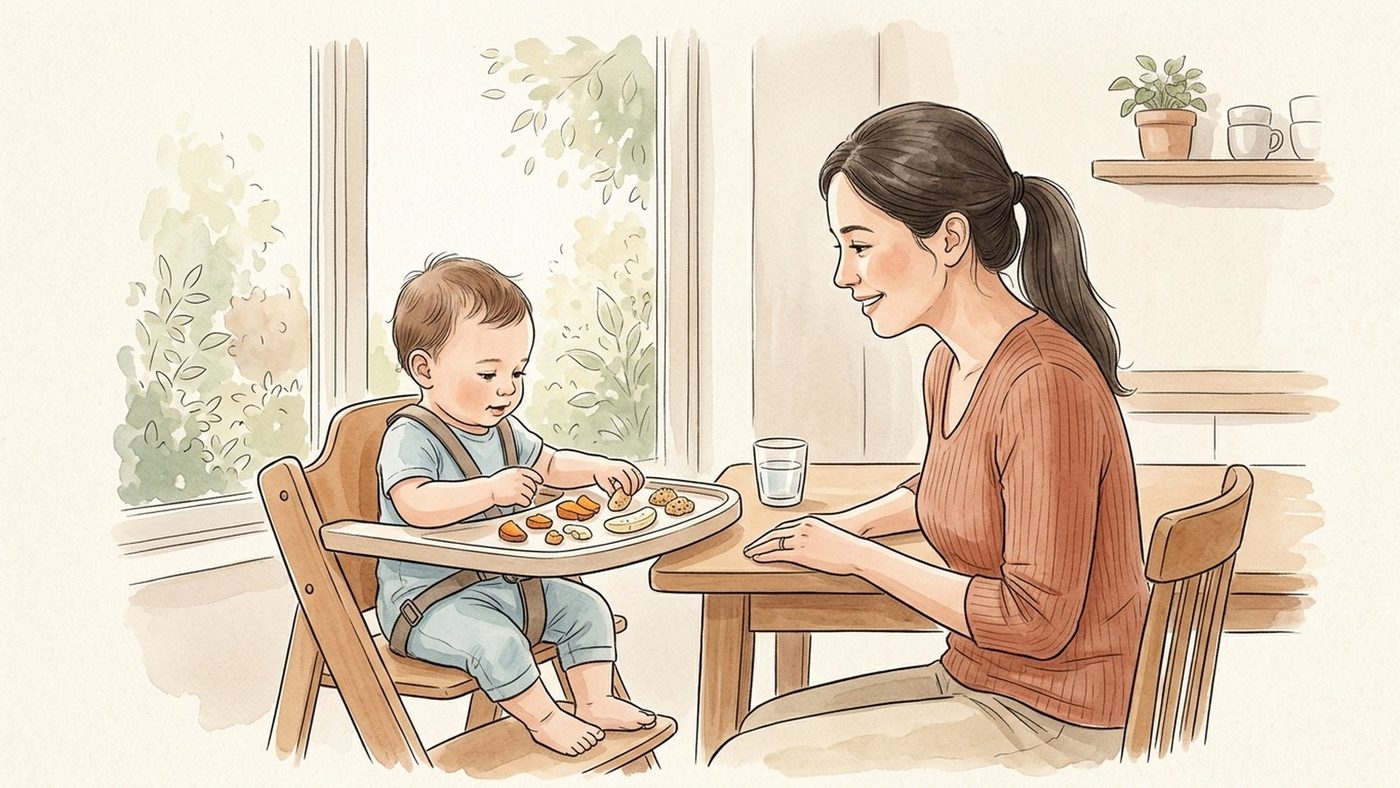
Short answer: Gagging is loud: your baby coughs, sputters, or retches, and their eyes may water. It’s a normal reflex while they learn to eat, so stay calm and let them work it out. Choking is quiet: your baby can’t cry, cough, or breathe properly and may start to look blue. That’s an emergency, so call 911 and start infant first aid.
The first time Adam gagged on a soft piece of banana, my heart stopped, but he pushed it forward and kept eating. Knowing the difference made our meals much calmer.
Key takeaways
- Loud means gagging, quiet means choking. A baby who is coughing and making noise is moving air.
- Gagging protects the airway. The AAP calls it a good body reflex that helps prevent choking.
- Shape matters most. Soft foods that squash between your fingers, pieces no larger than ½ inch (1 cm) once your baby picks up small bites, round foods quartered.
- Choking hazards last until about age 4, so the safe-shapes rules don’t end at the first birthday.
- Take an infant first-aid and CPR class. The AAP recommends a certified course for parents and caregivers.
What’s the difference between gagging and choking?
Gagging is noisy and your baby is still breathing; choking is silent or weak because the airway is blocked. The NHS puts it simply: gagging is loud, choking is quiet.
| Gagging (normal) | Choking (emergency) | |
|---|---|---|
| Sound | Noisy: coughing, sputtering, retching | Silent, or weak coughs that aren’t working |
| What you see | Watery eyes, tongue pushed forward or out, may bring food back up | Can’t cry, cough, or breathe; may look blue (in babies with darker skin, check the gums, inside the lips, or the fingernails) |
| What to do | Stay close and calm, and let your baby work it out | Call 911 and start infant first aid immediately |
Why do babies gag so much when starting solids?
Because they’re learning how much food they can chew and swallow at once. The NHS describes gagging as a normal reflex as babies learn to handle solid food. The AAP calls it a good body reflex: it keeps food out of the airway and helps prevent choking.
Gagging often shows up when textures change, such as the first soft lumps or the first finger foods. That’s expected, and it’s not a reason to stay on smooth purées. Babies who are given lumpy foods late tend to have more feeding difficulties later, so keep moving forward at your baby’s pace. Our baby feeding schedule by month shows which textures fit each age.
In a New Zealand trial of 206 babies, those following a baby-led approach gagged more often at 6 months than spoon-fed babies, but less often by 8 months. Gagging tends to fade with practice.
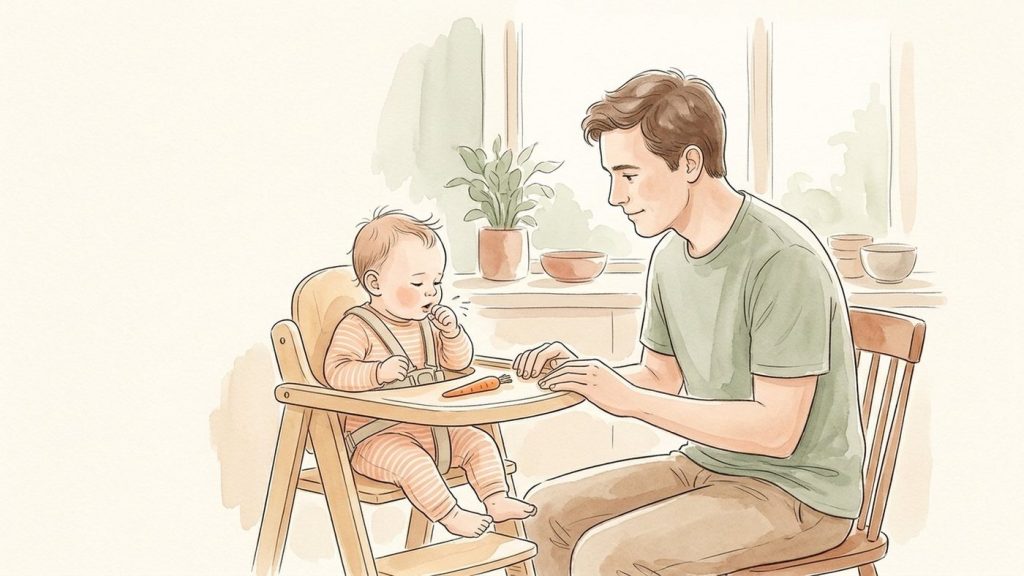
What should I do when my baby gags?
Stay calm, stay close, and let your baby clear the food themselves.
- Keep your baby seated upright in the high chair.
- Let them cough. Coughing is how they move the food.
- Don’t put your fingers in their mouth to search for the food. The NHS says to remove something only if you can clearly see it, and never to poke around blindly.
- Slow down. The AAP suggests offering smoother foods or smaller amounts if your baby gags often.
Your calm face helps. Babies watch you, and a relaxed reaction keeps mealtimes pleasant.
What should I do if my baby is choking?
Act right away: shout for help, have someone call 911, and start infant first aid.
For babies under 1, first aid for choking uses back blows and chest thrusts, repeated until the food comes out. Abdominal thrusts are not used for infants. If your baby becomes unresponsive, start CPR. Get your baby checked by a doctor afterward, even if the food comes out. Read an official guide now, before you need it, such as the American Red Cross infant choking page or the NHS choking guide, and take a hands-on infant first-aid and CPR class.
Technique details change as guidelines are updated; the American Heart Association revised its infant choking advice in 2025. A certified class keeps you current and lets you practice on a baby manikin, which is the best way to feel ready.
Which foods are choking hazards for babies?
Foods that are round, hard, sticky, or come in chunks. You don’t have to avoid most of them; you change their shape.
| Food | Make it safer |
|---|---|
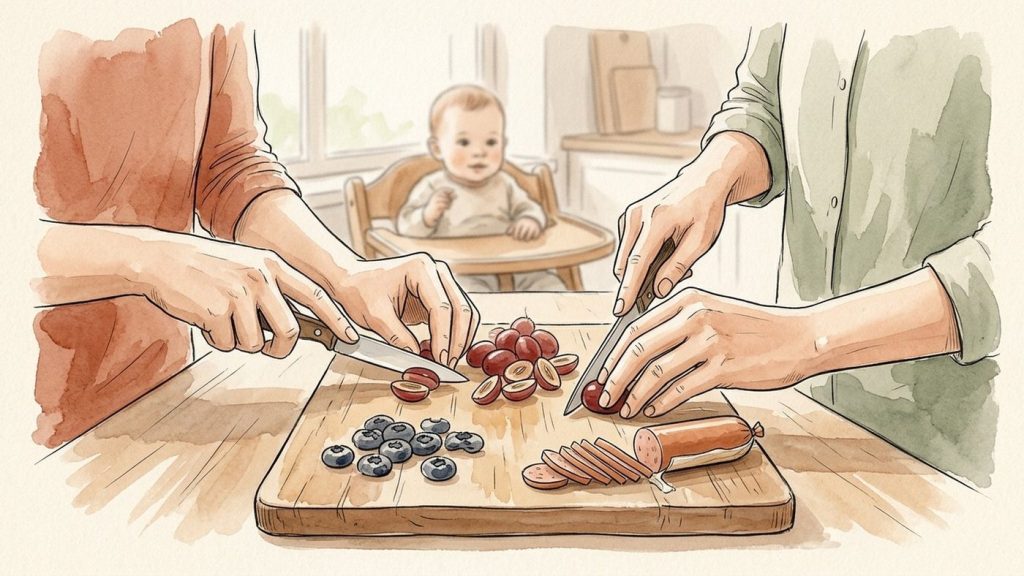
| Grapes, cherry tomatoes, cherries, large berries | Never whole. Cut into quarters. Squash blueberries flat. |
| Hot dogs and sausages | Never in round coins. Cut into thin strips, then chop small. |
| Cheese | Grate it or cut thin strips. Avoid cubes and string cheese. |
| Raw carrot, apple, and other hard produce | Cook until soft, or grate finely. |
| Nuts and seeds | No whole or chopped nuts under 5. Use finely ground nuts or thinned smooth nut butter. |
| Nut butters | Never by the spoonful or in lumps under 4. Spread thinly or stir into food. |
| Whole beans, corn, raisins | Mash, flatten, or chop. |
| Popcorn, chips, hard candy, gum, marshmallows | Avoid. |
If you’d like safe shapes, textures, and first foods mapped out month by month, The Well-Fed Mind has a full chapter on choking and gagging, plus 260 recipes cut and cooked for each age.
Peanut butter deserves a special mention, because early peanut helps prevent allergy. Our guide on when babies can eat peanut butter shows how to thin it safely.
How you eat matters as much as what you serve: your baby sits upright, strapped into a high chair, with an adult watching the whole meal. Never let them eat in a car seat or stroller, lying down, walking, or crawling. Keep an eye on older siblings, who often hand babies unsafe foods.
Does baby-led weaning cause more choking?
Not in the best trial so far, as long as parents follow safe-food rules. In the BLISS trial, a modified baby-led approach was compared with spoon-feeding, and choking rates were the same in both groups.
The trial also showed why shapes matter for everyone: about 35% of all the babies choked at least once between 6 and 8 months, and by 12 months, 94% had been offered a food on the choking-risk list, whatever the feeding style. Spoon-fed, baby-led, or a mix are all fine choices when the food is soft and the shapes are safe.
What the research says: safe-shape and supervision rules are consistent across the AAP, the CDC, and the NHS. The finding that baby-led weaning doesn’t raise choking comes from one well-run randomized trial of 206 babies, using a modified approach with extra safety advice, so it may not apply to every version of baby-led weaning.
Talk to your pediatrician if your baby:
- has had a choking episode, even if the food came out and they seem fine
- gags, vomits, or chokes with many different textures, or still can’t manage lumpy food as the months go on
- seems in pain or very distressed at meals, or is losing weight
Frequently asked questions
Is it normal for my baby to vomit after gagging?
Yes, it can happen. The NHS lists retching and vomiting among the normal signs of gagging. If your baby vomits often or seems unwell, talk to your pediatrician.
Should I go back to purées if my baby gags a lot?
Slow down rather than stop. Offer smaller amounts or slightly smoother versions for a while, then try the new texture again. Lumpy foods should be in place by 8–10 months at the latest, according to ESPGHAN.
What size should finger foods be?
Around 6–8 months, offer soft strips about the size of an adult finger, so your baby can hold them in a fist. Once they pick up small pieces between finger and thumb, usually from about 9 months, switch to soft pieces no larger than ½ inch (1 cm).
Can my baby eat while I drive?
No. The CDC says children shouldn’t eat in a car or stroller. If you can’t watch your baby’s face while they eat, wait until you can stop.
Sources
- NHS Best Start in Life. Choking and gagging on food. nhs.uk
- NHS. How to stop a child from choking. nhs.uk
- American Academy of Pediatrics, HealthyChildren.org. Choking Prevention. healthychildren.org
- American Academy of Pediatrics, HealthyChildren.org. Solid Foods (Baby Foods) symptom guide. healthychildren.org
- CDC. Choking Hazards. cdc.gov
- Fangupo LJ, et al. (2016). A baby-led approach to eating solids and risk of choking. Pediatrics 138(4):e20160772. pubmed.ncbi.nlm.nih.gov
- American Heart Association (2025). Updated CPR guidelines tackle choking response. heart.org
- American Red Cross. Infant Choking: How To Help. redcross.org
- Fewtrell M, et al. (2017). Complementary Feeding: A Position Paper by the ESPGHAN Committee on Nutrition. espghan.org