Short answer: Most babies can have peanut around 6 months, soon after they’ve started a few other solid foods, and never before 4 months. Serve it as smooth peanut butter thinned with water or stirred into a purée, never as whole nuts or a spoonful of peanut butter. If your baby has severe eczema or an egg allergy, talk to your pediatrician first.
Introducing peanut to Adam made me more nervous than any other first food, so I followed the official steps carefully. Here they are.
Key takeaways
- Early is protective: in the LEAP trial, high-risk babies who ate peanut regularly from 4–11 months had an 81% lower rate of peanut allergy at age 5.
- A first serving: 2 teaspoons of smooth peanut butter thinned with 2–3 teaspoons of hot water, then cooled. That’s about 2 g of peanut protein.
- Keep it going: once your baby tolerates peanut, offer it regularly, at least once a week.
- Safe shapes: no whole or chopped nuts before age 5, and no spoonfuls or lumps of peanut butter before age 4.
When can babies have peanut butter?
For most babies, around 6 months, once they’ve eaten a few other first foods. The 2017 US guidelines from the National Institute of Allergy and Infectious Diseases (NIAID) split babies into three groups, and the 2025–2030 Dietary Guidelines for Americans follow the same approach.
| If your baby has… | When to start peanut | Where |
|---|---|---|
| No eczema and no food allergy | Around 6 months, with other solid foods | At home |
| Mild to moderate eczema | Around 6 months | At home |
| Severe eczema, egg allergy, or both | As early as 4–6 months, after talking to your doctor | Your doctor may suggest allergy testing or a first taste in the office |
European advice is very similar. ESPGHAN, Europe’s pediatric nutrition society, says allergenic foods can be introduced any time after 4 months, and that high-risk babies should have peanut between 4 and 11 months after a professional evaluation. France allows all allergens, peanut included, between 4 and 6 months. The NHS in the UK suggests around 6 months, one allergen at a time, and asks families with a history of allergy to check with their GP first. The UK allergy society (BSACI) does not count family history alone as high risk.
Why should babies eat peanut early?
Because eating peanut regularly in infancy can prevent most peanut allergy. Parents were once told to wait, and that advice has been fully reversed.
The landmark LEAP trial followed 640 babies at high risk of peanut allergy (severe eczema, egg allergy, or both). Half ate peanut three times a week from 4–11 months; half avoided it. At age 5, the peanut eaters had an 81% lower rate of peanut allergy. When researchers checked again at age 12–13, the protection was still there: about 71% lower, even though the children had eaten peanut as they liked in the meantime.
What the research says: the case for early peanut rests on randomized trials led by LEAP, and a 2016 analysis that pooled the two main peanut trials found early peanut lowered the risk of peanut allergy by about 70%. It is backed by the NIAID, the AAP, ESPGHAN, and the 2021 US and Canadian allergy consensus. One honest caveat: real-world drops in peanut allergy have been smaller than in the trials, so early peanut lowers the risk but doesn’t remove it completely.
How do I give my baby peanut for the first time?
At home, on a day your baby is well, with a tiny taste first. These steps come from the NIAID’s home-feeding instructions.
- Pick a healthy day. Skip it if your baby has a cold, vomiting, diarrhea, or another illness.
- Do it at home, not at daycare or a restaurant, with one adult giving your baby full attention. Daytime makes it easier to watch afterward.
- Offer a small taste on the tip of a spoon, then wait 10 minutes.
- If there’s no reaction, give the rest slowly, at your baby’s usual pace.
- Watch for 2 hours afterward for any signs of a reaction.
Introduce one new allergen at a time, so you’ll know what caused any reaction. Well-cooked egg is the other allergen to start early. Peanut fits easily into the first weeks of solids; our baby feeding schedule by month shows where a first peanut meal can go in a 6-month-old’s day.
What are safe ways to serve peanut to a baby?
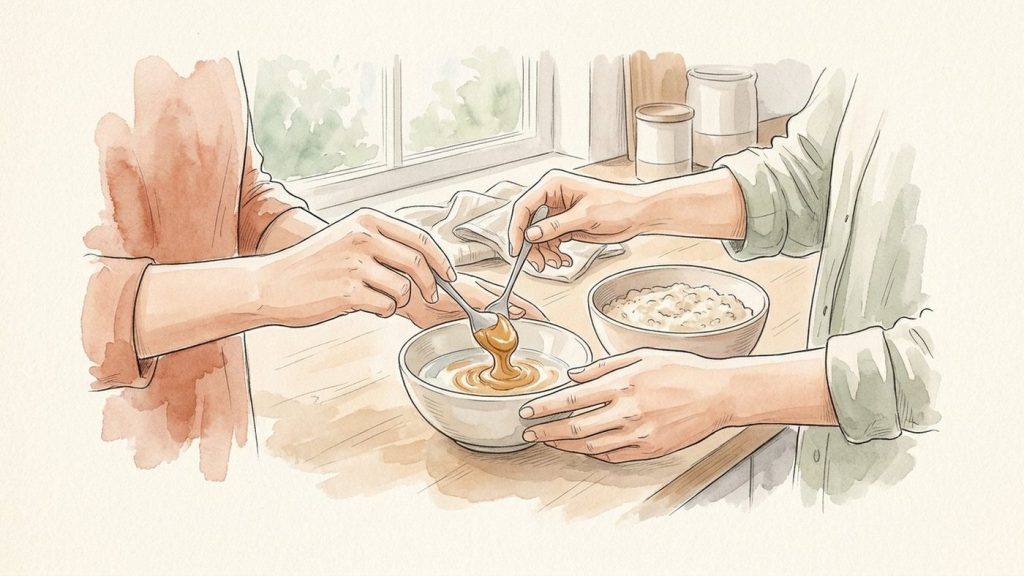
Thin it, mix it, or soften it. Each of these NIAID recipes gives about 2 g of peanut protein, the amount used in the trials.
| Option | How to make it |
|---|---|
| Thinned peanut butter | 2 teaspoons smooth peanut butter plus 2–3 teaspoons hot water. Stir until smooth, then let it cool. Thicken with infant cereal your baby already eats if needed. |
| Peanut butter purée | 2 teaspoons smooth peanut butter stirred into 2–3 tablespoons of a fruit or vegetable purée your baby already eats. |
| Peanut powder purée | 2 teaspoons peanut flour or peanut butter powder mixed into about 2 tablespoons of purée. |
| Softened peanut puffs | 21 peanut puffs. For babies under 7 months, soften them with 4–6 teaspoons of water first. |
For more ways to keep peanut on the menu, The Well-Fed Mind includes a step-by-step allergen plan and 260 month-by-month recipes, like a first peanut oatmeal for 6 months and peanut butter pear oatmeal for 7 months.
Whole peanuts, nut pieces, and spoonfuls or dollops of peanut butter are choking hazards. The NIAID says no whole nuts before age 5 and no peanut butter straight from a spoon or in lumps before age 4. Always serve it thinned or mixed in, with your baby seated upright and an adult watching. Our guide to gagging vs. choking covers safe shapes for every food.
How often should my baby eat peanut?
Regularly, ideally at least once a week, for years. For high-risk babies, the NIAID recommends about 6–7 g of peanut protein a week (roughly three of the servings above), spread over three or more feedings. For other babies, the 2021 US and Canadian allergy consensus calls 1–2 teaspoons of peanut butter at least once a week a reasonable amount.
The exact amount doesn’t need to be perfect. The experts behind that consensus say regular exposure over several years matters more than a fixed dose. If your baby is sick for a week or doesn’t finish a serving, just carry on when you can.
Rubbing peanut butter on your baby’s skin to “test” for allergy doesn’t work, according to Australia’s allergy society (ASCIA). And redness only around the mouth, where food touched the skin, is usually not an allergic reaction.
What does a peanut allergy reaction look like in a baby?
Most reactions start within minutes to 2 hours of eating. Mild signs are a new rash or a few hives around the mouth or face. If you see them, stop feeding the food, call your pediatrician, and keep watching closely.
Call 911 (or your local emergency number) right away if your baby has any of these after eating:
- swelling of the lips, face, or tongue
- any trouble breathing, wheezing, or repeated coughing
- vomiting or hives spreading over the body
- turning pale or blue, or sudden floppiness or sleepiness
Use an epinephrine auto-injector if one has been prescribed. Don’t offer peanut again until you’ve talked to your doctor.
Frequently asked questions
Does my baby need an allergy test before trying peanut?
Usually not. The 2017 NIAID guidelines suggest considering a test only for babies with severe eczema, egg allergy, or both. The 2021 US and Canadian allergy consensus says testing isn’t required even then, but remains an option. Talk to your pediatrician, and try not to let testing delay peanut for long.
Is crunchy peanut butter OK?
No. Use smooth peanut butter only. Crunchy varieties contain nut pieces, which are a choking hazard for young children.
Should I avoid peanut while pregnant or breastfeeding?
No. The AAP and the 2021 allergy consensus don’t recommend avoiding allergens during pregnancy or breastfeeding to prevent food allergy.
A sibling has a peanut allergy. Is my baby high risk?
Not necessarily. The 2021 consensus says younger siblings of peanut-allergic children aren’t clearly at higher risk, while the NHS suggests checking with your doctor if allergies run in the family. Mention it at your next visit, and keep the allergic child safe while you introduce peanut.
Sources
- Togias A, et al. (2017). Addendum guidelines for the prevention of peanut allergy in the United States: report of the NIAID-sponsored expert panel. niaid.nih.gov
- Du Toit G, et al. (2015). Randomized trial of peanut consumption in infants at risk for peanut allergy (LEAP). N Engl J Med 372:803–813. nejm.org
- NIAID (2024). Introducing peanut in infancy prevents peanut allergy into adolescence. niaid.nih.gov
- Ierodiakonou D, et al. (2016). Timing of allergenic food introduction to the infant diet and risk of allergic or autoimmune disease: a systematic review and meta-analysis. JAMA 316:1181–1192. pubmed.ncbi.nlm.nih.gov
- Fleischer DM, et al. (2021). A consensus approach to the primary prevention of food allergy through nutrition. J Allergy Clin Immunol Pract 9:22–43. aaaai.org
- Fewtrell M, et al. (2017). Complementary Feeding: A Position Paper by the ESPGHAN Committee on Nutrition. espghan.org
- NHS. Food allergies in babies and young children. nhs.uk
- British Society for Allergy and Clinical Immunology. Early introduction of food allergens. bsaci.org
- ASCIA. How to introduce solid foods to babies for allergy prevention. allergy.org.au
- US Department of Agriculture and Department of Health and Human Services. Dietary Guidelines for Americans, 2025–2030. dietaryguidelines.gov