
Short answer: From about 6 months, offer an iron-rich food at every meal. The best first choices are meat, poultry, fish, well-cooked eggs, iron-fortified infant cereal, lentils, beans, and tofu. From 7 to 12 months, babies need 11 mg of iron a day, more than an adult man, and breast milk alone provides very little. Pairing plant sources with a vitamin C food, like tomato or strawberries, helps your baby absorb more.
Key takeaways
- Iron first: include an iron-rich food in your baby’s first meals and at every meal after that.
- Two kinds of iron: iron from meat, fish, and eggs is absorbed easily; iron from cereal, beans, and lentils is absorbed better with vitamin C.
- Breastfed babies: ask your pediatrician about iron drops. The AAP and the UK’s NHS give different advice here.
- After age 1: keep cow’s milk to about 16–24 oz a day so it doesn’t crowd out iron-rich food.
Why do babies need iron-rich foods at 6 months?
Because the iron they were born with runs low just as their needs jump. Healthy full-term babies have enough stored iron for about the first 4 to 6 months. Iron builds the brain and carries oxygen in the blood, and breast milk is naturally low in it, so food has to fill the gap. That’s why the AAP, the CDC, the WHO, and Europe’s pediatric nutrition society (ESPGHAN) all put iron-rich foods at the start of solids.
| Age | Iron needed per day | Where it comes from |
|---|---|---|
| 0–6 months | 0.27 mg | Stored iron, plus breast milk or iron-fortified formula |
| 7–12 months | 11 mg | Iron-rich foods, plus breast milk or formula |
| 1–3 years | 7 mg | Mostly food |
These are the US recommended amounts from the National Institutes of Health. Standard iron-fortified infant formula (12 mg per liter) meets a formula-fed baby’s needs, according to the CDC.
Which first foods have the most iron?
Red meat, lentils, beans, tofu, and iron-fortified infant cereal top the list. Here are values from USDA FoodData Central, per 100 g (about 3½ oz) of cooked food. Your baby will eat far less than this at a meal, so the column is for comparing foods, not for counting.
| Food (cooked) | Iron per 100 g | Source |
|---|---|---|
| Lentils | 3.3 mg | Plant |
| Ground beef, 90% lean | 3.1 mg | Animal |
| Beef stew meat, braised | 3.0 mg | Animal |
| Kidney beans | 2.9 mg | Plant |
| Chickpeas | 2.9 mg | Plant |
| Firm tofu | 2.7 mg | Plant |
| Black beans | 2.1 mg | Plant |
| Ground lamb | 1.8 mg | Animal |
| Ground turkey | 1.5 mg | Animal |
| Chicken thigh (dark meat) | 1.4 mg | Animal |
| Egg, hard-boiled | 1.2 mg | Animal |
| Chicken breast | 1.0 mg | Animal |
| Breast milk, for comparison | 0.03 mg |
Iron-fortified infant oat cereal is one of the richest sources around. In USDA data, one level tablespoon of the dry cereal (about 3 g) has roughly 2 mg of iron, because the iron is added. Brands differ, so check the label.
Vary your grains, too. The FDA has set limits on arsenic in infant rice cereal, and choosing oat, barley, or multigrain cereal rather than only rice is a simple way to spread the risk.
How can I help my baby absorb more iron?
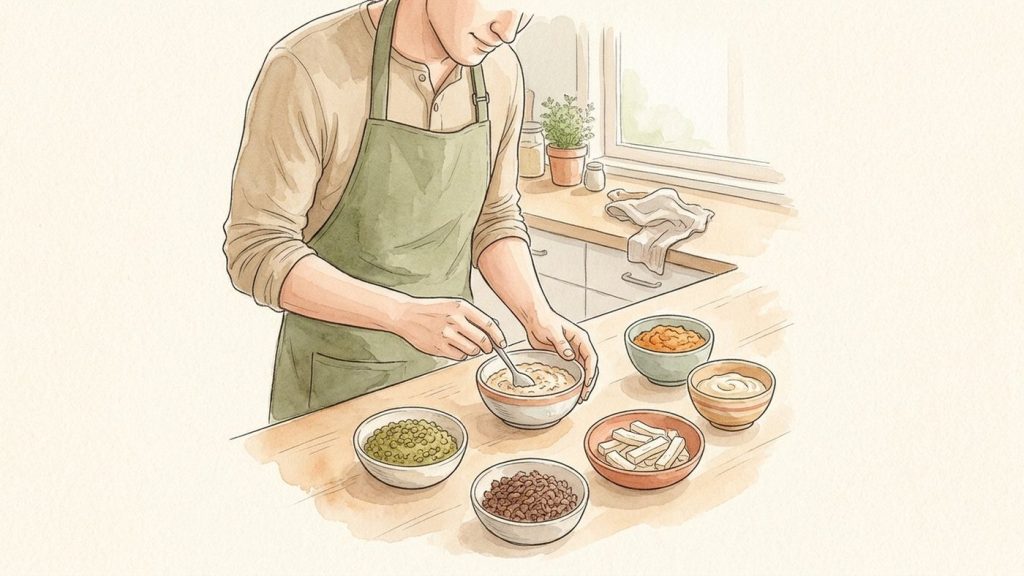
Serve plant iron with a vitamin C food. Iron from meat, poultry, fish, and eggs (heme iron) is absorbed easily. Iron from cereal, beans, lentils, tofu, and leafy greens (non-heme iron) is absorbed less well, and the CDC says pairing it with vitamin C helps. Some easy pairings:
- red lentil dal cooked with tomatoes
- iron-fortified oat cereal stirred with mashed strawberries
- mashed black beans with soft sweet potato
- soft tofu strips with well-steamed broccoli
When my son Adam started solids at 6 months, I kept a short list of iron foods and vitamin C partners taped inside a kitchen cabinet, so I didn’t have to think about it before coffee.
For a full plan of iron foods, textures, and pairings for every month, The Well-Fed Mind has 260 recipes with the iron worked out per portion from USDA data.
Does my breastfed baby need iron drops?
Ask your pediatrician, because advice differs between countries. The AAP’s 2010 clinical report recommends iron drops (1 mg per kg of body weight a day) for exclusively breastfed babies from 4 months until they’re eating iron-rich foods. Some pediatricians have questioned whether every breastfed baby needs this. The UK’s NHS recommends vitamins A, C, and D for young children, not routine iron drops. The CDC simply advises asking your baby’s doctor whether iron drops are needed before 6 months, and notes that babies born early may need extra iron.
How do I serve iron-rich foods safely?
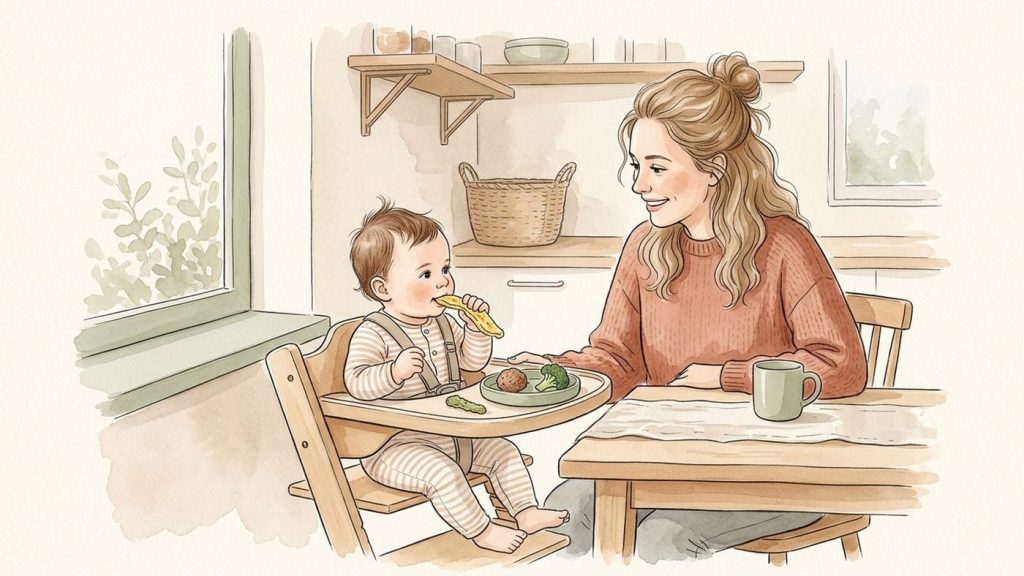
Cook them until soft and match the texture to your baby’s stage. Around 6 months, try puréed or finely minced meat, mashed lentils, or soft meatballs and strips of well-cooked omelet your baby can hold. Cook eggs until fully set. Egg is also a common allergen, so introduce it early and keep it on the menu, as with peanut butter.
Shred or mince meat, and remove every bone from fish. Mash or flatten whole beans, which can be a choking hazard. Our guide to gagging vs. choking covers safe shapes, and our feeding schedule by month shows where iron foods fit in the day.
How much milk is too much after age 1?
More than about 24 oz (720 ml) a day. Nemours KidsHealth advises keeping a toddler’s milk to 16–24 oz a day, because too much fills children up so they eat fewer iron-rich foods, and nutrients in milk can reduce iron absorption from other foods. Before 12 months, cow’s milk isn’t given as a drink at all; breast milk or formula is the main milk.
What the research says: the advice to offer iron-rich foods from the start of solids is consistent across the AAP, the CDC, the WHO, ESPGHAN, and the NHS, and the daily iron needs come from official US reference values. The one area of real disagreement is routine iron drops for breastfed babies, where US and UK advice differ and the evidence is debated.
Talk to your pediatrician about iron if your baby:
- was born early or small, or is exclusively breastfed and under 6 months
- eats a vegetarian or vegan diet, or refuses most iron-rich foods
- drinks more than 24 oz of milk a day after age 1, or seems unusually pale or tired
Only give iron supplements your doctor recommends, at the dose they give, and store them out of reach. Too much iron is dangerous for young children.
Frequently asked questions
Is spinach a good source of iron for babies?
Cooked spinach has some iron (about 3.6 mg per 100 g in USDA data), but it’s the plant kind, which is absorbed less well. It’s a fine part of the plate, ideally alongside a vitamin C food, but don’t rely on it alone.
Can a vegetarian baby get enough iron?
It takes planning. Use iron-fortified infant cereal, lentils, beans, tofu, and eggs if you eat them, always with a vitamin C food. The NIH notes that people who don’t eat meat, poultry, or seafood need almost twice as much iron, because plant iron is absorbed less well. Ask your pediatrician whether your baby needs a supplement.
Do I have to start with meat or cereal?
No. There’s no required order of first foods. The AAP suggests meat or iron-fortified cereal as easy iron sources, but lentils, beans, tofu, and eggs count too. What matters is having an iron food on the plate every day, and ideally at every meal.
My baby only eats a few bites. Are they getting enough?
Small amounts are normal at first, and breast milk or formula still provides most nutrition until 12 months. Keep offering iron foods without pressure. If you’re worried, your pediatrician can check your baby’s iron with a simple blood test.
Sources
- Centers for Disease Control and Prevention. Iron: Infant and Toddler Nutrition. cdc.gov
- National Institutes of Health, Office of Dietary Supplements. Iron: Fact Sheet for Consumers. ods.od.nih.gov
- Baker RD, Greer FR; AAP Committee on Nutrition (2010). Diagnosis and prevention of iron deficiency and iron-deficiency anemia in infants and young children (0–3 years of age). Pediatrics 126(5):1040–1050. doi.org
- American Academy of Pediatrics, HealthyChildren.org. Starting Solid Foods. healthychildren.org
- NHS. Vitamins for children. nhs.uk
- Fewtrell M, et al. (2017). Complementary feeding: a position paper by the ESPGHAN Committee on Nutrition. J Pediatr Gastroenterol Nutr 64:119–132. espghan.org
- Nemours KidsHealth. Feeding Your Child: 1 to 2 Years. kidshealth.org
- US Department of Agriculture, Agricultural Research Service. FoodData Central (SR Legacy records). fdc.nal.usda.gov