
Short answer: Wake windows are the idea that a baby should go back to sleep after a set amount of awake time, with shorter windows for newborns and longer ones as babies grow. No controlled study has tested them, and popular charts disagree with each other, even for newborns, where suggested windows range from 30 to 90 minutes. Use them as a loose reminder if you like, but your baby’s sleepy cues are a better guide.
Every app gave me a different wake window for Adam, and none of them matched the baby in front of me. So I checked what the research actually supports.
Key takeaways
- 0 controlled studies: we couldn’t find a single trial testing wake-window schedules against simply watching a baby’s cues.
- Charts disagree: published newborn wake windows range from about 30 to 90 minutes, depending on the source.
- The kernel of truth: sleep pressure builds quickly in young babies and more slowly with age, which is why newborns nap often and toddlers nap once.
- What is tested: a consistent bedtime routine, and “bedtime fading” for babies who take a long time to fall asleep.
What are wake windows?
A wake window is the stretch of time a baby spends awake between sleeps. Apps, sleep consultants, and social media accounts publish charts that list an ideal window for each age, with the promise that putting your baby down at the “right” minute prevents overtiredness and leads to better naps and nights.
The idea is everywhere, so it’s easy to assume it comes from sleep research. It doesn’t, and knowing that can take a lot of pressure off.
Are wake windows backed by research?
No. When we searched for studies, we couldn’t find a single controlled trial of wake windows, and the infant sleep trials we reviewed advised only “consistent daytime naps” without set timings. Pediatric sleep physician Dr. Craig Canapari writes that there is little evidence that wake-window systems improve naps, and that the concept isn’t taught, discussed, or researched in medical training.
The charts also contradict each other. For newborns alone, published wake windows range from about 30 to 90 minutes. If the numbers came from data, you’d expect sources to roughly agree.
There is a real biological idea underneath: sleep pressure. The longer anyone is awake, the stronger the drive to sleep becomes, and in babies it builds fast. Dr. Canapari explains that this is why young babies nap often and older children nap less. What hasn’t been shown is that a fixed number of minutes for each age works better than watching your own baby.
What the research says: wake windows are untested. The idea of rising sleep pressure is real, but no study has shown that following age-based wake-window charts improves naps or nights. Claims about “overtiredness” and very early bedtimes also rest mainly on clinical experience and observational data rather than trials.
What does research show about naps and sleep by age?
Instead of a minute-by-minute chart, here is what studies and expert panels have actually measured. It gives you a realistic picture without a stopwatch.
| Age | Total sleep in 24 hours | Naps (what studies show) |
|---|---|---|
| 0–3 months | 14–17 hours | Many short naps; about 3 a day on average up to 5 months, ranging from 1 to 5 |
| 4–12 months | 12–16 hours, naps included | Often about 3 at first; many babies settle into 2 later in the first year (a common pattern, not a research finding) |
| 12–18 months | 11–14 hours, naps included | Most children move from 2 naps to 1 |
| 1–2 years | 11–14 hours, naps included | 1 nap, averaging a little over 2 hours |
| 2–3 years | 11–14 hours, naps included | 1 nap, averaging just under 2 hours; about 1 in 3 stop by age 3 |
Even these are averages with wide ranges. For the full picture, including what’s normal at night, see our baby sleep chart by age.
In a survey of nearly 30,000 babies and toddlers across 17 countries, average bedtimes ranged from about 7:30 p.m. in New Zealand to after 10 p.m. in Hong Kong. Healthy children thrive on very different schedules.
How do I know when my baby is tired?
Watch for their cues; they’re more reliable than any chart. Common sleepy signs include:
- yawning or rubbing eyes
- staring off, or turning away from faces and toys
- fussing, or losing interest in play
Some babies show cues clearly, and some barely at all. If your baby’s cues are hard to read, a wake-window chart can be a gentle starting point: note when they seem sleepy, compare it with the chart, and let your baby win when the two disagree. Dr. Canapari’s view is similar: fine to try, but no need to feel you must.

What actually helps babies fall asleep more easily?
Two timing tools have real trials behind them.
A consistent bedtime routine. In a trial of 405 families, babies 7–18 months on a nightly routine (bath, massage, quiet time, lights out within about 30 minutes) went from a longest stretch of 6.9 to 8.5 hours within two weeks, and toddlers fell asleep faster and woke less. A mini version of the routine before naps is a sensible way to signal sleep during the day too.
Bedtime fading. If bedtime has become a long battle, your baby may simply not be sleepy yet. In a trial of 43 babies aged 6–16 months, temporarily moving bedtime to when the baby actually fell asleep, then bringing it earlier step by step, cut the time it took to fall asleep. Notice that this sometimes means a later bedtime, the opposite of what many wake-window charts suggest.
Our guide The Well-Rested Mind walks through both, plus every other research-tested method, step by step. If night wakings are the bigger issue, read does sleep training work?
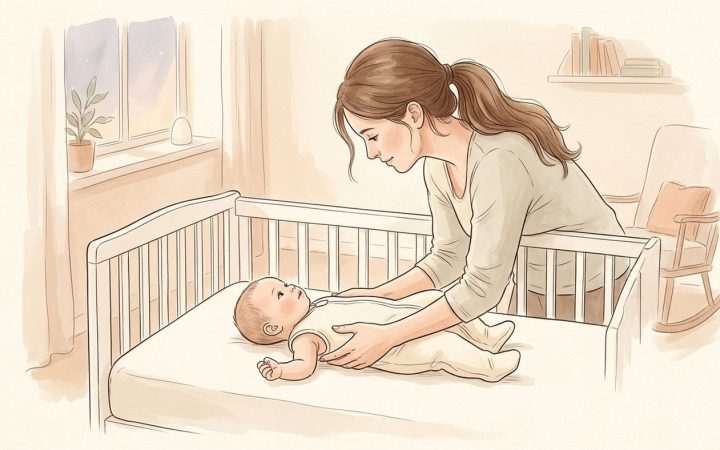
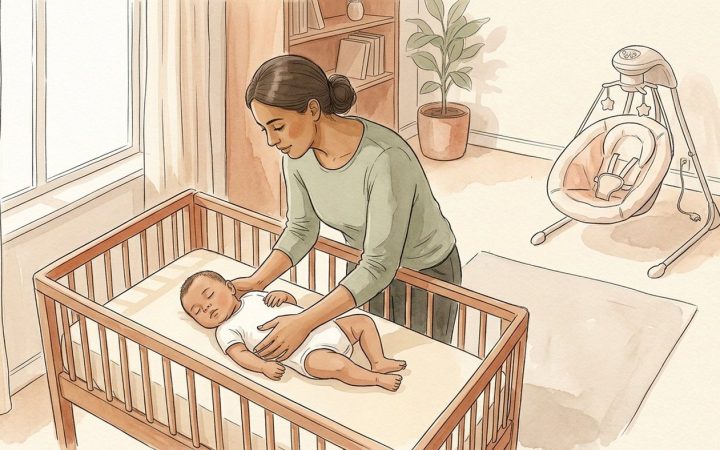
Naps count as sleep for safety too. In the first year, every nap should be on your baby’s back, alone, on a firm, flat surface with only a fitted sheet. Car seats, swings, strollers, and carriers aren’t for routine sleep; if your baby dozes off in one, move them to a flat sleep space when you can.
Talk to your pediatrician if your child:
- snores loudly most nights, gasps, or has pauses in breathing during sleep
- seems unusually sleepy, hard to wake, or too drowsy to feed
- has very restless sleep with a lot of movement
Frequently asked questions
Should I wake my baby to stay on a wake-window schedule?
There’s no evidence that you need to. The exception is feeding: in the newborn weeks, follow your pediatrician’s advice on how long your baby can go between feeds.
Are wake windows harmful?
There’s no sign they hurt babies. The main risk is to parents: watching the clock can add stress, and a chart can make a perfectly normal baby look “off schedule.” If it helps you, use it loosely. If it worries you, let it go.
My baby fights naps even when the chart says it’s time. What now?
Your baby may not be sleepy yet. Try waiting for clear sleepy cues, keep the pre-nap routine short and the same each time, and give it a week or two before judging. Nap refusals are common, and many pass on their own.
When will my baby drop to one nap?
Most children move from two naps to one between 12 and 18 months, according to a review of 44 studies. There’s no official rule; a nap that keeps getting refused, or a bedtime that keeps getting later, are common signs.
Sources
- Canapari C. Do Wake Windows Help Babies and Kids Nap Better? drcraigcanapari.com
- Hiscock H, Wake M (2002). Randomised controlled trial of behavioural infant sleep intervention to improve infant sleep and maternal mood. BMJ. pmc.ncbi.nlm.nih.gov
- Paruthi S, et al. (2016). Recommended Amount of Sleep for Pediatric Populations: A Consensus Statement of the American Academy of Sleep Medicine. Journal of Clinical Sleep Medicine. pmc.ncbi.nlm.nih.gov
- Galland BC, et al. (2012). Normal sleep patterns in infants and children: a systematic review of observational studies. Sleep Medicine Reviews. pubmed.ncbi.nlm.nih.gov
- Staton S, et al. (2020). Many naps, one nap, none: a systematic review and meta-analysis of napping patterns in children 0–12 years. Sleep Medicine Reviews. pmc.ncbi.nlm.nih.gov
- Mindell JA, et al. (2010). Cross-cultural differences in infant and toddler sleep. Sleep Medicine. pubmed.ncbi.nlm.nih.gov
- Mindell JA, et al. (2009). A nightly bedtime routine: impact on sleep in young children and maternal mood. Sleep. pmc.ncbi.nlm.nih.gov
- Gradisar M, et al. (2016). Behavioral Interventions for Infant Sleep Problems: A Randomized Controlled Trial. Pediatrics. pubmed.ncbi.nlm.nih.gov
- American Academy of Pediatrics, HealthyChildren.org. How to Keep Your Sleeping Baby Safe: AAP Policy Explained. healthychildren.org