Short answer: Stop swaddling as soon as your baby shows any sign of trying to roll over, which the American Academy of Pediatrics says can start as early as 2 months. Rolling itself usually happens around 3 to 4 months, so for many babies that means stopping somewhere between 2 and 4 months. From then on, use a non-weighted sleep sack with the arms free, and keep placing your baby on their back.
The night Adam wriggled one arm free and tried to roll, I knew the swaddle had to go. This is the guidance I followed.
Key takeaways
- The signal is rolling, not a birthday: stop at the first signs of trying to roll, even if your baby is only 2 months old.
- Why it matters: a swaddled baby who rolls onto their stomach can’t easily push up or roll back, and the AAP says the risk of suffocation is higher.
- While you swaddle: always on the back, a thin blanket, room for two or three fingers at the chest, and hips free to bend up and out.
- After the swaddle: a sleeveless, non-weighted sleep sack. No loose blankets, no weighted products, no inclined sleepers.
When should you stop swaddling your baby?
When your baby starts trying to roll. The AAP’s parenting site puts it plainly: stop swaddling as soon as your baby shows any signs of trying to roll over. It adds that some babies start working on rolling as early as 2 months, and that every baby is different.
So there’s no single “swaddle until” age. The AAP’s safe sleep guidance says rolling usually happens around 3 to 4 months but can happen earlier, and the NIH’s Safe to Sleep campaign says usually around 3 months. Those are averages. Your own baby’s movements are what count.
Here’s what “trying to roll” can look like in real life, and what to do about each sign:
| What you notice | What it can mean | What to do |
|---|---|---|
| Rocking from side to side, or arching and twisting the hips | Early rolling practice | Stop swaddling now |
| Ending up on their side in the crib or on the play mat | Rolling is close | Stop swaddling now |
| Rolling tummy to back during tummy time | Rolling has started | Stop swaddling now |
| Wriggling arms out of the swaddle most nights | A loose wrap can cover the face | Switch to an arms-free sleep sack |
| No rolling signs yet at 2–3 months | Still fine to swaddle safely | Watch closely and plan the transition |
Tummy time is often where you’ll spot these signs first, so it’s worth doing every day. Our guide to how much tummy time a baby needs covers it by age.
How do I swaddle safely until then?
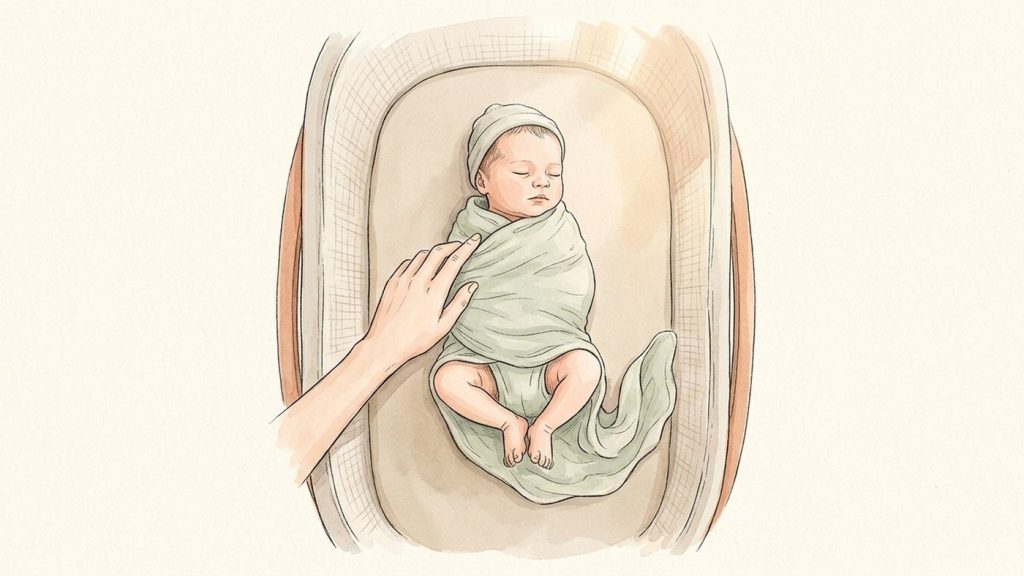
Swaddling isn’t unsafe on its own. The AAP says that, done correctly, it can help calm babies and promote sleep. It just doesn’t lower the risk of SIDS, so it only works as a comfort tool on top of every other safe sleep rule. These are the AAP’s basics:
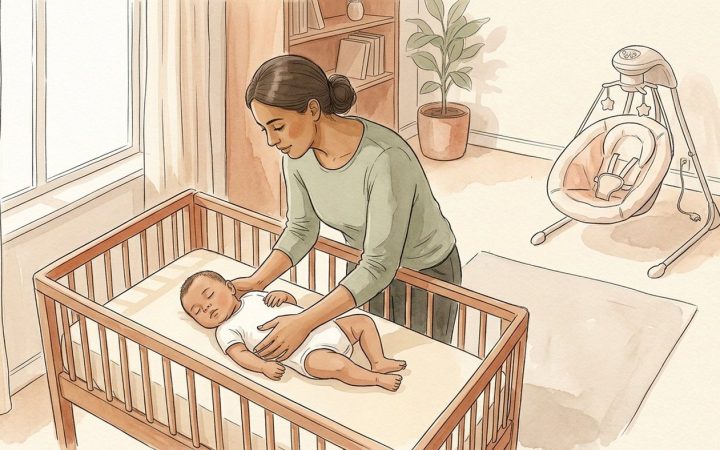
- Use a thin blanket. Spread it flat with one corner folded down, and lay your baby face-up with their head above the fold.
- Wrap the arms, not the chest tight. You should be able to slide at least two or three fingers between your baby’s chest and the swaddle.
- Leave the hips loose. Fold or twist the bottom loosely so the legs can bend up and out at the hips, like a frog. Never wrap the legs straight down and pressed together.
- Back to sleep, every time. A swaddled baby should only ever be placed on their back, in a crib or bassinet with a firm, flat mattress and a fitted sheet.
- Watch the temperature. Swaddling can make babies overheat. Sweating, damp hair, flushed cheeks, heat rash, or fast breathing mean your baby is too warm.
The hip step matters more than it looks. The AAP notes that tightly wrapping a baby’s legs straight has been linked to hip dysplasia, where the top of the thighbone doesn’t sit firmly in the socket. The International Hip Dysplasia Institute recommends keeping the hips and knees slightly bent during swaddling, and the Pediatric Orthopaedic Society of North America and the AAP’s orthopedics section promote this “hip-healthy” way of wrapping.
Why is swaddling risky once a baby can roll?
Because a swaddled baby who rolls face-down can’t use their arms to lift their head or roll back. The AAP says the risk of suffocation is higher if your baby rolls to their stomach while swaddled, and Safe to Sleep warns that a swaddled baby may have trouble moving out of the stomach or side position.
Swaddling also changes how deeply babies sleep. A systematic review found that swaddled babies sleep longer and wake less easily, and the AAP notes that this lower arousal may make it harder for a baby to wake up when something is wrong. That’s helpful for a newborn on their back, and worrying for a baby who might end up on their tummy.
The best data comes from a 2016 meta-analysis of four studies, with 760 SIDS cases and 1,759 comparison babies. Swaddled babies placed on their stomach had about 13 times the odds of SIDS, and on their side about 3 times. Even on the back, the odds were about 1.9 times higher, which is one more reason to stop once your baby is mobile. The authors also found limited evidence that the risk rises with age, at roughly double for babies older than 6 months.
What the research says: the link between swaddling, tummy or side sleeping, and SIDS is consistent across studies, and it’s why every major health body says to stop at rolling. But only four studies met the meta-analysis criteria, they defined swaddling differently, and they couldn’t fully rule out other risks, so the exact numbers are less certain than the direction.
The startle reflex that makes newborns fling their arms out and wake themselves usually peaks in the first month and starts to fade after about two months, according to the AAP. That’s around the same time many babies begin working on rolling, so the swaddle often stops being needed right when it stops being safe.
How do I transition my baby out of the swaddle?
How you do it depends on whether rolling has started. If your baby is already trying to roll, skip the gradual steps and go straight to arms-free sleep tonight. The AAP says sleep sacks that compress the arms, chest, and body should stop at the same point as a blanket swaddle. By that wording, an “arms out” swaddle that still wraps the chest should stop too.
If you’re planning ahead and there are no rolling signs yet, a gentler approach many families use looks like this. It’s common practice rather than something that’s been studied, so adjust it to your baby:
- Free one arm for a few nights. Some parents start with the side their baby likes to bring a hand to their mouth.
- Then free both arms. Once your baby settles with one arm out, leave both out.
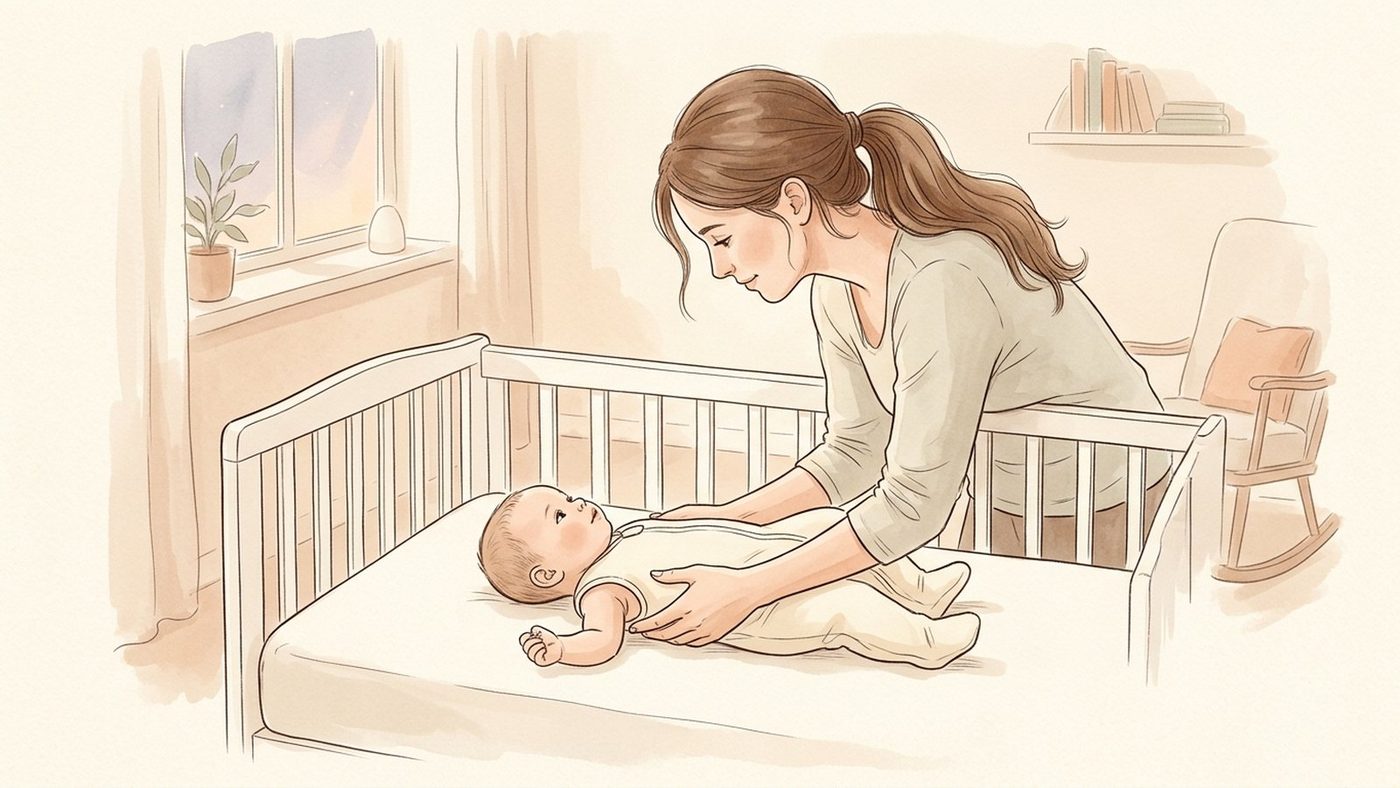
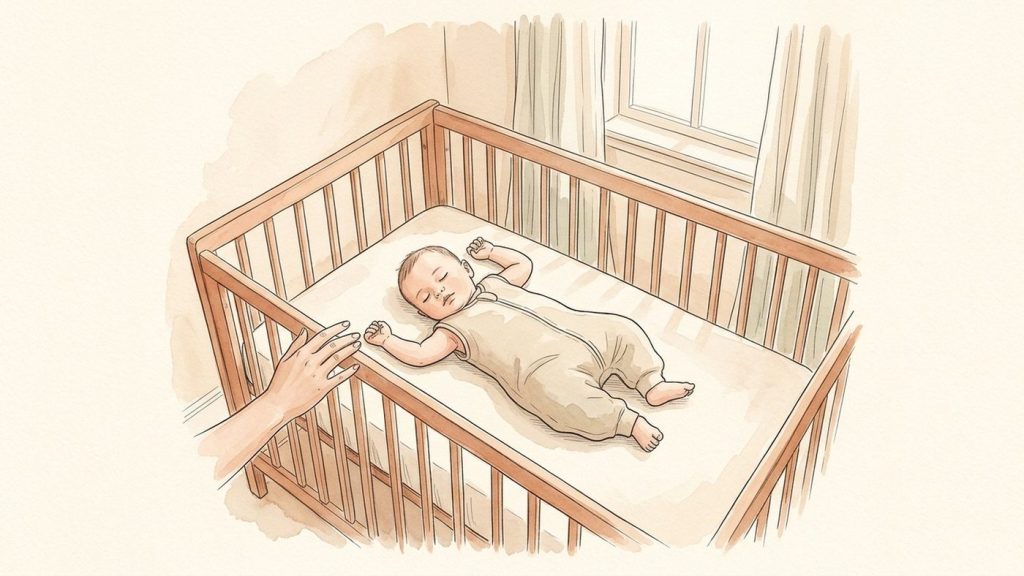
- Move to a sleeveless sleep sack. Choose a non-weighted wearable blanket in the right size, so it can’t ride up over the face. The AAP says sleep sacks that don’t swaddle and let your baby move freely can be used as long as you like.
- Keep everything else the same. Same bedtime routine, same room, same sleep space. The sleep sack becomes the new “it’s time to sleep” cue.
- Stop the moment rolling starts, even if you’re halfway through. Don’t go back to swaddling once your baby is trying to roll.
Expect a few unsettled nights. Your baby is getting used to moving arms that used to be still, and you may see more startling and wiggling at first. We couldn’t find a study measuring how long this takes, so give it a week or two before judging. If it lands at the same time as other changes, our post on the 4-month sleep regression explains why sleep can feel rocky at this age.
Are weighted swaddles and sleep sacks safe?
No. Weighted sleep sacks are often marketed for exactly this transition, but every major US safety body advises against them. The AAP says not to use weighted swaddles or weighted blankets, which can place too much pressure on a baby’s chest and lungs, and not to put weighted objects like rice bags inside a swaddle.
The CDC says products labeled as weighted, including sleepers, swaddles, sleep sacks, and blankets, are not safe for infants. The Consumer Product Safety Commission’s safe sleep advice is simply: don’t use weighted blankets or weighted swaddles. In 2024, Target, Walmart, Nordstrom, and Babylist said they would stop selling weighted infant products after a CPSC commissioner wrote to retailers about infant deaths that had occurred in these products.
A regular, non-weighted sleep sack keeps your baby warm without a loose blanket. For the full story on when blankets become OK, see when can a baby sleep with a blanket.
What should I avoid after the swaddle comes off?
The end of swaddling is a tempting moment to try a product that promises to help. Most of them aren’t safe for sleep:
- Loose blankets. Use a sleep sack or an extra layer of clothing instead. An unwrapped swaddle blanket in the crib is a loose blanket too.
- Inclined sleepers. The AAP says any surface that inclines more than 10 degrees isn’t safe for sleep, and inclined sleepers for infants have been banned from sale in the US since 2022.
- Swings, car seats, and loungers for routine sleep. If your baby falls asleep in one, move them to a flat sleep space. Our guide to baby sleep in a swing or car seat explains why.
- Positioners, wedges, pods, and nests. The AAP warns these haven’t been shown to reduce SIDS, and the NHS advises keeping anything that holds a baby in place out of the cot.
- Swaddling in a shared bed. The NHS says that if you ever share a bed with your baby, don’t swaddle, and notes that baby sleeping bags are safer.
Swaddled or not, place your baby on their back for every sleep until age 1, alone, on a firm, flat surface with only a fitted sheet. Once your baby can roll both ways easily, the AAP says you don’t need to keep turning them onto their back, as long as the crib is clear of blankets, pillows, toys, and bumpers. Keep the room comfortable rather than warm; UK guidance suggests about 16–20°C (61–68°F).
Talk to your pediatrician if:
- one leg looks shorter, moves less than the other, or the skin creases on the thighs or bottom look uneven, which can be signs of hip dysplasia
- your baby was born early or has a medical condition, and you’re unsure when to stop swaddling
- your baby seems hot, sweaty, or unwell after sleep, or has a fever
Frequently asked questions
Can I swaddle my baby for naps after they start rolling?
No. The rolling rule applies to every sleep, naps included. A baby can roll during a short nap just as easily as at night.
Is it OK to swaddle with the arms out?
Before rolling starts, yes. The AAP says there’s no evidence that arms in or out changes SIDS risk. Once your baby tries to roll, stop any wrap that compresses the chest and body, even with the arms out.
My 4-month-old isn’t rolling yet. Can I keep swaddling?
If there are truly no signs of trying to roll, the guidance doesn’t set a hard cutoff. But many 4-month-olds are close, so watch carefully during tummy time and have a sleep sack ready to go.
What if my baby rolls onto their tummy in the sleep sack?
Always put them down on their back. If they can roll both ways on their own, the AAP says you can leave them in the position they choose. If they can only roll one way, Safe to Sleep suggests gently turning them back.
Does swaddling help prevent SIDS?
No. The AAP says swaddling doesn’t reduce the risk of SIDS. It can help calm a young baby, but back sleeping in a bare crib is what protects them.
Will my baby sleep worse without the swaddle?
Possibly for a few nights, while they get used to their arms. Keeping the rest of the bedtime routine the same gives them something familiar while they adjust.
Sources
- American Academy of Pediatrics, HealthyChildren.org (2022). Swaddling: Is it Safe? healthychildren.org
- American Academy of Pediatrics, HealthyChildren.org. How to Keep Your Sleeping Baby Safe: AAP Policy Explained. healthychildren.org
- Moon RY, Carlin RF, Hand I, et al. (2022). Sleep-Related Infant Deaths: Updated 2022 Recommendations for Reducing Infant Deaths in the Sleep Environment. Pediatrics. pubmed.ncbi.nlm.nih.gov
- NIH, Eunice Kennedy Shriver National Institute of Child Health and Human Development. Safe to Sleep: Ways to Reduce Baby’s Risk. safetosleep.nichd.nih.gov
- Pease AS, et al. (2016). Swaddling and the Risk of Sudden Infant Death Syndrome: A Meta-analysis. Pediatrics. pubmed.ncbi.nlm.nih.gov
- van Sleuwen BE, et al. (2007). Swaddling: a systematic review. Pediatrics. pubmed.ncbi.nlm.nih.gov
- International Hip Dysplasia Institute. Hip-Healthy Swaddling. hipdysplasia.org
- Clarke NMP (2014). Swaddling and hip dysplasia: an orthopaedic perspective. Archives of Disease in Childhood. pubmed.ncbi.nlm.nih.gov
- American Academy of Pediatrics, HealthyChildren.org. Hip Dysplasia. healthychildren.org
- American Academy of Pediatrics, HealthyChildren.org. Newborn Reflexes. healthychildren.org
- Centers for Disease Control and Prevention (2024). Helping Babies Sleep Safely. cdc.gov
- US Consumer Product Safety Commission. Safe Sleep. cpsc.gov
- US Consumer Product Safety Commission. Safe Sleep for Babies Act Business Guidance. cpsc.gov
- Trumka RL Jr., CPSC Commissioner (2024). Target, Walmart, Nordstrom, and Babylist Commit to Stop Selling Weighted Infant Products. cpsc.gov
- NHS. Sudden infant death syndrome (SIDS). nhs.uk