Short answer: A fever is a temperature of 38°C (100.4°F) or higher. In a baby under 3 months, any fever means calling your doctor or getting urgent care right away; for older babies and toddlers, how your child looks and acts matters more than the number. Call emergency services if your child struggles to breathe, turns blue or grey, has a rash that doesn’t fade under a glass, or is very hard to wake.
I printed the red-flag list below and stuck it on our fridge before Adam’s first cold season. I hope you never need it, but it helps to know it by heart.
Call your pediatrician right away, day or night, if your child has a fever and:
- is under 3 months old with a temperature of 38°C (100.4°F) or higher, even if they seem well
- looks very ill, is unusually drowsy, or is very fussy and hard to settle
- has a rash, repeated vomiting or diarrhea, signs of dehydration, or has had a seizure
- still acts sick once the fever comes down, or seems to be getting worse
This article is general information from a mom, not medical advice. In an emergency, call 911 or your local emergency number (999 in the UK).
Key takeaways
- 38°C (100.4°F) or higher is a fever. Check with a digital thermometer, not your hand.
- Under 3 months, never wait. Every major guideline treats fever at this age as urgent.
- Watch your child, not just the number. Feeding, waking easily, and smiling are reassuring.
- Comfort first: extra feeds, one light layer, no cold baths or alcohol rubs.
- Medicine only with guidance, and never aspirin.
What temperature is a fever in a baby?
38°C (100.4°F) or higher. The American Academy of Pediatrics (AAP) and the NHS use the same cutoff.
A normal temperature for babies is about 36.4°C (97.5°F), says the NHS. A reading can be briefly higher after a warm bath or being wrapped up, so check again a little later if that might be why.
The NHS calls a high temperature “a natural and healthy response to infection,” and the AAP describes it as a sign the immune system is working. Fever isn’t the illness; it’s a clue that your baby’s body is fighting something.
How do I take my baby’s temperature?
With a digital thermometer, using the method recommended for your baby’s age. This is one place where US and UK advice differ, so here’s both:
| Method | AAP (US) | NHS and NICE (UK) |
|---|---|---|
| Rectal (bottom) | The most accurate, especially under 3 months | Not routinely recommended for children under 5 |
| Armpit | Fine for a quick check at any age, but the least accurate | The recommended method under 5; the only one NICE advises under 4 weeks |
| Forehead (temporal artery scanner) | Can be used at any age | Not in NICE’s list; forehead strips are unreliable |
| Ear | From 6 months; ear canals are too small before then | An option from 4 weeks, but easy to misread if not placed correctly |
| Mouth | Not before age 4 | Not routinely for children under 5 |
For a rectal reading, the AAP suggests a little petroleum jelly on the tip, inserting it gently about ½ inch (1 cm) in babies under 6 months, and stopping if you feel resistance. For an armpit reading, the NHS says to tuck the thermometer into the armpit and hold your baby’s arm gently against their body until it beeps.
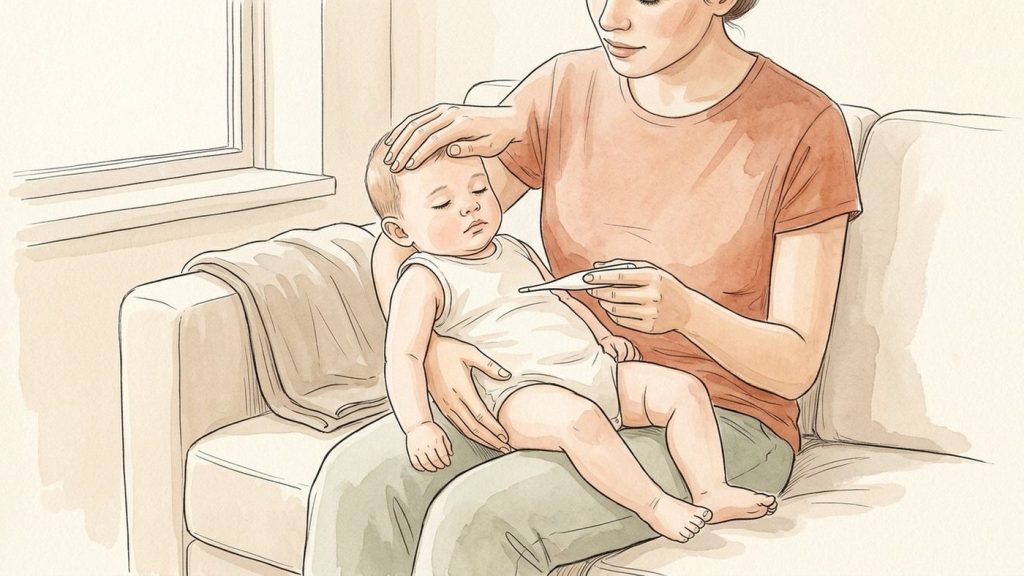
If a reading is borderline and your baby is very young or seems unwell, call anyway. NICE, which writes UK guidance for doctors, says a parent’s sense that their child has a fever should be taken seriously.
When should I call the doctor about my baby’s fever?
It depends most on age. The younger the baby, the lower the bar for calling. Here’s what each side of the Atlantic says:
| Age | Call the pediatrician (AAP, US) | Get urgent advice (NHS and NICE, UK) |
|---|---|---|
| Under 3 months | 38°C (100.4°F) or higher: call immediately, even with no other symptoms | 38°C or higher: urgent GP appointment or call 111. NICE classes this as high risk. |
| 3–6 months | 38.3°C (101°F) or higher | 39°C (102.2°F) or higher. NICE classes this as at least intermediate risk. |
| Over 6 months | 39.4°C (103°F) or higher, or above 40°C (104°F) again and again | The number alone isn’t used to judge risk. Call if your child seems unwell or you’re worried. |
| How long it lasts | More than 24 hours under age 2; more than 3 days from age 2 | 5 days or more |
| Any age | Looks very ill, is unusually drowsy, still acts sick when the fever comes down, or seems worse | Not acting like themselves, has other signs such as a rash, or you’re worried |
What the research says: the under-3-months rule is the same everywhere. The AAP, NICE, and the NHS all say a fever of 38°C or more at this age needs a doctor promptly, because very young babies can have serious infections without looking very sick.
Where guidelines differ: after 3 months, the exact numbers vary. The AAP uses 38.3°C at 3–6 months, while NICE and the NHS use 39°C. US advice also suggests calling sooner about a fever that won’t go away. These are expert-panel cutoffs, not proven dividing lines, so when in doubt, call.
Does a higher temperature mean my baby is sicker?
Not necessarily. After 6 months, NICE tells doctors not to use the height of the temperature alone to decide who is seriously ill. How your child looks and behaves tells you more.
NICE uses a “traffic light” system to sort feverish children by risk. In short:
- Green (low risk): normal color, smiles and responds to you, wakes easily, strong cry, moist mouth.
- Amber (see a doctor): pale, no smile, hard to wake, feeding poorly, fewer wet diapers, fast breathing, or fever for 5 days or more.
- Red (high risk): mottled, ashen, or blue; won’t stay awake; a weak, high-pitched, or nonstop cry; grunting; or any emergency sign below.
Whether a fever comes down with medicine doesn’t tell you how serious the illness is. NICE tells doctors not to rely on it, and the AAP says to call if your child still acts sick once the fever is lower.
When is a baby’s fever an emergency?
When it comes with signs that your child is struggling. This list comes from the NHS and NICE.
Call 911 (or 999, or your local emergency number) if your child has a fever and:
- has trouble breathing: grunting, very fast breathing, or the belly sucking in under the ribs
- has blue, grey, pale, or blotchy skin or lips, or unusually cold hands and feet
- has a rash that doesn’t fade when you press the side of a clear glass firmly against it. On brown or black skin, check paler areas such as the palms, soles, and roof of the mouth
- is floppy, very hard to wake, not responding normally, or unusually agitated or confused
- has a seizure lasting more than 5 minutes, or a first-ever seizure
- has a stiff neck or a bulging soft spot on top of the head
Signs of dehydration need urgent care the same day: fewer wet diapers, a dry mouth, sunken eyes, no tears when crying, or a sunken soft spot. If your baby is also very sleepy or floppy, treat it as an emergency.
How can I make my baby with a fever more comfortable?
Keep fluids going, keep clothing light, and let them rest.
- Offer feeds often. NICE says breast milk is the best fluid for a breastfed baby; formula-fed babies can have formula more often. Under 6 months, no water is needed (see when babies can drink water).
- Dress them in one light layer. NICE says not to over-wrap or underdress a feverish child.
- Skip cold baths, sponging, and alcohol rubs. NICE and the NHS advise against sponging. A Cleveland Clinic pediatrician warns that a cold bath can push temperature up, and rubbing alcohol can be absorbed through the skin and cause poisoning.
- Check on them regularly, including overnight, as NICE and the NHS advise.
- Keep them home from daycare while the fever lasts, and let the daycare know.
Sick babies often eat less solid food; milk feeds matter most. Our baby feeding schedule by month helps you ease back to normal afterward.
Should I give my baby fever medicine?
Only if they’re uncomfortable, and only with guidance from your pediatrician or pharmacist. NICE says fever medicine is for a child who seems distressed, not for bringing the number down.
- Never give aspirin. The AAP links it to Reye syndrome, a rare but serious illness. The NHS says no aspirin under 16.
- Under 3 months, call first. The NHS says no paracetamol (acetaminophen) under 2 months, and the AAP says to give it under age 2 only with a doctor’s guidance.
- Ibuprofen: the AAP says not under 6 months unless your doctor advises it. The NHS says not under 3 months or 5 kg, or if your child is dehydrated or has chickenpox.
- Doses depend on weight. Ask your pediatrician or pharmacist, and use the syringe that comes in the box, never a kitchen spoon.
- Don’t give both medicines at once, or alternate them, unless a health professional tells you to.
What does a febrile seizure look like, and what should I do?
Your child may stiffen, twitch or jerk, roll their eyes, and not respond to you. It’s frightening to see, but the AAP says most febrile seizures are short and don’t cause brain damage.
The AAP says they affect about 3 to 4 in 100 children, usually between 6 months and 5 years, most often at 12 to 18 months. The NHS says they usually last 2 to 3 minutes, with sleepiness for up to an hour afterward.
- Note the time it starts.
- Lay your child on the floor or a bed, away from hard or sharp objects, and turn their head to the side.
- Don’t hold them down or put anything in their mouth. The AAP says they won’t swallow their tongue.
- Call 911 if it lasts more than 5 minutes or they have trouble breathing. The NHS also advises calling 999 for a first febrile seizure.
- Afterward, place them on their side in the recovery position and call your doctor, even if they recover quickly.
One thing that surprised me: the AAP and NICE both say fever medicine doesn’t prevent febrile seizures, so a seizure doesn’t mean you missed a dose.
Is it normal for a baby to have a fever after vaccines?
Yes, a mild fever is a common, expected reaction. The CDC lists fever, fussiness, and tiredness among the mild reactions after routine shots such as DTaP.
Seattle Children’s Hospital says it usually starts within the first day and lasts 1 to 2 days. In the UK, the NHS recommends liquid paracetamol after the MenB vaccine at 8 and 12 weeks to lower the chance of fever.
Still call your doctor if your baby is under 3 months with a fever, if the fever goes above 40°C (104°F), if it lasts more than 3 days, or if it starts more than 2 days after the shot, which suggests something else is going on. In the UK, follow the MenB leaflet your nurse gives you, and call 111 if you’re worried.
Can teething cause a fever?
Not a true fever. The AAP says teething may cause a slight rise in temperature but doesn’t cause a real fever, so a reading of 38°C (100.4°F) or higher is probably from something else and is worth a call.
Our post on teething symptoms and remedies explains what teething does and doesn’t cause, and how to soothe sore gums safely.
The clingy, low-energy recovery days after a fever can feel long. For gentle ideas for days like that, The First-Year Mind has 50 simple, research-based play activities, 10 for each stage of the first year, plus printable CDC milestone checklists for 2 to 12 months.
An infant first-aid class is worth it too; our guide to gagging vs. choking explains why.
Talk to your pediatrician, or call 111 in the UK, if your child:
- is under 3 months with a temperature of 38°C (100.4°F) or higher
- is 3–6 months with a temperature of 38.3°C (101°F) or higher (39°C in UK guidance)
- has a fever lasting more than 24 hours under age 2, or more than 3 days from age 2
- is feeding poorly, has fewer wet diapers, or has an immune or heart condition
- worries you, for any reason. You know your baby best.
Frequently asked questions
My baby is under 3 months and seems fine. Do I still need to call?
Yes. The AAP says to call your pediatrician immediately for a temperature of 38°C (100.4°F) or higher in a baby 3 months or younger, even without other signs of illness. Young babies can be seriously ill without looking it.
Is 37.5°C a fever in a baby?
No. The AAP and the NHS both put the line at 38°C (100.4°F). Check again in a while if you’re unsure, and watch how your baby is acting.
How long can a fever last before I should worry?
The AAP says to call after 24 hours under age 2, or 3 days from age 2. UK guidance says 5 days. At any age, call sooner if your child seems worse.
Is a high fever dangerous by itself?
A fever from infection is the body’s natural response, and after 6 months the number alone isn’t a reliable guide. Overheating is different: the AAP says above 40.5°C (105°F) after being somewhere very hot, like a car, is an emergency.
If the fever goes down with medicine, does that mean it’s nothing serious?
Not on its own. NICE tells doctors not to judge how serious an illness is by the response to fever medicine. If your child still seems unwell, call.
Sources
- American Academy of Pediatrics, HealthyChildren.org. Fever and Your Baby. healthychildren.org
- American Academy of Pediatrics, HealthyChildren.org. When to Call the Pediatrician: Fever. healthychildren.org
- American Academy of Pediatrics, HealthyChildren.org. How to Take a Child’s Temperature. healthychildren.org
- American Academy of Pediatrics, HealthyChildren.org. Febrile Seizures. healthychildren.org
- American Academy of Pediatrics, HealthyChildren.org. Acetaminophen dosing for fever and pain in children. healthychildren.org
- American Academy of Pediatrics, HealthyChildren.org. Ibuprofen dosing for fever and pain in children. healthychildren.org
- American Academy of Pediatrics, HealthyChildren.org. Reye Syndrome. healthychildren.org
- American Academy of Pediatrics, HealthyChildren.org. Teething: 4 to 7 Months. healthychildren.org
- National Institute for Health and Care Excellence (2019, updated 2021). Fever in under 5s: assessment and initial management (NG143). nice.org.uk
- NHS. High temperature (fever) in children. nhs.uk
- NHS. How to take your baby’s temperature. nhs.uk
- NHS. Febrile seizures. nhs.uk
- NHS. Meningitis: symptoms. nhs.uk
- NHS. Vaccination tips for parents. nhs.uk
- CDC. DTaP (Diphtheria, Tetanus, Pertussis) Vaccine Information Statement. cdc.gov
- Seattle Children’s Hospital. Immunization Reactions. seattlechildrens.org
- Cleveland Clinic. Never Use Rubbing Alcohol To Bring Down a Fever. clevelandclinic.org