Short answer: Start tummy time in the first days after birth with 2–3 short sessions of 3–5 minutes a day. Build up to 15–30 minutes in total a day by about 2 months, then aim for at least 30 minutes spread through the day until your baby is crawling or moving around.
Adam protested tummy time loudly in his first weeks, so we started with a minute or two on my chest. That is exactly how the plan below begins.
Key takeaways
- Tummy time means your baby is on their tummy, awake and watched. Sleep is always on the back.
- It builds the neck, shoulder, and arm strength that rolling, sitting, and crawling need, and helps prevent flat spots on the head.
- Short and often beats long and miserable. Your chest counts as tummy time.
- The WHO also suggests no more than 1 hour at a time in a car seat, stroller, bouncer, or carrier.
How much tummy time does a baby need at each age?
| Age | How much | Source |
|---|---|---|
| First days to a few weeks | 2–3 sessions a day, 3–5 minutes each | NIH Safe to Sleep |
| By about 2 months | 15–30 minutes a day in total | NIH Safe to Sleep |
| Until your baby is mobile | At least 30 minutes a day, spread through waking hours | WHO 2019 |
These are totals across the day, not one long session. Many babies do best with lots of 1–5 minute bursts: after a diaper change, after a nap, or while you lie on the floor together.
Why does tummy time matter?
Since babies began sleeping on their backs to reduce the risk of sleep-related deaths, they spend much less awake time on their tummies. Tummy time fills that gap. According to the NIH, it strengthens your baby’s neck, shoulder, and arm muscles and helps prevent flat spots on the back of the head. It doesn’t directly reduce the risk of SIDS; safe sleep does that.
What the research says: a 2020 review of 16 studies (4,237 babies, 8 countries) found tummy time was linked to better gross motor development, earlier rolling and crawling, and fewer flat-head shapes. Links to thinking and social skills were unclear, and most studies were observational, so the evidence is promising but not definitive.
How do I do tummy time with a newborn?
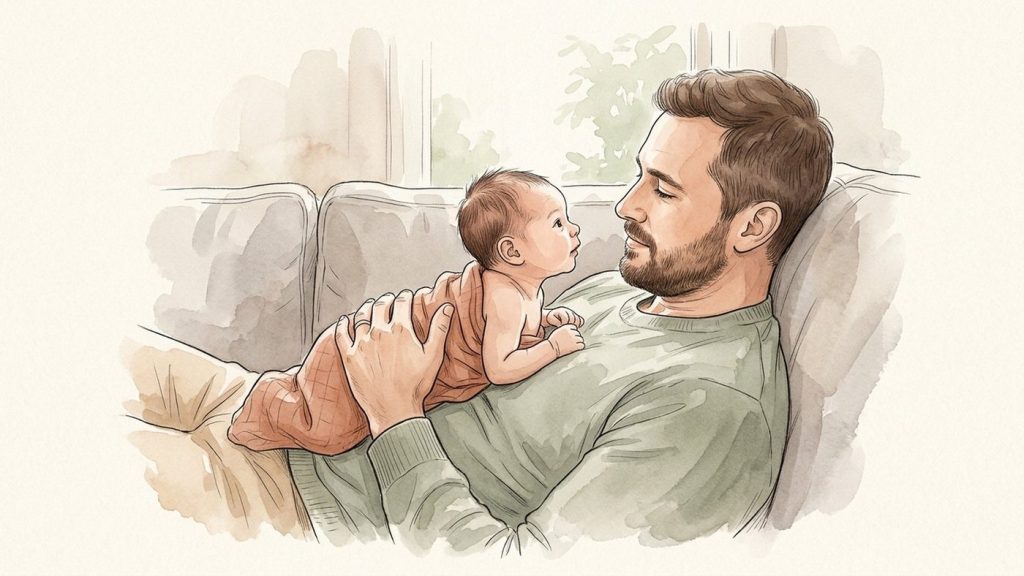
- Start on you. Lie back and place your baby tummy-down on your chest. Talk and make faces: they’ll lift their head to see you.
- Move to the floor. Use a blanket on a clear, firm area of floor, never a bed or sofa.
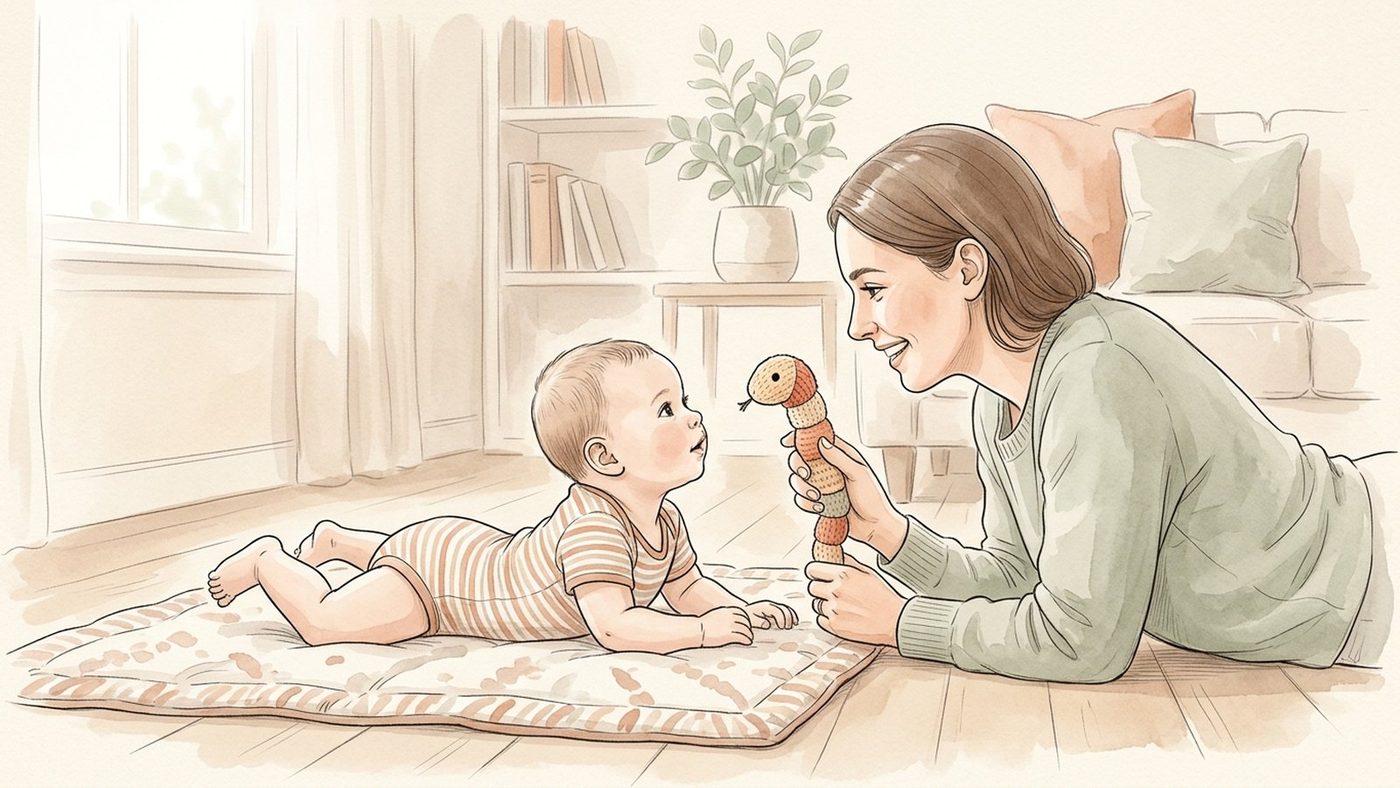
- Get down to their level. Your face is the best toy. A baby-safe mirror or a toy at eye level helps too.
- Use a rolled towel under the chest and armpits if your baby finds it hard.
- Stop before tears. End on a good note and try again later. Little and often is the goal.
“Holds head up when on tummy” is one of the CDC’s milestones for 2 months, and “pushes up onto elbows or forearms when on tummy” is one for 4 months. Tummy time is how babies practice both.
What if my baby hates tummy time?
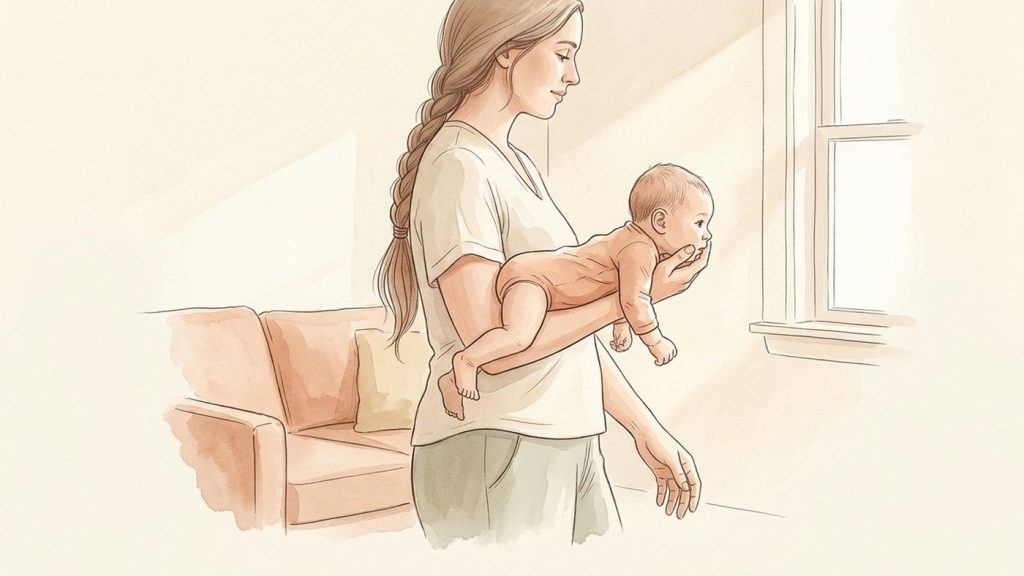
Very common, and usually temporary. Try sessions after a nap rather than right after a feed, keep them very short, and change the view: lie them across your lap, carry them tummy-down along your forearm (the “football hold”), or let an older sibling lie face-to-face with them. Every minute counts, and it gets easier as their neck gets stronger.
Tummy time is only for when your baby is awake and someone is watching. If your baby falls asleep on their tummy, move them onto their back in their own crib or bassinet.
- Your baby always turns their head to the same side, or a flat spot is getting worse
- By 2 months, your baby can’t lift their head at all during tummy time
- Your baby seems very stiff or very floppy, or has lost a skill they had
Frequently asked questions
When can I start tummy time?
The NIH says most babies can start a day or two after birth, with short, supervised sessions.
Does tummy time on my chest count?
Yes. Any time your awake baby is on their tummy and being watched counts, including on your chest or across your lap.
When can I stop tummy time?
Once your baby rolls, crawls, or moves around on the floor by themselves, they get plenty of tummy time naturally. Keep giving them lots of safe floor time.
Sources
- NIH Safe to Sleep campaign. Tummy Time. safetosleep.nichd.nih.gov
- World Health Organization (2019). Guidelines on physical activity, sedentary behaviour and sleep for children under 5 years of age. who.int
- Hewitt L, Kerr E, Stanley RM, Okely AD (2020). Tummy time and infant health outcomes: a systematic review. Pediatrics, e20192168. doi.org
- CDC. Learn the Signs. Act Early.: milestones at 2 and 4 months. cdc.gov