Short answer: For babies and toddlers under 2, the CDC says screen time is not recommended, apart from video calls with loved ones. From age 2, the CDC and WHO suggest no more than 1 hour a day, ideally a children’s program watched with an adult. The AAP’s newest guidance puts the focus on how screens are used: together, with good content, and not in place of play and conversation.
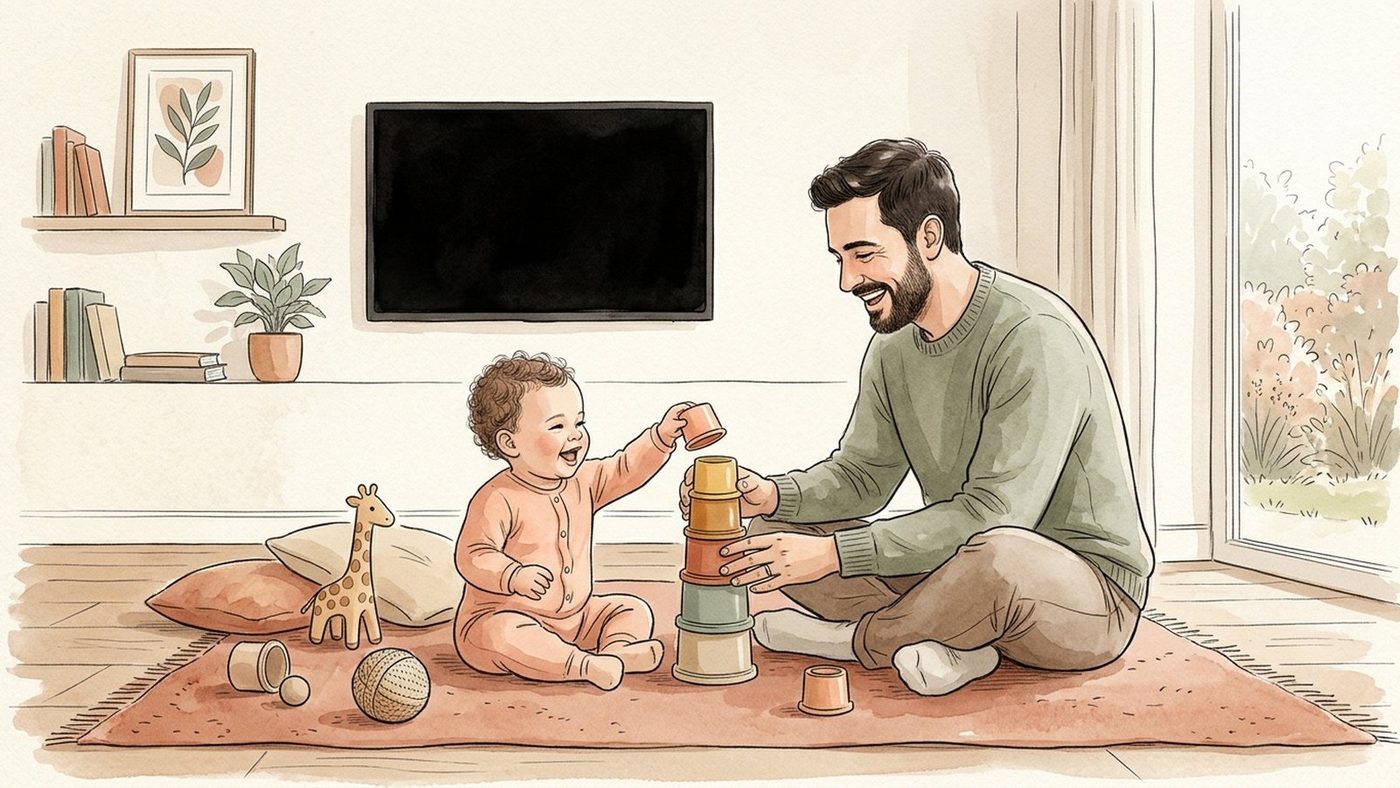
At home, the only screen Adam sees is a video call with his grandparents. Here’s what the AAP and WHO base that on.
Key takeaways
- Under 2: no screens except video chatting with family and friends (CDC). The WHO says no screen time at all under 1.
- Ages 2 to 4: no more than 1 hour a day, and less is better (WHO). The CDC adds: a children’s program, with an adult present.
- A 2020 review of 42 studies (18,905 children) linked more screen time and background TV to weaker language skills, and educational shows and watching together to stronger ones.
- Your own phone counts too. The CDC suggests limiting it when you’re with your child so you can respond to them.
How much screen time is OK for babies and toddlers?
Before age 2, the official advice is essentially none, other than video calls; from age 2, up to about an hour a day.
| Age | CDC (2026 milestone pages) | WHO (2019) |
|---|---|---|
| Under 1 year | “Screen time is not recommended for children younger than 2 years of age.” Video calls with loved ones are fine. | “Screen time is not recommended.” |
| 1 year | Same as above: video calls only. | “Sedentary screen time (such as watching TV or videos, playing computer games) is not recommended.” |
| 2 years | Limit screens to “no more than 1 hour a day of a children’s program with an adult present.” | “Sedentary screen time should be no more than 1 hour; less is better.” |
| 3 to 4 years | At 3 years: no more than 1 hour a day of a children’s program with an adult present, and no screens in your child’s bedroom. | “Sedentary screen time should be no more than 1 hour; less is better.” |
The WHO guidance also encourages reading and storytelling with a caregiver whenever little ones are sitting still, and it suggests babies and toddlers not be strapped into a stroller, high chair, or carrier for more than 1 hour at a time.
What does the AAP recommend for screen time?
For years the AAP said to avoid screens other than video chatting before 18 months; its 2026 policy keeps the spirit of that advice but looks beyond minute counts.
The AAP’s 2016 policy, “Media and Young Minds,” was the one most parents have heard of. It said to avoid screen media other than video chatting before 18 months. Between 18 and 24 months, families who wanted to introduce media were advised to choose high-quality programs and watch together. For ages 2 to 5, it suggested no more than 1 hour a day.
In January 2026, the AAP published a new policy statement, “Digital Ecosystems, Children, and Adolescents,” which replaces its earlier media guidance. It argues that children’s media use can’t be judged “solely through the lens of individual child behaviors or screen limits alone.” Instead, it also looks at how apps and platforms are designed, and at family habits. It encourages parents to model healthy device use and to keep some spaces media-free, like the car or the dinner table. The policy also notes that babies under 18 months have difficulty transferring what they see on a screen to the real world.
Background TV counts. In the 2020 review, having a TV on in the background was linked to weaker language skills in young children.
Why is screen time not recommended for babies?
Because babies learn best from real people and real things, and screens tend to replace exactly that.
In the first two years, much of your baby’s learning happens in back-and-forth moments. Your baby coos, you answer. They point, you name what they see. A screen can’t respond to your baby, and young babies struggle to connect what’s on a screen with the world around them. Every hour of passive watching is also an hour without floor play, talking, or tummy time.
What the research says: a 2020 meta-analysis in JAMA Pediatrics pooled 42 studies of 18,905 children. More screen time was linked to weaker language skills, and so was background TV. Educational programs, watching together with a caregiver, and starting screens later were linked to stronger language. The links were modest, and the studies were observational, so they can’t prove cause and effect. Still, they line up with the advice to limit screens, choose good content, and watch together.

Is video chatting OK for babies?
Yes. Video calls are the exception the CDC and AAP make, because a real person is responding to your baby.
A grandparent on a video call can smile back, answer babbling, and play peekaboo. That’s real back-and-forth, just through a screen. The AAP’s 2016 policy noted that by about 24 months, toddlers can learn words from live video chatting with a responsive adult. Hold your baby on your lap, join in, and let the call be short and sweet.

How do I cut back on screens without guilt?
Start small, swap screens for simple routines, and remember that real life with a baby sometimes includes a screen.
- Turn off background TV. It’s the easiest change, and the one with a clear link to language.
- Keep meals screen-free. The CDC suggests avoiding screens during meals.
- Keep screens out of the bedroom. The CDC advises not putting any screens in your child’s bedroom.
- Watch together after age 2. Pick a calm, good-quality children’s show, sit with your child, and talk about what you see.
- Notice your own phone. The CDC suggests limiting your own screen time with your child so you can respond to their words and actions. The AAP’s 2026 policy notes that frequent digital interruptions of time together have been linked to behavior challenges in children.
- Have a few screen-free go-tos ready. A basket of board books, pots and a wooden spoon, or a song you both know.
If you’d like ready-made ideas, The First-Year Mind has 50 simple, research-based play activities, 10 for each stage of the first year, plus printable CDC milestone checklists for 2 to 12 months. And if a screen keeps everyone sane while you shower or cook, that’s not a failure. Aim for “mostly,” not “perfect.”
- Your child isn’t reaching the CDC’s talking milestones, for example, by 18 months, “Tries to say three or more words besides ‘mama’ or ‘dada’”
- Your child has lost words or other skills they used to have
- Screens have become the only way to calm your child, or you’d like help making a family media plan
If you have any concern about your child’s development, the CDC’s advice is to act early: talk with your doctor and ask about developmental screening. You can also contact your state’s early intervention program at cdc.gov/FindEI. See what to expect at each age in Baby milestones by month.
Frequently asked questions
Are “educational” baby videos and apps OK?
Official guidance doesn’t make an exception for them before age 2. The AAP has said that claims of educational benefit for many “interactive” media products are unproven. Babies learn more from you.
Does TV on in the background count as screen time?
For practical purposes, yes. Research links background TV to weaker language skills, likely because it cuts into talk and play. Turn it off when nobody is watching.
My toddler already watches TV. Have I done harm?
The research shows modest links, not damage from any single show. Focus on what you can change now: fewer background screens, more watching together, and plenty of talking and play.
When can my child start watching TV?
The CDC and WHO suggest waiting until age 2, then keeping it to an hour a day or less. The AAP’s 2016 guidance allowed high-quality programs, watched together, from 18 months.
Sources
- CDC. Learn the Signs. Act Early.: milestones and tips by 6 months, 18 months, 2 years, 30 months, and 3 years. 6 months, 18 months, 2 years, 30 months, 3 years
- World Health Organization (2019). Guidelines on physical activity, sedentary behaviour and sleep for children under 5 years of age. who.int
- AAP Council on Communications and Media (2016). Media and young minds. Pediatrics, 138(5), e20162591. doi.org
- Munzer T, Parga-Belinkie J, et al. (2026). Digital ecosystems, children, and adolescents: policy statement. Pediatrics, 157(2), e2025075320. doi.org. Parent summary at healthychildren.org
- Madigan S, McArthur BA, Anhorn C, Eirich R, Christakis DA (2020). Associations between screen use and child language skills: a systematic review and meta-analysis. JAMA Pediatrics, 174(7), 665–675. doi.org
- Healey A, Mendelsohn A; AAP (2019). Selecting appropriate toys for young children in the digital era. Pediatrics, 143(1), e20183348. Summary at healthychildren.org