
Short answer: If you think your baby or toddler swallowed a button battery, go to the emergency room right away, even if they seem fine, and call the National Battery Ingestion Hotline at 800-498-8666 on the way. A swallowed button battery can burn through a child’s throat in as little as two hours. Swallowing two or more magnets, or a magnet and a piece of metal, is also an emergency.
I once found a coin battery from a remote on the floor, inches from where Adam was playing. That evening I went through every gadget in our home.
Key takeaways
- A swallowed button battery is always an emergency. Go to the ER immediately. Don’t wait for symptoms.
- Save two numbers in your phone today: the National Battery Ingestion Hotline, 800-498-8666, and Poison Help, 800-222-1222.
- Honey is never for babies under 12 months. For children 12 months and older, poison experts give specific honey guidance, but it never replaces or delays the ER.
- Two or more swallowed magnets can pull together inside the gut and cause serious injury. Get medical care right away.
- Prevention is simple: screwed-shut battery compartments, spares stored up high, and used batteries taped and taken away.
What should I do if my baby swallowed a button battery?
Go to the nearest emergency room immediately, and call the National Battery Ingestion Hotline (800-498-8666) while you’re on your way.
You don’t need to be sure. If a battery is missing and your baby was nearby, treat it as swallowed. The National Capital Poison Center says an x-ray is usually needed right away to find out where the battery is, so this isn’t something you can check at home. Here’s what to do in the moment:
| What happened | What to do |
|---|---|
| Swallowed, or might have swallowed, a button battery | Go to the ER immediately. Call 800-498-8666 on the way. If you can quickly find the battery package or the device, bring it: the battery’s ID number helps. |
| Battery in the nose or ear | Get medical care right away. Don’t use nose or ear drops until a doctor has checked your child. |
| Swallowed two or more magnets, or a magnet and metal | Get medical attention immediately. |
| Swallowed medicine, a cleaner, or something else | Call Poison Help at 800-222-1222. Call 911 if your child is struggling to breathe or won’t wake up. |
Don’t make your child throw up, and apart from honey for children 12 months and older (more on that below), don’t give anything to eat or drink until an x-ray shows the battery has moved past the esophagus. These steps come from the National Capital Poison Center, which runs the battery hotline.
Why are button batteries so dangerous?
A battery stuck in the throat can create a chemical reaction that burns the tissue around it, fast.
When a button battery lodges in the esophagus, an electrical current forms around it and produces a caustic chemical that damages tissue. The US Consumer Product Safety Commission (CPSC) warns this can burn through a child’s throat in as little as two hours. The National Capital Poison Center says the 20 mm lithium coin cell is the battery most often involved in serious esophageal injuries. Smaller batteries get stuck less often, but they can still cause serious harm, especially in babies under 1.
What the research says: the danger is well documented. From 2011 through 2021, the CPSC knew of 27 deaths and an estimated 54,300 emergency room injuries linked to swallowed or inserted button and coin batteries. These are national figures, and they are why the US passed Reese’s Law in 2022 to require safer battery compartments and packaging.
Can I give my baby honey after swallowing a battery?
Not if your baby is under 12 months: honey is not safe for babies under 1, and the ER is the only step that matters.
You may have heard that honey can help. Here is exactly what the National Capital Poison Center’s guideline says, and it’s quoted by the CPSC too. Honey slows the injury but does not prevent it, so it is only ever something to do on the way to the hospital.
| Age | Honey? |
|---|---|
| Under 12 months | No. Honey is not safe for babies under 1. Go straight to the ER. |
| 12 months and older | Only if the battery was swallowed in the past 12 hours, your child can swallow, and honey is already on hand: 10 mL (2 teaspoons) every 10 minutes, for up to 6 doses, on the way to the ER. Use regular store-bought honey. |
Never delay leaving to find or give honey. If you’re unsure, skip it and drive.
Why are swallowed magnets dangerous?
Two or more magnets can find each other through the walls of the intestines and get stuck, which can cause serious injury.
The CPSC explains that swallowed high-powered magnets “can attract to each other, or to another metal object.” That can lead to holes, twisting, or blockage of the intestines, infection, and in rare cases death. Warning signs are mostly tummy symptoms: belly pain, nausea, vomiting, or diarrhea. If you think your child swallowed magnets, the CPSC advises getting medical attention immediately.
The CPSC notes that on an x-ray, several magnets stuck together can look like a single object. If you know a set had more than one piece missing, tell the doctor.
Where do button batteries and magnets hide at home?
Almost anywhere there’s a small gadget, which is why a room-by-room check is worth 15 minutes.
- Button batteries: remote controls, key fobs, hearing aids, watches, toys and games, flashing jewelry, singing greeting cards, and spare battery packs.
- Magnets: magnet sets sold as desk toys or fidgets, magnetic building toys with loose or broken pieces, and small fridge magnets that can come apart.
Babies explore with their mouths, and that’s healthy and normal. The CDC encourages letting babies mouth safe objects that aren’t sharp, hot, or small enough to choke on. Our book The First-Year Mind pairs every play idea for the first year with simple safety notes like these, so the fun stuff stays the safe stuff.

How do I keep button batteries and magnets away from my baby?
Secure the compartments, store spares out of reach, and get used batteries out of the house.
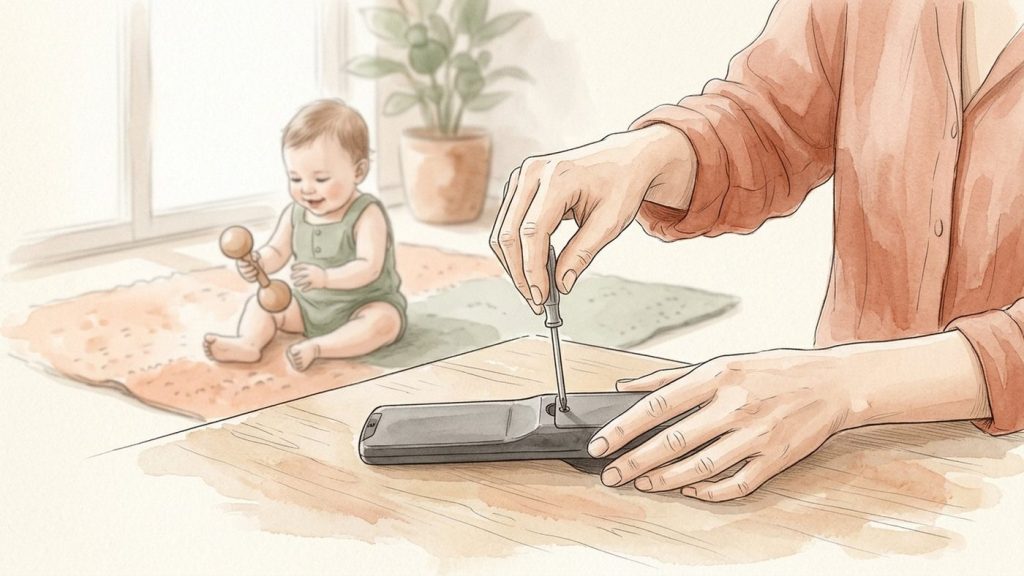
- Check every battery compartment. Toys must have closures that need a tool to open. For other products, keep anything without a screw-shut compartment away from your child, and repair or replace anything with a broken cover.
- Store spares up high, in their original child-resistant packaging, inside a closed cabinet.
- Tape used batteries. The CPSC suggests putting non-conductive tape over a used battery as soon as you take it out, then taking it to a battery collection point. “Dead” batteries can still be dangerous.
- Skip magnet sets while you have little ones at home, and check magnetic toys for loose or missing pieces.
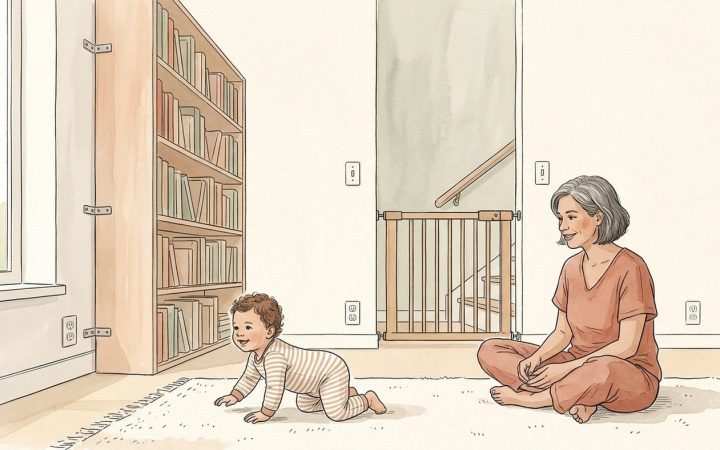
- Do a floor sweep before playtime, especially after guests or older kids have been over.
With my own baby, I started doing a quick battery hunt in each room once everything started going straight into my baby’s mouth, and the number of gadgets with little coin cells surprised me.
For other everyday safety questions, see Gagging vs. choking and Are baby walkers safe?
If your child swallowed a button battery or magnets, go to the ER now. Don’t wait for symptoms, and don’t let honey or a phone call slow you down. If your child is choking, struggling to breathe, or unresponsive, call 911.
- A battery or magnet went missing and your child now has fever, belly pain, vomiting, or blood in their stool
- Your child has pain or discharge from the nose or an ear and may have put something small inside
- You’re worried about anything your child may have swallowed, even if they seem fine
Frequently asked questions
My child seems fine. Do I still need to go to the ER?
Yes. You can’t tell from the outside where a battery is. The National Capital Poison Center says an x-ray is usually needed right away, and a battery stuck in the esophagus needs to come out quickly.
Should I make my child throw up?
No. The National Capital Poison Center advises against making your child vomit. Head to the ER instead.
Is one swallowed magnet an emergency?
The CPSC’s advice is to seek medical attention right away whenever you suspect magnets were swallowed. A single magnet can still attract to a metal object, and it’s often hard to know how many pieces are missing.
Are toys with button batteries safe?
Toys sold in the US must have battery compartments that need a tool, like a screwdriver, to open. Check older or secondhand toys, and stop using any toy with a loose or broken cover.
Sources
- National Capital Poison Center. Button batteries: what to do if swallowed. poison.org
- National Capital Poison Center. Button battery ingestion triage and treatment guideline. poison.org
- US Consumer Product Safety Commission. Button cell and coin battery information center. cpsc.gov
- US Consumer Product Safety Commission (2023). Making families safer from button cell or coin battery dangers: Reese’s Law leads to new federal mandatory safety standard. cpsc.gov
- US Consumer Product Safety Commission (2012). CPSC warns high-powered magnets and children make a deadly mix. cpsc.gov
- US Consumer Product Safety Commission (2024). Warning on high-powered magnetic ball sets due to ingestion hazard. cpsc.gov
- Seattle Children’s Hospital. Dangers of button batteries and magnets. seattlechildrens.org
- CDC. Learn the Signs. Act Early.: milestones by 4 months. cdc.gov