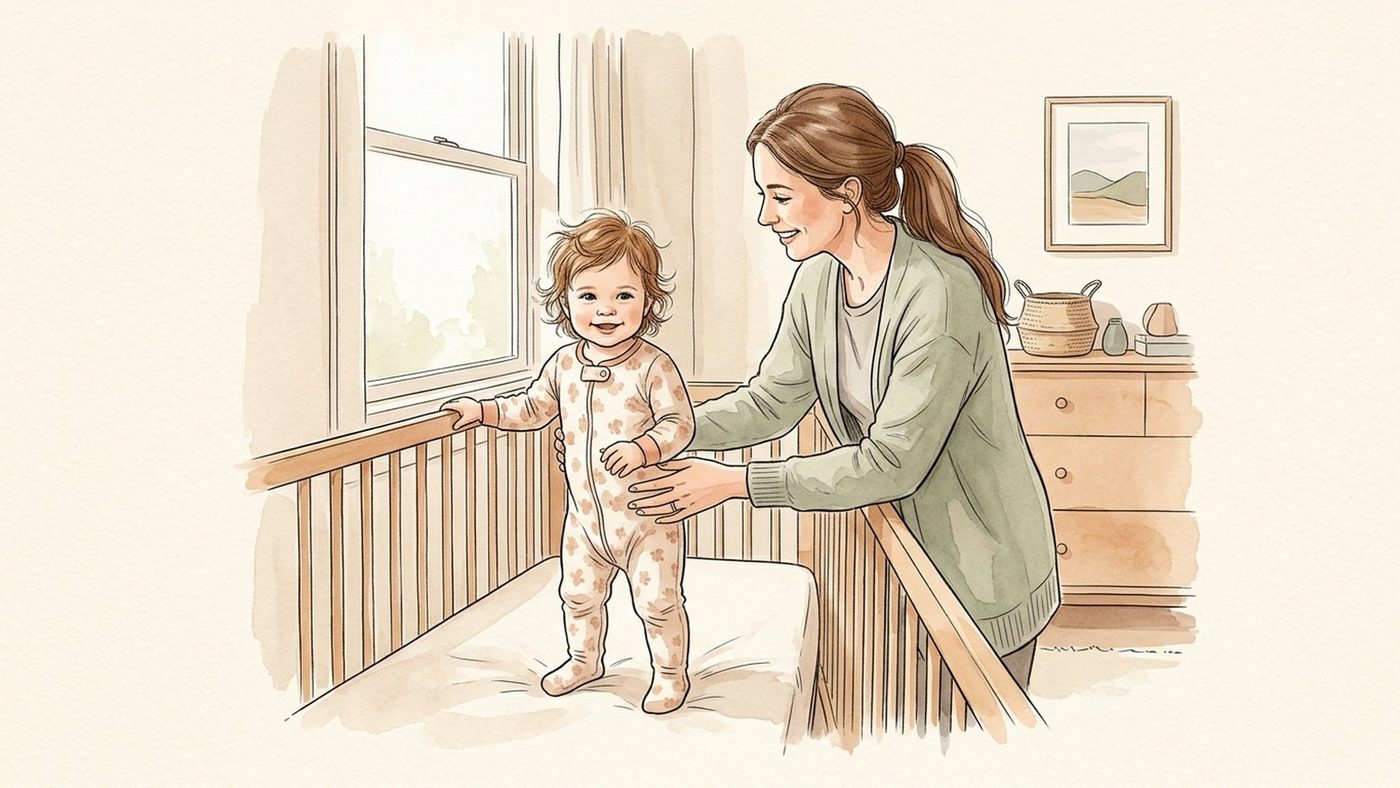
Short answer: If your toddler is climbing out of the crib, first make sure the mattress is at its lowest setting and remove anything they can use as a step. Many toddlers can be kept in a crib a bit longer that way, and a sleep sack may make climbing harder. But once your child can reliably climb out, reaches about 35 inches (89 cm) tall, or the top rail is below about three-quarters of their height, the crib has done its job and a low toddler bed in a childproofed room is safer than repeated falls from crib height.
Key takeaways
- Falls are the main danger: in a large US study, two-thirds of crib, playpen, and bassinet injuries in children under 2 were falls, and the share rose with age.
- First steps: lowest mattress setting, nothing in or near the crib to climb on, and a sleep sack if your child still fits one.
- When the crib is outgrown: your child can climb out, is about 35 inches (89 cm) tall, or the rail is below about three-quarters of their height.
- Avoid: crib tents, rail extenders, and anything that ties a child in. Some crib tents were recalled over strangulation and entrapment.
- Before the switch: childproof the whole bedroom, since your child will soon be able to roam it at night.
Is it dangerous when a toddler climbs out of the crib?
It can be. A fall from the top of a crib rail is a fall of several feet, often head-first onto a hard floor. Most of these falls end with a fright and a bruise, but they’re the most common way young children get hurt in cribs.
A study from Nationwide Children’s Hospital, published in Pediatrics in 2011, looked at nearly two decades of US emergency room data. It found that, on average, more than 9,500 children under 2 were treated in emergency departments each year for injuries linked to cribs, playpens, and bassinets. Falls caused about two-thirds of those injuries, and the share rose with age, to around three-quarters in children 18 to 23 months old. That’s around the age many toddlers start testing the crib rail.
So a first escape isn’t an emergency, but it is a signal. Your job now is to make another climb less likely, and to make the room safe in case it happens anyway.
What should I do first when my toddler climbs out?
Start with the changes that make the crib harder to climb and the landing softer. These come from injury prevention guidance and pediatric health systems, plus some common-practice tips that haven’t been formally studied:
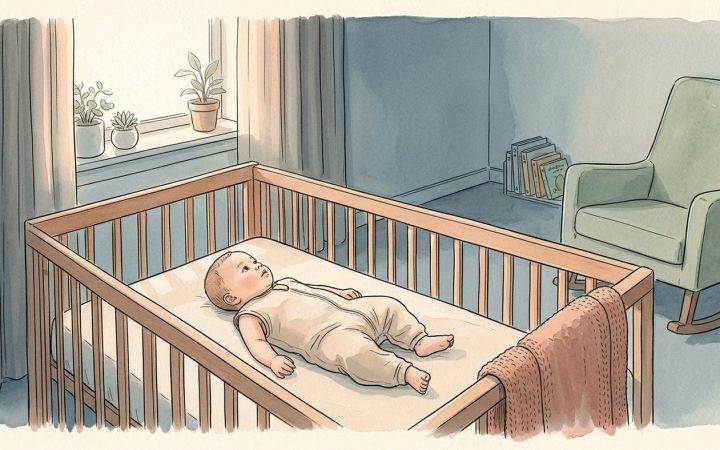
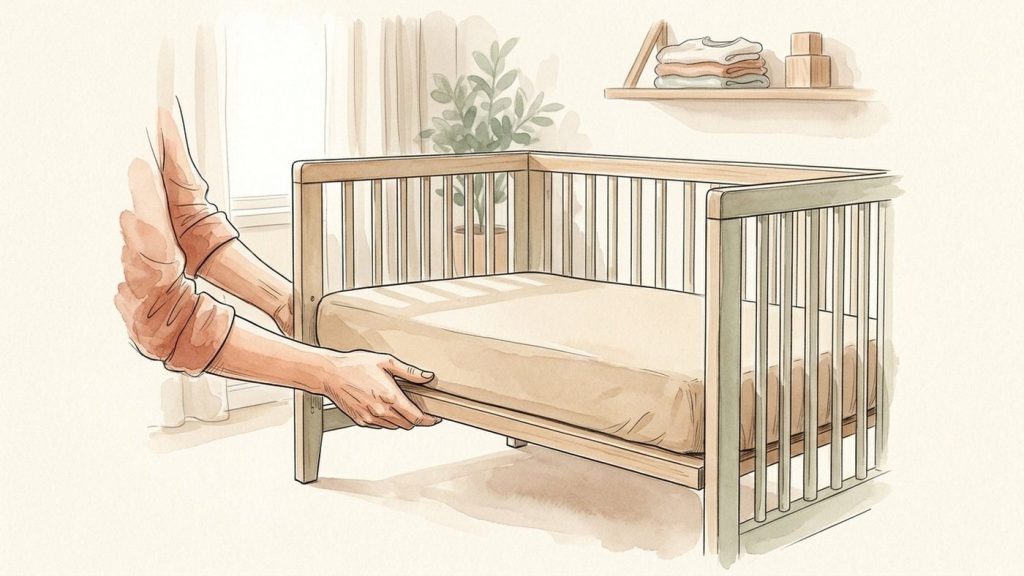
- Drop the mattress to the lowest setting. Injury researchers advise doing this as soon as a child can pull up or stand. The crib sides should be at least 26 inches (66 cm) above the mattress.
- Remove every foothold. Take out bumpers, pillows, large stuffed toys, and anything your child can stand on. The AAP’s safe sleep advice is to keep pillows, blankets, soft toys, and bumper pads out of the crib anyway.
- Check what’s outside the crib. Move the crib away from windows, blinds and cords, dressers, and shelves your child could reach or climb toward.
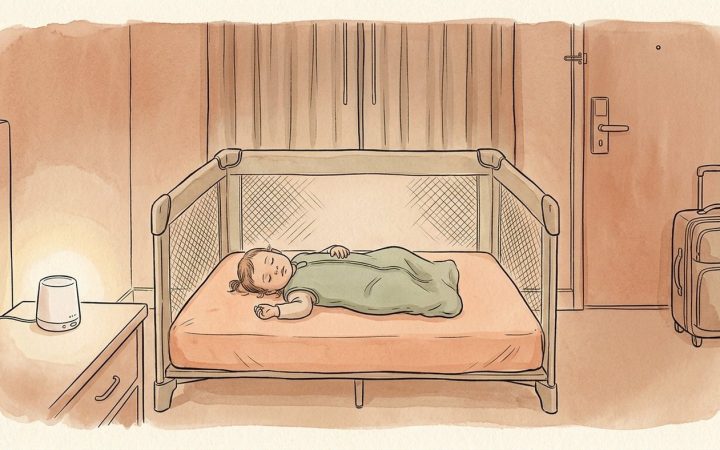
- Try a sleep sack. Many parents find a well-fitting, non-weighted sleep sack makes it harder to swing a leg over the rail. It’s a common tip rather than a tested one, and some toddlers climb in them anyway.
- Respond calmly and the same way every time. If you catch a climb, a short, flat “Feet stay down in your bed” and placing them back works better for many families than a big reaction, which can turn climbing into a game.
When is my toddler too big for a crib?
When they can climb out, are about 35 inches (89 cm) tall, or the top rail is below roughly three-quarters of their height, which is around chest level. Whichever comes first.
The 35-inch figure is widely attributed to the AAP by pediatric health systems such as UPMC. We couldn’t find it on a current AAP page ourselves, but the same cutoff appears in US crib instruction manuals, which typically warn that the crib should no longer be used once a child can climb out or reaches 35 inches, and the child should move to a youth or regular bed. Always check the label and manual for your own crib.
| Sign | What it means | What to do |
|---|---|---|
| Pulling up to stand | Climbing is coming | Lower the mattress to its lowest setting now |
| Hooking a leg over the rail | An escape is close | Remove footholds, try a sleep sack, start childproofing the room |
| One climb-out | Possible fluke | Check mattress height and footholds; watch closely |
| Climbing out regularly (for example weekly or more) | Crib is no longer containing them | Plan the move to a low bed |
| About 35 in (89 cm) tall, or rail at chest level | Crib outgrown by size | Move to a low bed even if they haven’t climbed out |
Age matters less than these signs. UPMC notes most children move to a bed between ages 2 and 3, and that a crib is still the best place for a child who isn’t ready. Our guide on when to move a toddler from crib to bed goes through readiness in more detail.
What the research says: the injury data is solid: falls are the leading cause of crib-related injuries in young children, and they rise with age. The 35-inch and three-quarters-height rules are practical safety thresholds built into crib warnings, not cutoffs tested in trials. And there’s no research comparing “keep them in the crib” tricks such as sleep sacks, so those rest on parent experience.
Free download
Free: safe sleep checklist and sleep log
Track naps and night wakings for a week and the pattern shows itself. Part of our free 7-page printables pack.
Are crib tents or rail extenders a safe fix?
No. Crib tents seem like an easy answer, but they’ve caused serious harm. In 2012, the US Consumer Product Safety Commission announced a recall of about 330,000 Tots in Mind crib and play yard tents after reports of 27 failures, including a child who died after becoming trapped between a tent and a play yard rail and another who suffered a severe brain injury. The CPSC warned that children could be strangled or trapped if the dome inverted or the tent partly detached.
The same logic applies to homemade fixes: don’t add straps, nets, or anything that ties your child into the crib, and don’t put bumpers or pillows in to “pad” the rail. These add strangulation and suffocation risks without solving the climbing. If your child is determined to climb, a lower sleep surface is the safer fix.
How do I make the room safe before switching to a bed?
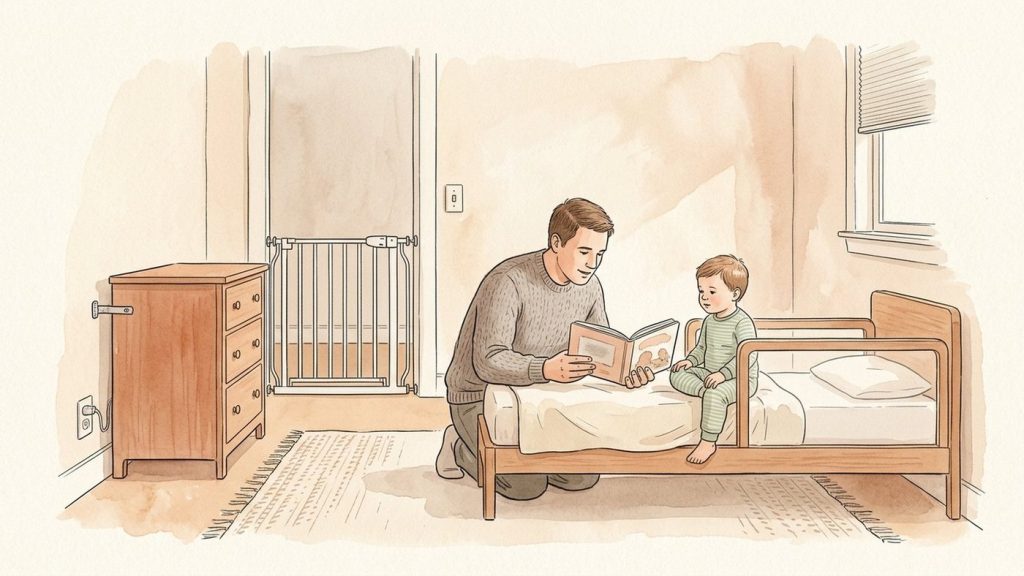
Treat the whole bedroom as a big crib, because once your child can get out of bed, it is. Children’s hospital and pediatric health system guidance lists these steps:
- Anchor furniture. Fasten dressers, bookcases, and TVs to the wall, and keep drawers shut or latched so they can’t be used as steps.
- Mind windows and cords. Keep the bed away from windows, and move or secure blind cords and electrical cords.
- Cover outlets and remove hazards. Medicines, cosmetics, button batteries, magnets, and small objects should be out of reach. See our babyproofing checklist by age.
- Gate the door or stairs. A safety gate at the bedroom door or top of the stairs keeps night wanderings contained.
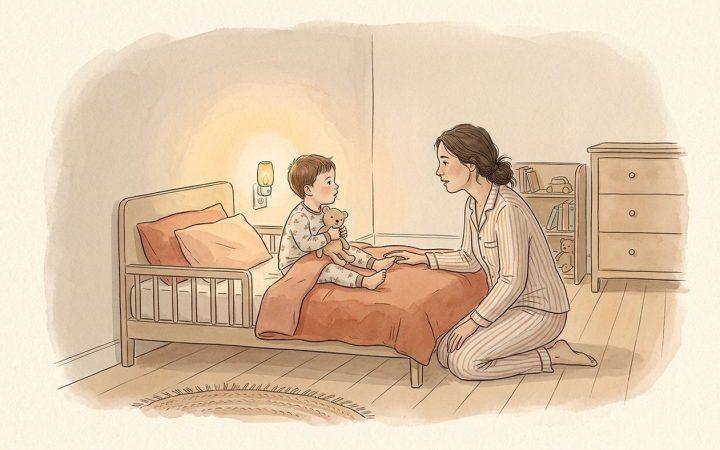
- Go low. Choose a low toddler bed, or put the crib mattress on the floor. Use a guard rail that fits snugly with no gaps, and avoid bunk beds and raised beds for young children.
- Keep the bed simple. If your child moves to a bed before age 2, keep bedding and toys to a minimum.
Expect an adjustment period. UPMC suggests about two weeks before a new bed feels normal. Keeping the same toddler bedtime routine and returning your child to bed calmly and briefly each time they get up helps. If the move happens close to other changes, such as a new sibling or the 2-year-old sleep regression, try to space them out by a few weeks.
Never put a climbing toddler to sleep in an adult bed with pillows and duvets as a stopgap, and never place the bed or crib under a window. If you’re using a crib mattress on the floor, make sure there’s no gap between it and the wall where your child could get wedged.
After a fall, call your local emergency number if your child:
- can’t be woken, has a seizure, or has trouble breathing
- was knocked out, even briefly, or isn’t moving their neck normally
Call your pediatrician right away if your child vomits repeatedly, is unusually sleepy or hard to wake, seems confused or not themselves, cries in a way you can’t settle, has weakness in an arm or leg, or has trouble walking. For a child under 2, the AAP suggests calling the pediatrician after any head injury that is more than a light bump.
Frequently asked questions
At what age do toddlers start climbing out of the crib?
There’s no fixed age. It depends on height, strength, and determination. Some children try in the first half of the second year, and others never do before moving to a bed.
Does a sleep sack stop climbing?
It may make climbing harder, and many parents swear by it, but it hasn’t been studied and some toddlers manage anyway. Use a non-weighted sack that fits well, and still lower the mattress.
My toddler climbed out once. Do I need a bed right away?
Not necessarily. Lower the mattress, remove footholds, and watch. If climbing becomes regular, or your child is about 35 inches tall, it’s time to plan the move.
Is it safe to put a crib mattress on the floor?
Yes, for a child who has outgrown the crib, as long as the room is childproofed and the mattress sits flush against the wall or well away from it, with no gaps. It removes the fall risk entirely.
Can I lock my toddler’s bedroom door?
Locking a child in isn’t recommended, because you need to reach them quickly in an emergency such as a fire. A safety gate in the doorway is a common alternative that keeps them in the room while leaving it open.
Sources
- Yeh ES, Rochette LM, McKenzie LB, Smith GA (2011). Injuries associated with cribs, playpens, and bassinets among young children in the US, 1990-2008. Pediatrics. pubmed.ncbi.nlm.nih.gov
- ScienceDaily / Nationwide Children’s Hospital (2011). Nearly 10,000 children injured in cribs, playpens and bassinets each year. sciencedaily.com
- UPMC HealthBeat (2026). When Should Your Child Move to a Toddler Bed? upmc.com
- Hawaii Pacific Health / StayWell (reviewed 2025). Moving Your Toddler From Crib to Bed. hawaiipacifichealth.org
- US Consumer Product Safety Commission (2012). Five Retailers Agree to Stop Sale and Recall Tots in Mind Crib Tents Due to Strangulation and Entrapment Hazards. cpsc.gov
- American Academy of Pediatrics, HealthyChildren.org. How to Keep Your Sleeping Baby Safe: AAP Policy Explained. healthychildren.org
- American Academy of Pediatrics, HealthyChildren.org. Head Injury: What to Do if Your Child Loses Consciousness. healthychildren.org
- American Academy of Pediatrics, HealthyChildren.org. Head Injury in Children: How to Know If It’s Minor or Serious. healthychildren.org