
Short answer: Start reading to your baby from birth. The American Academy of Pediatrics encourages shared reading beginning at birth, a few minutes at a time, ideally every day. In the early months, any book read in your voice works. From about 6 months, sturdy board and fabric books with bold pictures, faces, and everyday objects are easiest for little hands (and mouths).
Adam’s favorite book right now is a crinkly cloth book he mostly tries to eat. I keep reading to him anyway, and the research below is why.
Key takeaways
- It’s never too early. The AAP’s 2024 policy says shared reading should begin at birth, including in the NICU when possible.
- A few minutes counts. You don’t need to finish the book, and chewing on it is normal.
- Point, name, and pause. The talking you do around the pictures matters as much as the words on the page.
- Print books are best for little ones. The AAP says digital books don’t create the same back-and-forth.
When should I start reading to my baby?
Right from birth: newborns can’t follow a story, but they soak up your voice and the closeness.
In 2024, the AAP updated its literacy policy and asked pediatricians to “encourage shared reading beginning at birth and continuing at least through kindergarten.” The CDC’s tips for 2-month-olds say the same thing in everyday terms: talk, read, and sing to your baby. In the first weeks, the book is really a reason to hold your baby close and talk. Snuggles and the sound of you are the whole point.
The AAP’s 2024 policy specifically encourages reading to babies in the neonatal intensive care unit (NICU) when possible. If your baby starts life in the NICU, a book can be one of the ways you connect.
What should I read to my baby at each age?
Match the book to what your baby’s hands and eyes can do right now.
| Age | What your baby may do | Books to try |
|---|---|---|
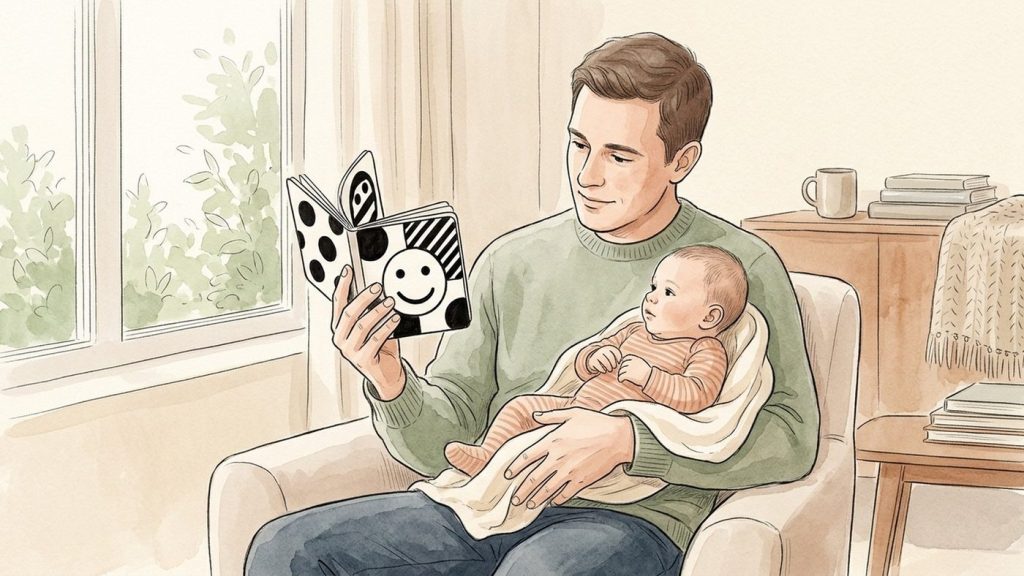
| Birth to 3 months | Listen to your voice, look at your face, snuggle | Anything you read aloud, plus simple rhymes and bold, high-contrast pictures |
| 3 to 6 months | Swipe at the book and bring it to their mouth | Sturdy board books and soft fabric books with different textures |
| 6 to 12 months | Sit up, grab at pages, chew on corners | Board and bath books with faces and everyday objects; books with mirrors, flaps, or textures |
| 12 to 18 months | Turn board pages (several at a time), point to pictures when you ask “Where is the…?”, carry books to you | Books with simple pictures to point at and sounds to make together |
| 18 months to 2 years | Name familiar pictures, finish lines in favorite books | Favorite books again and again; pause before the last word so they can fill it in |
These come from the AAP’s guides to sharing books and early literacy milestones. By 2 years, the CDC lists “Points to things in a book when you ask, like ‘Where is the bear?’” as a milestone, so you can see how much those early pointing games add up. For milestones in every area, see Baby milestones by month.
Why does reading to a baby matter?
Reading builds closeness and language at the same time, during a period when your baby’s brain is growing fast.
The AAP says shared reading helps build the foundation for social-emotional, cognitive, language, and literacy development, and fosters “loving, nurturing relationships during a critical time of brain development.” Books also give you new things to point at, name, and talk about together. For more on how talk builds language, see When do babies start talking?
What the research says: a 2020 review of 19 randomized trials (2,594 children aged about 1 to 6) found that book-sharing programs had small benefits for children’s language, both in the words they used and the words they understood. The biggest change was in parents’ own book-sharing skills. Programs with very little reading made little difference, and a 2019 review found smaller effects overall. So reading helps, modestly, and regular reading seems to matter.
How do I read to a baby who just wants to chew the book?
Let them. Mouthing books is normal and a sign of interest, so keep it short, follow their lead, and talk about the pictures.
- Get cozy. Hold your baby on your lap in a quiet spot where they can see the pages and your face.
- Point, name, and pause. “Look, a dog! Woof!” Then wait. A coo, a kick, or a slap at the page is your baby’s turn.
- Skip around. If your baby wants a different page, go there. You don’t have to read the words or finish the book.
- Use your voice. Different voices, animal sounds, and sing-song rhymes keep babies interested.
- Stop when they’re done. Looking away, arching their back, or fussing means it’s time for a break. The AAP’s advice: reading should be fun, not forced.
With my own baby, our best reading times are short: two or three board books after the bath, with plenty of chewed corners. Our book The First-Year Mind includes simple reading activities for every stage of the first year, from reading aloud on day one to lift-the-flap books near the first birthday.

Do e-books and reading apps count?
For babies and toddlers, the AAP recommends print books, because digital books don’t foster the same parent-child interaction.
The AAP’s 2024 policy emphasizes print books for young children, and its experts note that screens are “typically passive or solitary experiences.” If you do read from a screen sometimes, make it a shared, back-and-forth activity rather than something your baby watches alone. For the bigger picture, see Screen time for babies.
How long and how often should I read to my baby?
A few minutes at a time, every day, is a great goal.
The CDC’s tips for 6-month-olds suggest “reading” to your baby every day by looking at pictures and talking about them. The AAP notes that babies around 6 to 11 months usually pay attention to a book for just a few minutes at a time, so several mini-sessions work better than one long one. Many families tie reading to bedtime, which the AAP suggests as a way to connect and wind down.
- Your baby doesn’t seem to react to your voice or to sounds
- By 2 years, your child doesn’t point to things in a book when you ask
- Your child has lost words or skills they used to have, or you’re worried for any reason
Frequently asked questions
Is it too late to start reading if my baby is already 6 months old?
Not at all. The AAP recommends shared reading from birth through at least kindergarten, so any day is a good day to start.
Does it matter what I read to a newborn?
Not much. Newborns benefit most from hearing your voice and snuggling with you, so your own novel read aloud works too. Simple rhymes and bold pictures become more fun as your baby starts to look and reach.
My baby won’t sit still for a book. Is that OK?
Yes. Babies have short attention spans. Read for a minute, let them crawl off, and try again later. Following their lead keeps reading something they enjoy.
Should I read in my home language?
Yes. The AAP suggests using the language or languages you’re most comfortable with. Warm, expressive reading in any language helps.
Sources
- Klass P, et al. (2024). Literacy promotion: an essential component of primary care pediatric practice. Pediatrics. doi.org
- American Academy of Pediatrics (2024). Beyond literacy: shared reading starting in infancy offers lifelong benefits. HealthyChildren.org. healthychildren.org
- American Academy of Pediatrics. How to share books with your baby. HealthyChildren.org. healthychildren.org
- American Academy of Pediatrics. Developmental milestones of early literacy. HealthyChildren.org. healthychildren.org
- Dowdall N, Melendez-Torres GJ, Murray L, Gardner F, Hartford L, Cooper PJ (2020). Shared picture book reading interventions for child language development: a systematic review and meta-analysis. Child Development, 91(2), e383–e399. doi.org
- Noble C, Sala G, Peter M, et al. (2019). The impact of shared book reading on children’s language skills: a meta-analysis. Educational Research Review. hope.ac.uk
- CDC. Learn the Signs. Act Early.: milestones by 2 months and 6 months. cdc.gov
- CDC. Learn the Signs. Act Early.: milestones by 2 years. cdc.gov
- American Academy of Pediatrics. Young children learning multiple languages: parent FAQs. HealthyChildren.org. healthychildren.org