Short answer: Most babies who crawl start between about 7 and 10 months, according to the American Academy of Pediatrics, but healthy babies can start anywhere from about 5 to 13 months. Some never crawl at all, which is one reason the CDC no longer lists crawling as a milestone.
Adam has figured out how to scoot backward on his tummy but not forward, which frustrates him a lot. That’s what sent me to the research on crawling.
Key takeaways
- The AAP says crawling is usually mastered between 7 and 10 months.
- In a WHO study of 816 children in 5 countries, hands-and-knees crawling started anywhere from 5.2 to 13.5 months, and 4.3% of children never crawled on hands and knees.
- Scooting, rolling, and belly-slithering all count as getting around. What matters more is that your baby uses both sides of their body.
- The CDC’s 9- and 12-month milestones focus on sitting, pulling up to stand, and walking while holding on to furniture.
When do babies start crawling?
Usually between 7 and 10 months, though the normal range is wider than most parents expect.
The AAP describes crawling as “a skill usually mastered between seven and ten months.” The best data on the full range comes from the World Health Organization’s Motor Development Study, which followed 816 healthy children in Ghana, India, Norway, Oman, and the United States. Trained fieldworkers checked them at regular visits and recorded when each skill appeared.
| What we know | Age or figure | Source |
|---|---|---|
| When most babies master crawling | 7 to 10 months | AAP (HealthyChildren.org) |
| Normal window for hands-and-knees crawling | 5.2 to 13.5 months | WHO Motor Development Study |
| Children who never crawled on hands and knees | 4.3% | WHO Motor Development Study |
| CDC milestone at 9 months | “Sits without support” | CDC |
| CDC milestones at 12 months | “Pulls up to stand”; “Walks, holding on to furniture” | CDC |
The WHO window runs from the 1st to the 99th percentile, so it describes the range seen in healthy children. A baby who starts at 6 months and one who starts at 12 months can both be right on track.
What are the signs a baby is getting ready to crawl?
Pushing up on straight arms, sitting steadily, and rocking on hands and knees are the usual warm-ups.
By 6 months, the CDC lists “Pushes up with straight arms when on tummy” and “Rolls from tummy to back.” Later, the AAP notes, many babies rock on their hands and knees for a while. Because their arms are stronger than their legs, some push themselves backward before they go forward. That’s normal, even if it’s a little frustrating for them.
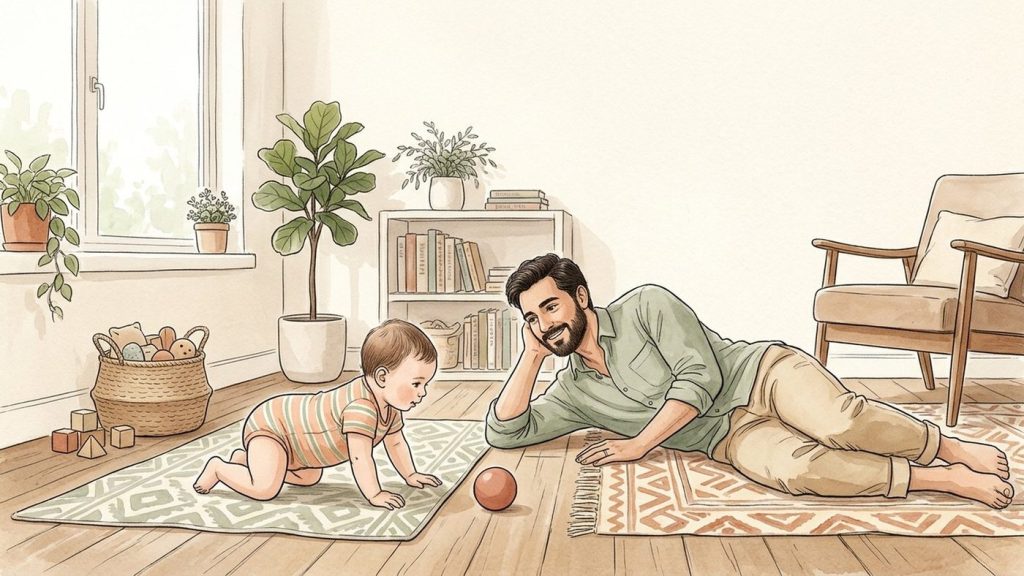
Babies often crawl backward first. Their arms are stronger than their legs, so pushing off with their hands sends them in reverse, sometimes right under the sofa.
Why did the CDC drop crawling as a milestone?
Because crawling is too variable to be a useful check-in point: it starts at very different ages, looks different from baby to baby, and some healthy babies skip it.
When the CDC and AAP rewrote the milestone checklists in 2022, they placed each milestone at the age when at least 75% of children can do it, and they kept only skills that parents can observe and answer with a clear yes or not yet. Crawling didn’t fit well. A 2022 article for physical therapists explained the reasons given by the CDC team: a lack of normative data, inconsistent definitions of crawling, variable timing, and no evidence that all typically developing children crawl.
The same authors pointed out that, unlike sitting, reaching, and walking, crawling is a passing phase rather than a skill we use for life. That doesn’t make it unimportant. It just means a baby who skips it isn’t automatically behind. See the full list in Baby milestones by month.
What the research says: the age range for crawling comes from a large, carefully run WHO study with trained observers in 5 countries, which is good evidence. The reasons for dropping crawling are well documented but rest partly on expert judgment, and some therapists worry crawling may now get less attention. Nobody is saying crawling is bad, only that it isn’t a reliable yardstick.
Is it OK if my baby skips crawling?
Usually, yes, as long as your baby is finding a way to move and uses both sides of their body.
The AAP says “A few children never crawl,” and instead scoot on their bottoms or slither on their stomachs. In its words: “As long as your baby is coordinating each side of her body and using each arm and leg equally, there’s no cause for concern.” Many of these babies go on to pull up, cruise along furniture, and walk on the usual timeline. The CDC’s 15-month milestone is “Takes a few steps on his own.”
How can I help my baby learn to crawl?
Give lots of safe floor time and a reason to move; you can’t teach crawling, but you can invite it.
- Start with tummy time. It builds the neck, shoulder, and arm strength crawling depends on. Here’s how much tummy time a baby needs.
- Put a toy just out of reach. The CDC suggests this to encourage crawling, scooting, or rolling. Any way of getting there counts.
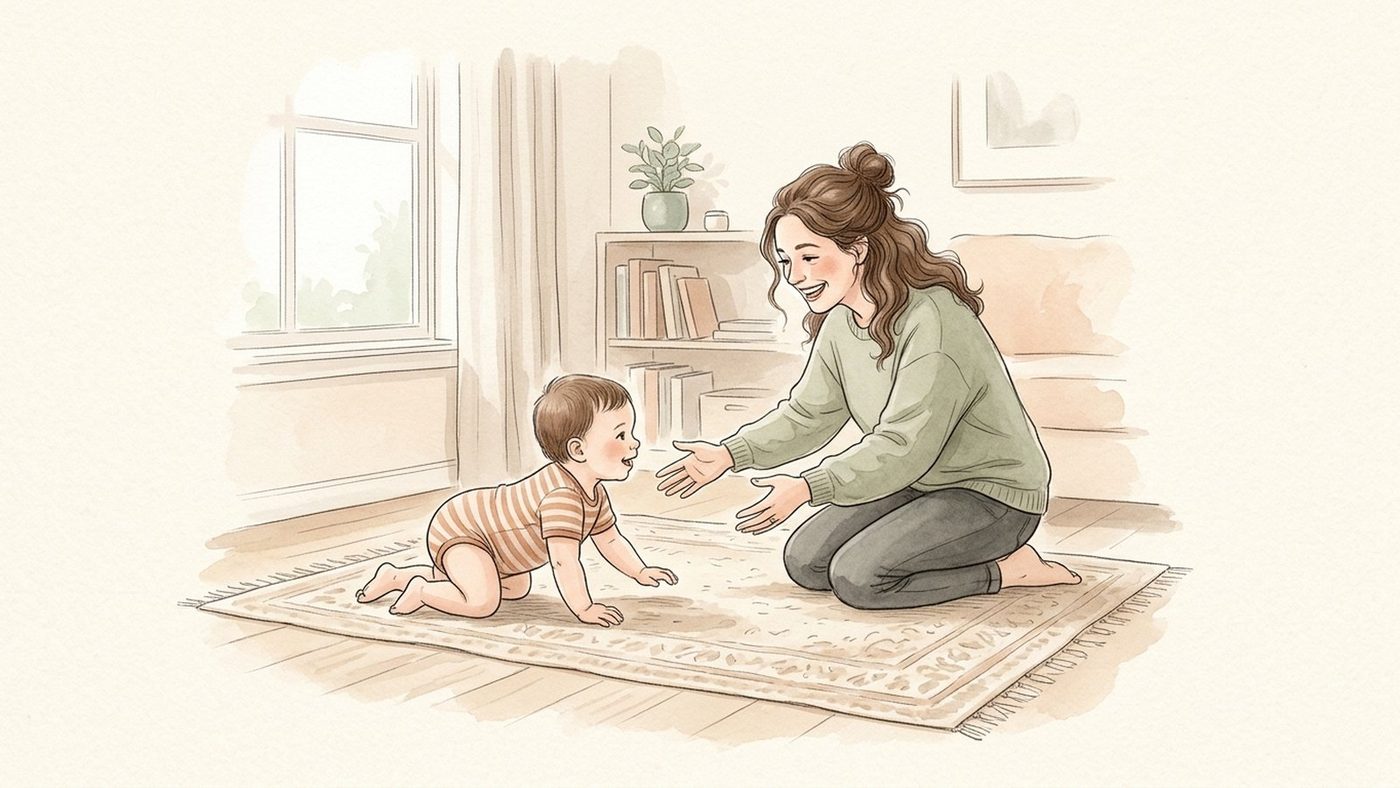
- Get on the floor together. Your face a few feet away is the best motivation there is.
- Limit time in containers. The CDC suggests not keeping babies for long stretches in swings, strollers, or bouncy seats, and the WHO suggests no more than 1 hour at a time strapped in.
- Skip the baby walker. The AAP says walkers don’t help babies learn to walk, and they cause serious falls. Read Are baby walkers safe?
If you’d like a plan for each stage, The First-Year Mind has 50 research-based activities, 10 per stage, including floor games that give babies a reason to move, plus printable CDC milestone checklists for 2 to 12 months.
Once your baby is on the move, babyproof at their level. The AAP advises sturdy gates at the top and bottom of stairs, kept closed at all times, and keeping small objects off the floor. Anchor furniture your baby might pull up on.

When should I talk to the doctor about crawling?
Not crawling on its own isn’t a concern, but talk to your doctor if your baby isn’t reaching the CDC’s movement milestones or moves in a lopsided way.
- By 9 months, your baby doesn’t sit without support
- By 12 months, your baby doesn’t pull up to stand or walk holding on to furniture
- Your baby favors one side, dragging one arm or leg, or seems very stiff or very floppy
- Your baby has lost a skill they had, or you simply feel something isn’t right
The CDC’s advice is to act early: talk with your doctor, ask about developmental screening, and if you’re still concerned, contact your state’s early intervention program at cdc.gov/FindEI. You don’t need a doctor’s referral.
Frequently asked questions
Is it normal for a baby to crawl backward?
Yes. The AAP notes that because babies’ arms are stronger than their legs, some push themselves backward before they move forward.
Does skipping crawling cause problems later?
There’s no good evidence that it does. The CDC team found no evidence that all typically developing children crawl, and the AAP says bottom-scooting or belly-slithering is fine as long as both sides of the body are used equally.
Can a baby walk without crawling first?
Yes. Some babies go straight from sitting to pulling up, cruising, and walking.
Is army crawling (on the belly) real crawling?
It’s a perfectly good way to get around. The AAP lists “slithering on their stomachs” among the normal alternatives to hands-and-knees crawling.
Sources
- American Academy of Pediatrics. Movement: 8 to 12 months. HealthyChildren.org. healthychildren.org
- WHO Multicentre Growth Reference Study Group; Martorell R, et al. (2006). WHO Motor Development Study: windows of achievement for six gross motor development milestones. Acta Paediatrica Supplement 450, 86–95. Tables at who.int
- Kretch KS, Willett SL, Hsu LY, et al. (2022). “Learn the Signs. Act Early.”: updates and implications for physical therapists. Pediatric Physical Therapy, 34(4), 440–448. pmc.ncbi.nlm.nih.gov
- Zubler JM, Wiggins LD, Macias MM, et al. (2022). Evidence-informed milestones for developmental surveillance tools. Pediatrics, 149(3), e2021052138. doi.org
- CDC. Learn the Signs. Act Early.: milestones by 6, 9, 12, and 15 months. 6 months, 9 months, 1 year, 15 months
- World Health Organization (2019). Guidelines on physical activity, sedentary behaviour and sleep for children under 5 years of age. who.int