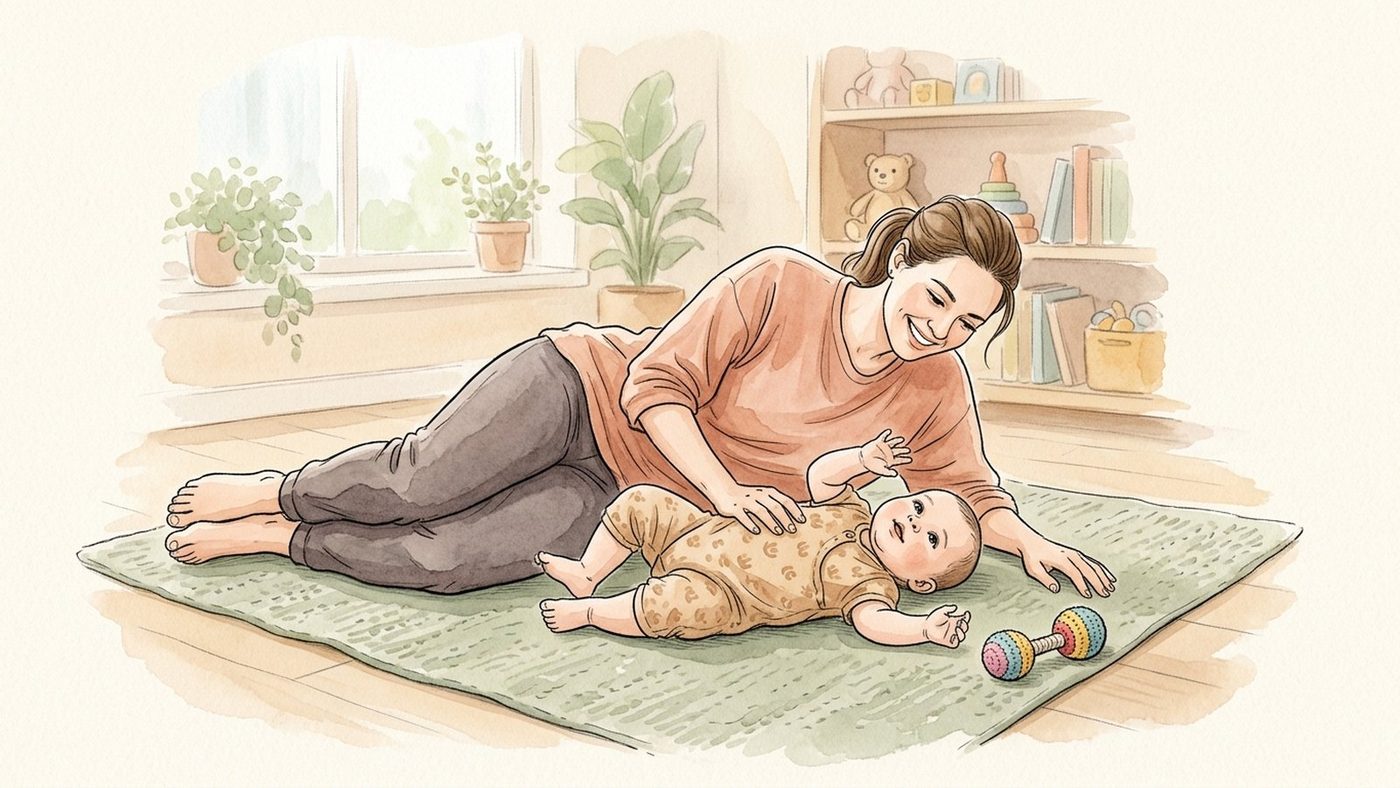
Short answer: Many babies roll for the first time between about 4 and 6 months, and the CDC’s milestone checklist lists “rolls from tummy to back” as something most babies do by 6 months. So if your 6-month-old isn’t rolling yet, mention it to your pediatrician, but it’s often not a sign of a problem, especially if your baby is pushing up on straight arms during tummy time, using both sides of the body equally, and making progress. Talk to your doctor sooner if your baby seems very floppy or stiff, favors one side, or has lost skills.
Key takeaways
- Typical window: the AAP says rolling usually develops around 5 months, and most babies roll both ways by 7 months.
- CDC checkpoint: “rolls from tummy to back” is on the 6-month checklist, which shows what at least 75% of babies can do.
- Look at the whole picture: pushing up on straight arms, reaching, and leaning on hands to sit all matter.
- Common reasons for later rolling: less tummy time, a bigger baby, premature birth, or simply temperament.
- Act early: raise it at your next visit, or sooner if there are red flags. Early intervention evaluations are free in the US.
Is it normal for a baby not to roll over at 6 months?
It can be, but it’s worth raising with your pediatrician. The CDC’s “Learn the Signs. Act Early.” checklist for 6 months includes rolling from tummy to back, along with pushing up with straight arms on the tummy and leaning on hands to support themselves when sitting. These checklists were updated in 2022 to show milestones that 75% or more of babies reach by that age. That means up to a quarter of healthy babies haven’t hit a given milestone yet, and missing one is a reason to check in, not a diagnosis.
The AAP’s HealthyChildren site says the skills needed for rolling usually appear at about 5 months, that by the end of the 4 to 7 month period babies will probably be able to roll in both directions, and that the time frame varies between babies. Most babies roll from tummy to back first, but going back to tummy first is normal too.
Here’s how rolling fits with the movement milestones around it, based on the CDC checklists:
| By about | Most babies (CDC) | What it builds toward |
|---|---|---|
| 4 months | Holds head steady when held; pushes up onto elbows or forearms on tummy; brings hands to mouth; swings at toys | Neck, shoulder, and core strength for rolling |
| 6 months | Rolls from tummy to back; pushes up with straight arms on tummy; leans on hands to support themselves when sitting | Rolling both ways, sitting |
| 9 months | Sits without support; gets to a sitting position alone | Crawling and pulling up |
For the full picture, see baby milestones by month. If your baby is pushing up strongly and sitting with support, a late roll is usually less concerning than if they’re behind on several of these at once.
Why isn’t my baby rolling over yet?
Often for ordinary reasons. Rolling depends on strength, practice, body shape, and motivation, and these vary a lot between babies:
- Not much floor time. Babies learn to roll on a flat, firm surface. Time spent in car seats, bouncers, swings, and loungers doesn’t give them that practice. See container baby syndrome.
- Not enough tummy time. Tummy time builds the neck, shoulder, and arm strength that rolling needs. Some babies dislike it, so they get less of it.
- Body size. Many parents and therapists notice that bigger or heavier babies sometimes roll a little later, simply because there’s more to move, though this hasn’t been well studied.
- Born early. Pediatricians usually judge milestones by corrected age (age counted from the due date) for babies born prematurely. A 6-month-old born 6 weeks early is closer to 4.5 months developmentally.
- Temperament. Some babies are content watching the world from their backs and have little reason to move.
- Swaddling or bulky clothing. A baby who is still swaddled for sleep, or dressed in thick layers for play, has fewer chances to practice.
Less often, late rolling can be one sign of a muscle tone or neurological issue. That’s why your pediatrician will look at how your baby moves overall, not just whether they roll.
How can I help my baby learn to roll?
Give them lots of supervised floor time and a reason to move. These play ideas are widely used by pediatric physical therapists. They’re low-risk and fun, though there’s little formal research on any single technique:
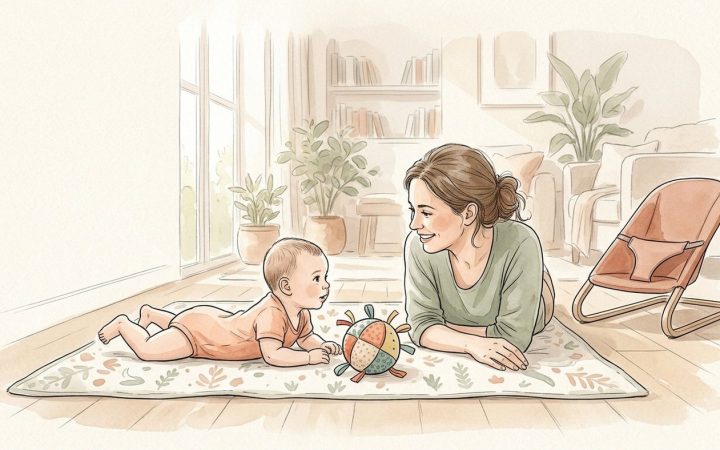
- Do tummy time several times a day. Short, frequent sessions while your baby is awake and supervised. Our guide to how much tummy time a baby needs has the targets by age.
- Use a firm, flat surface. A play mat or blanket on the floor, not a soft bed or sofa.
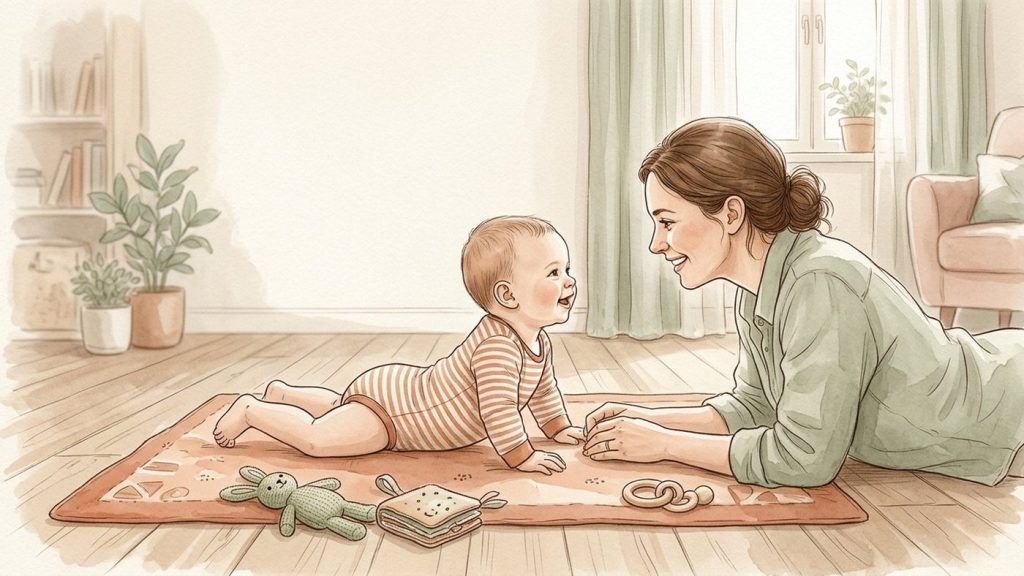
- Put toys just out of reach to the side. Reaching across the body shifts weight and can tip a baby over.
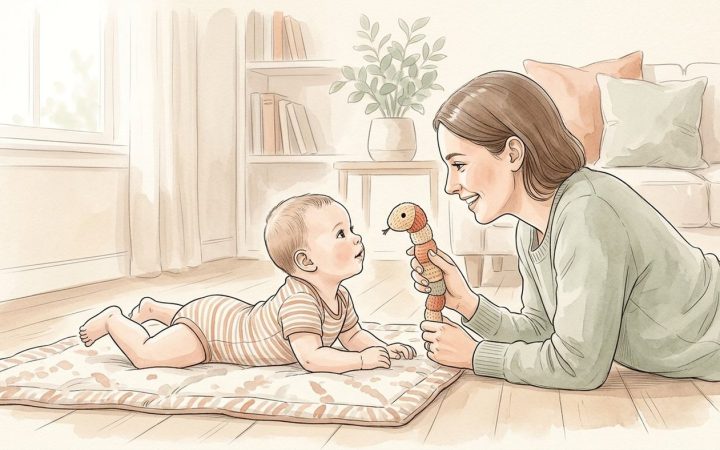
- Get down at their level. Lie beside your baby and encourage them to turn toward your face or voice. Switch sides so they practice both ways.
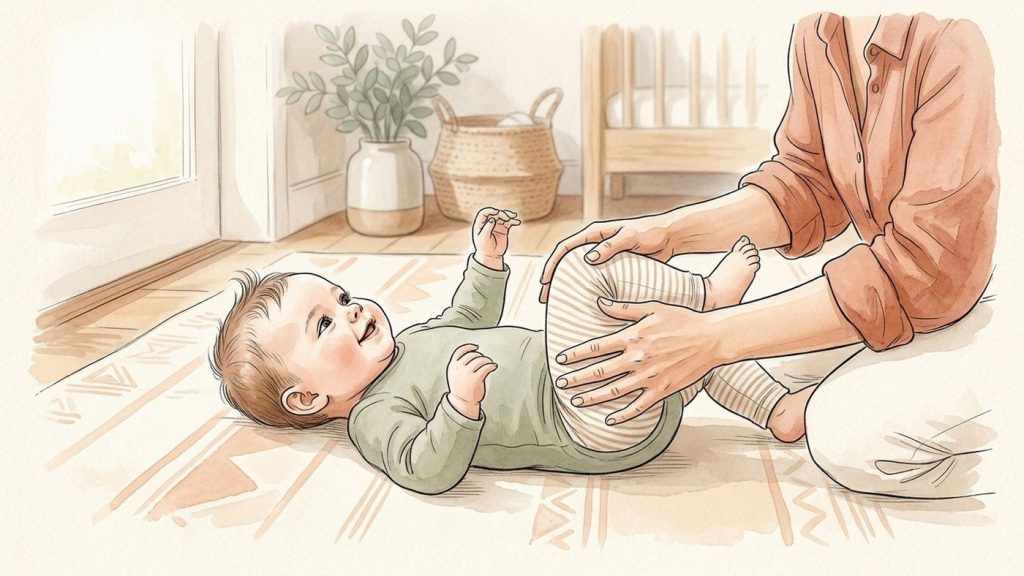
- Help them through the motion. From the back, gently bend one knee and guide it across the body, letting your baby do as much of the work as possible.
- Dress for movement. Light clothes and bare feet give better grip and freedom.
- Cut back on “container” time. Use seats and bouncers mainly when you need your hands free, and move your baby to the floor when you can.
Rolling often surprises parents. Never leave your baby alone on a bed, sofa, or changing table, even if they’ve never rolled before. Stop swaddling as soon as your baby shows any signs of trying to roll (see when to stop swaddling), and always place them on their back to sleep in a bare crib. Once your baby can roll both ways on their own, the AAP says you don’t need to turn them back if they roll during sleep.
Free download
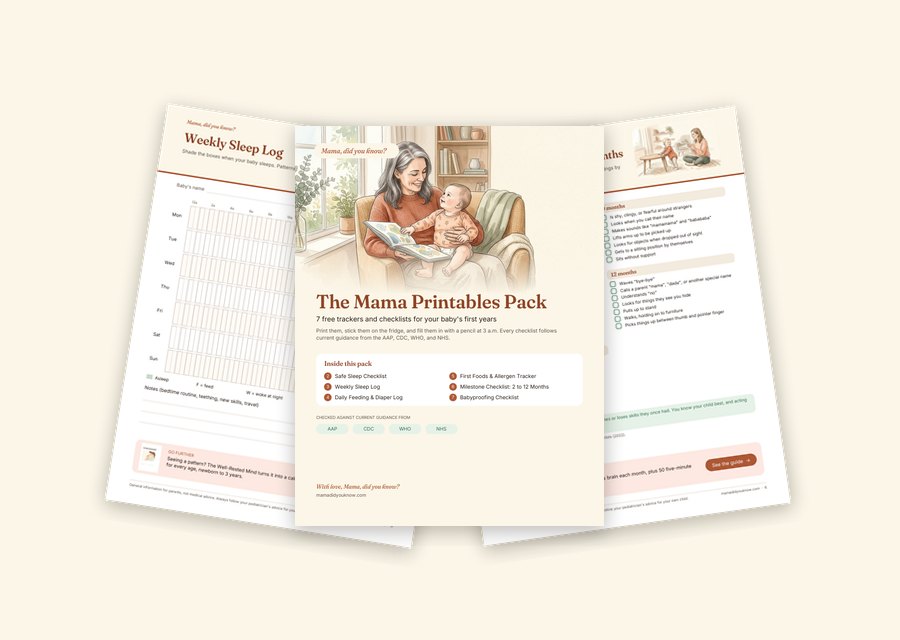
Free: milestone checklist, 2 to 12 months
The CDC milestones on one page, to tick off as your baby grows. Part of our free 7-page printables pack.
Do babies need to roll before crawling or sitting?
Not necessarily. Babies don’t always follow the milestones in textbook order. Some skip rolling as a main way of getting around and go straight to sitting, scooting, or crawling. What matters more is that your baby keeps gaining new movement skills and uses both sides of their body. See when do babies sit up and when do babies crawl for what comes next.
That said, the CDC’s guidance is clear that parents shouldn’t wait if they’re worried. Its message is that you know your child best, and that an early check costs little. If the doctor is still concerned after a screen, they may refer you to a specialist, or you can contact your state’s early intervention program directly, without a referral.
What the research says: the CDC milestones were revised in 2022 by an AAP expert group using available data, with the goal of listing skills that at least 75% of children show by each age. There’s less high-quality data on exactly when babies roll than on sitting or walking, which is why sources quote slightly different ages. The one point everyone agrees on is that the range of normal is wide.
Talk to your pediatrician if your baby:
- isn’t rolling in either direction by about 6 months (corrected age if born early), or isn’t rolling both ways by around 7 months
- can’t push up on their arms during tummy time, or has poor head control
- feels very floppy, or very stiff with tight arms and legs
- uses one side of the body much more than the other, or always turns their head the same way
- has lost skills they used to have. Tell your doctor right away.
Frequently asked questions
My baby rolls only one way. Is that OK?
Very common at first. Most babies roll tummy to back before back to tummy, or vice versa, and add the other direction within weeks. Mention it if your baby only ever rolls toward one side or seems to avoid using one side of the body.
My baby rolled once and hasn’t done it since. Does it count?
It shows they have the ability. Many babies roll once by accident and then take a while to do it on purpose. Keep offering floor time.
Does skipping rolling mean my baby will have problems later?
Not on its own. What matters is steady progress across movement skills. Your pediatrician can check muscle tone and overall development.
Should I use a corrected age for a premature baby?
Pediatricians usually do for babies born early, typically until about age 2. Ask your doctor which age to use when checking milestones.
My baby hates tummy time. What else can I do?
Try tummy time on your chest, across your lap, or for just a minute or two at a time, several times a day. Side-lying play on the floor also helps build rolling skills.
Sources
- Centers for Disease Control and Prevention. Milestones by 6 Months. cdc.gov
- Centers for Disease Control and Prevention. Milestones by 4 Months. cdc.gov
- Centers for Disease Control and Prevention. Milestones by 9 Months. cdc.gov
- American Academy of Pediatrics, HealthyChildren.org. Movement: Babies 4 to 7 Months. healthychildren.org
- Zubler JM, Wiggins LD, Macias MM, et al. (2022). Evidence-Informed Milestones for Developmental Surveillance Tools. Pediatrics 149(3):e2021052138. doi.org
- American Academy of Pediatrics, HealthyChildren.org. How to Keep Your Sleeping Baby Safe: AAP Policy Explained. healthychildren.org