Short answer: Most babies drop from three naps to two somewhere between about 6 and 9 months, and research following children’s nap patterns found that two naps a day is well established by 9 to 12 months. The signs are a third nap that’s hard to get or very short, and a bedtime that keeps drifting later. To make the switch, stretch the time awake a little at a time, and use an earlier bedtime for a week or two to cover the gap while your baby adjusts.
Key takeaways
- Typical timing: roughly 6 to 9 months, with two naps well established for most babies by 9 to 12 months.
- Main signs: refusing or fighting the third nap most days, short naps all round, and bedtime pushed late.
- How: lengthen wake windows by 10 to 15 minutes every few days, and move bedtime earlier while you adjust.
- Expect a bumpy week or two: some crankiness, short naps, or early waking is common during any nap change.
- Total sleep still matters: babies 4 to 12 months need about 12 to 16 hours in 24 hours, naps included.
When do babies go from 3 naps to 2?
Usually somewhere between 6 and 9 months, though it varies from baby to baby. There’s no official age for this from the American Academy of Pediatrics (AAP) or other health bodies, so the best guide is what studies of real children show.
The clearest data comes from a study by pediatrician Marc Weissbluth, who followed 172 children from 6 months to 7 years. He found that a pattern of two naps a day was well established by 9 to 12 months, and that the move to one afternoon nap came later, between 15 and 24 months. Babies in that study already varied at 6 months, and the number of naps a baby took at 6 months didn’t predict their later nap pattern.
So if your 6-month-old is ready to drop the third nap, or your 8-month-old still needs it, both are normal. What matters more is whether your baby is getting enough sleep overall. The American Academy of Sleep Medicine, in guidance endorsed by the AAP, recommends 12 to 16 hours per 24 hours for babies aged 4 to 12 months, including naps. Our baby sleep chart by age shows how that usually splits between day and night.
What are the signs my baby is ready to drop the third nap?
The key sign is that the third nap has become a fight most days for at least a week or two, not just once or twice. Look for a pattern like this:
| What you notice | What it can mean |
|---|---|
| Your baby plays, chats, or cries through the third nap instead of sleeping | They aren’t tired enough by late afternoon |
| The third nap only happens in the stroller or car, and is very short | It’s becoming a catnap that may no longer be needed |
| Bedtime keeps getting pushed to 8 or 9pm to fit the third nap in | The day has outgrown three naps |
| Your baby takes a long time to fall asleep at bedtime | Too much daytime sleep, too close to bed |
| Morning naps get short after the third nap went well | Sleep pressure is spread too thin across the day |
| Your baby happily stays awake 2.5 to 3 hours at a stretch | Longer wake windows, which make two naps possible |
A single bad nap day isn’t a sign. Teething, a cold, a new skill like sitting or crawling, or a busy day can all disrupt naps for a few days. Our guide to wake windows by age explains how awake time stretches as babies grow, which is what makes room for fewer naps.
How do I move my baby from 3 naps to 2?
Gradually, by pushing the naps a little later each few days until the third one is no longer needed. Nobody has studied the best way to do this, so these steps come from common practice. Adjust them to your baby:
- Keep morning wake-up time steady. A consistent start to the day anchors everything else.
- Stretch the first wake window. Every two or three days, push the first nap 10 to 15 minutes later.
- Stretch the second one too. As the morning nap moves later, the afternoon nap shifts later as well.
- Shrink, then drop, the third nap. If your baby still needs it, keep it to a short catnap, finishing well before bedtime. Once the two main naps sit around late morning and mid-afternoon, it usually falls away on its own.
- Bring bedtime earlier. On days without a third nap, move bedtime 30 to 60 minutes earlier than usual. This is the “early bedtime bridge,” and it stops the long late-afternoon stretch from leaving your baby overtired.
- Give it a week or two. Most babies settle into the new rhythm within a couple of weeks. Expect some days that look like the old schedule.
Some families switch more quickly, simply dropping the third nap and using an early bedtime from day one. That works for some babies, especially those who were already refusing the nap. There’s no evidence that one approach is better.
What the research says: observational studies, like Weissbluth’s cohort and a 2012 systematic review of normal sleep patterns, describe when babies tend to change nap patterns. But no trials compare ways of managing nap transitions, and wake-window lengths are clinical experience rather than tested rules. Treat any schedule as a starting point, not a prescription.

Free download
Free: safe sleep checklist and sleep log
Track naps and night wakings for a week and the pattern shows itself. Part of our free 7-page printables pack.
What does a 2-nap schedule look like?
Here’s one example for a baby who wakes at 7am. Your baby’s times may be different by half an hour or more, and that’s fine:
| Time | During the switch | Once settled on 2 naps |
|---|---|---|
| 7:00am | Wake, milk, breakfast | Wake, milk, breakfast |
| Morning nap | About 9:15–10:30am | About 9:30–11:00am |
| Afternoon nap | About 1:30–3:00pm | About 2:00–3:30pm |
| Third nap | Short catnap around 5pm, only if needed | None |
| Bedtime | About 6:30–7:00pm on no-catnap days | About 7:00–7:30pm |
Bedtimes as early as 6 or 6:30pm are completely fine while you adjust. An early bedtime doesn’t usually mean an earlier morning; an overtired baby is often the one who wakes at dawn. If early waking does start, see our post on a baby waking at 5am.
Why is my baby waking at night since dropping a nap?
Often because they’re a bit overtired while their body adjusts. Parents commonly report a few unsettled nights during any nap transition, such as more night waking, a long awake stretch in the middle of the night, or early mornings. These usually settle within a week or two once the new schedule fits.
- Waking an hour after bedtime: can happen when bedtime comes after a long wake window. Parents often call these “false starts.”
- Awake and happy for an hour or more at 2am: sometimes a sign of too much daytime sleep. See split nights.
- Night waking around 8 to 10 months: may line up with crawling, pulling up, and separation anxiety rather than the nap change.
Babies this age may also still need one or more night feeds, especially breastfed babies, so not every night waking is about the schedule.
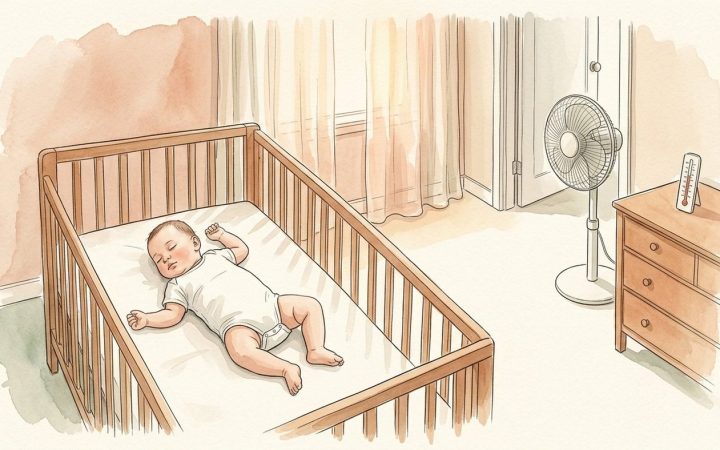
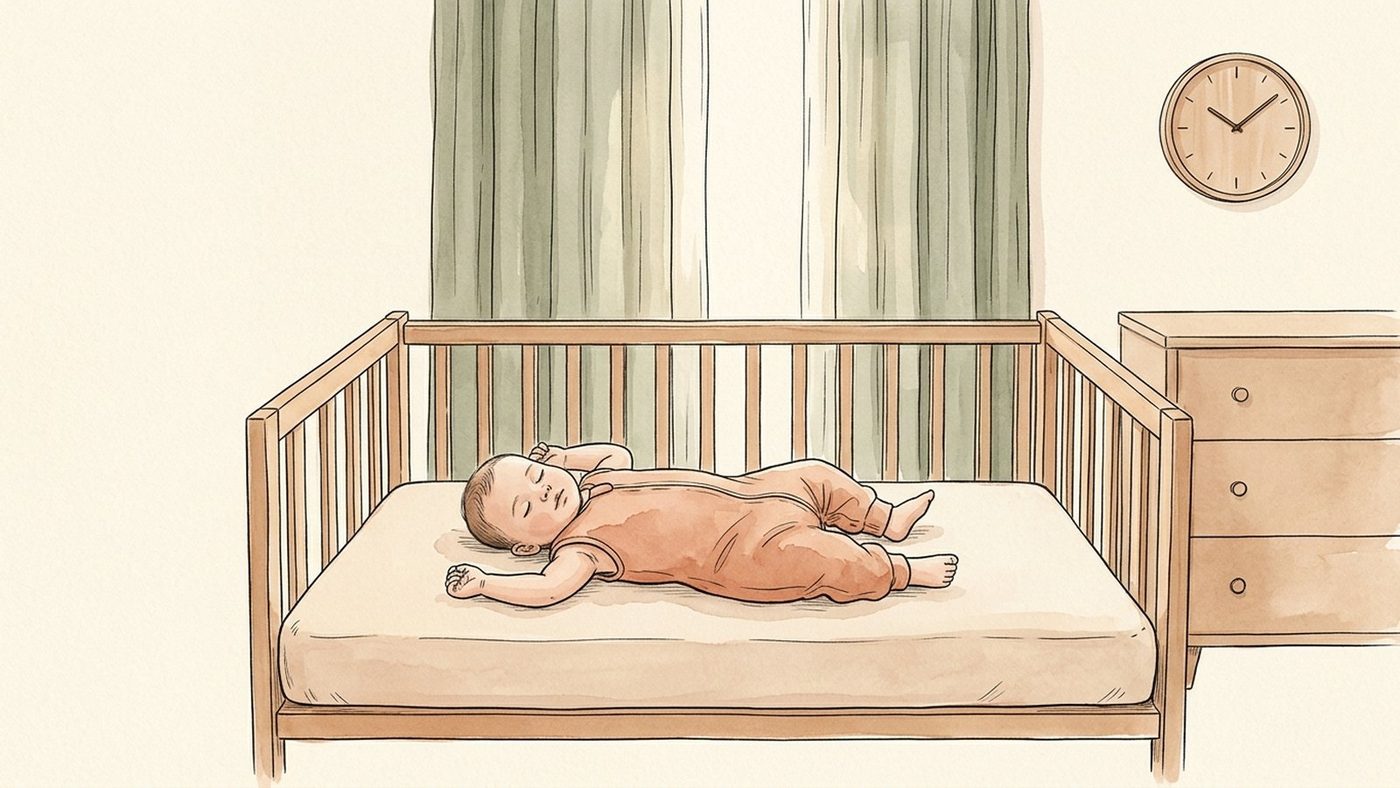
Whatever the schedule, every nap follows the same safe sleep rules as night sleep: on the back, in a crib or bassinet with a firm, flat mattress and only a fitted sheet, with no pillows, blankets, bumpers, or toys. If your baby falls asleep in the car seat, stroller, or swing during the transition, the AAP advises moving them to a firm, flat sleep surface as soon as possible. Our post on baby sleep in a swing or car seat explains why.
Talk to your pediatrician if your baby:
- seems very sleepy all the time, is hard to wake, or is much less alert than usual
- snores loudly most nights, pauses in breathing, or gasps during sleep
- is feeding poorly, has fewer wet diapers, or isn’t gaining weight
- has a fever or seems unwell, which can explain sudden nap changes
Frequently asked questions
Is 6 months too early to drop to 2 naps?
Not if your baby is clearly ready and getting enough total sleep. Some babies make the switch around 6 months; others keep a third catnap until 8 or 9 months.
How long should each nap be on 2 naps?
It varies. Many babies take two naps of about 1 to 2 hours each, but some do well with one longer nap and one shorter one. Look at your baby’s mood and total sleep rather than the clock.
Should I wake my baby from a nap during the transition?
Some parents cap a very late or very long afternoon nap to protect bedtime. It’s a reasonable tool, but there’s no research on it, so use it if it helps your baby rather than as a rule.
What if my baby needs 3 naps some days and 2 on others?
That’s very common during the switch. Offer the catnap on days when the naps were short, skip it on days they were long, and move bedtime earlier when there’s no third nap.
When will my baby go from 2 naps to 1?
Usually much later, in the second year. In Weissbluth’s study, children had settled into one afternoon nap somewhere between 15 and 24 months. Our post on the 12-month sleep regression and the 2-to-1 nap transition covers it.
Sources
- Weissbluth M (1995). Naps in children: 6 months–7 years. Sleep. pubmed.ncbi.nlm.nih.gov
- Paruthi S, et al. (2016). Recommended Amount of Sleep for Pediatric Populations: A Consensus Statement of the American Academy of Sleep Medicine. Journal of Clinical Sleep Medicine. pubmed.ncbi.nlm.nih.gov
- Galland BC, Taylor BJ, Elder DE, Herbison P (2012). Normal sleep patterns in infants and children: a systematic review of observational studies. Sleep Medicine Reviews. pubmed.ncbi.nlm.nih.gov
- Iglowstein I, Jenni OG, Molinari L, Largo RH (2003). Sleep duration from infancy to adolescence: reference values and generational trends. Pediatrics. pubmed.ncbi.nlm.nih.gov
- American Academy of Pediatrics, HealthyChildren.org. How to Keep Your Sleeping Baby Safe: AAP Policy Explained. healthychildren.org
- American Academy of Pediatrics, HealthyChildren.org. Healthy Sleep Habits: How Many Hours Does Your Child Need? healthychildren.org