
Short answer: A “split night” is when a baby or toddler wakes in the middle of the night and stays awake, often happily, for an hour or more before falling back asleep. It isn’t a medical term, but the usual explanation is low sleep pressure: too much daytime sleep, or a bedtime that’s too early, for the total sleep your child needs. Small changes to nap length and bedtime timing usually help within a week or two.
One night Adam woke at 2am in a perfectly cheerful mood and chatted to the ceiling for almost two hours. He wasn’t hungry or upset, just wide awake, and that sent me looking for an explanation.
Key takeaways
- What it looks like: a long, usually calm wake-up in the middle of the night, often lasting one to three hours.
- The likely cause: not enough “sleep pressure” left by the middle of the night, because the day had more sleep than your child needs.
- What helps: trimming or capping naps, protecting enough awake time before bed, a consistent bedtime, and keeping the night boring and dark.
- When to check with a doctor: loud snoring, pauses in breathing, gasping, or a child who seems unwell or in pain.
What is a split night in baby sleep?
A split night is a long middle-of-the-night wake-up where your baby seems wide awake and content rather than distressed. Parents usually describe it as a baby who goes to sleep fine at bedtime, wakes somewhere between midnight and 4am, then babbles, plays, or rolls around for an hour or more before finally falling asleep again.
It’s worth knowing that “split night” is a phrase from sleep consultants and parenting forums, not a diagnosis. The AAP, NHS, and other health bodies don’t define it. What they do describe is the sleep science underneath, and that’s what helps explain why it happens.
It’s also different from other common night wakings:
| Pattern | What it looks like | Common explanation |
|---|---|---|
| Split night | Awake and calm for 1–3 hours in the middle of the night | Too little sleep pressure left |
| False start | Wakes 30–60 minutes after bedtime | Often linked to nap timing or overtiredness |
| Early waking | Up for the day at 4–6am | Light early-morning sleep, light, or too-early bedtime |
| Hunger waking | Wakes, feeds, and settles back quickly | Still needs a night feed |
| Unwell or in pain | Upset, hard to settle, other symptoms | Illness, teething discomfort, or other cause |
Why is my baby awake for 2 hours in the middle of the night?
Most often because they’ve already had enough sleep for that 24-hour period. Sleep scientists describe sleep timing with what’s called the two-process model, first set out by Alexander Borbély in 1982. It has two parts:
- Sleep pressure (Process S). The drive to sleep builds the longer you’re awake and drains away while you sleep.
- The body clock (Process C). A roughly 24-hour circadian rhythm that makes sleep easier at some times than others.
When a baby has long naps, a late afternoon nap, or a very early bedtime, a lot of sleep pressure gets used up before or early in the night. By 2am there may not be enough left to carry them through. They wake, they feel rested, and they need a while awake to build the pressure back up before sleep comes again.
Total sleep is the other clue. The American Academy of Sleep Medicine, in guidance endorsed by the AAP, recommends 12 to 16 hours per 24 hours (naps included) for babies 4 to 12 months old, and 11 to 14 hours for children 1 to 2 years old. Those ranges are wide, and every child is different. If your baby’s naps plus night already add up to the top of their range, a split night may simply be their body saying “I’m done for now.”

Can naps cause split nights?
They can contribute, especially for toddlers. A 2015 systematic review of 26 studies in Archives of Disease in Childhood found that napping was linked to later sleep onset, shorter night sleep, and poorer night sleep quality, with the evidence strongest beyond age 2. For younger babies, naps are an important part of their total sleep, so the goal isn’t to cut them but to balance them.
Things that often line up with split nights:
- A nap transition on the way. Babies moving from three naps to two, or toddlers moving from two naps to one, often go through a phase where the old schedule is now too much daytime sleep. Our guide to the 3 to 2 nap transition covers the signs.
- A long or late last nap. A nap that ends close to bedtime leaves little time to build sleep pressure.
- A very early bedtime. If your baby goes down at 6pm and needs about 11 hours at night, waking around 2am or 5am isn’t surprising.
- Too little awake time before bed. Our guide to wake windows by age gives typical ranges.
What the research says: the two-process model of sleep is well established, and the link between napping and later or shorter night sleep has been shown in observational studies of young children. But there are no studies on “split nights” as a pattern, and no trials testing specific fixes. The advice below applies the general sleep science; it isn’t a proven protocol.
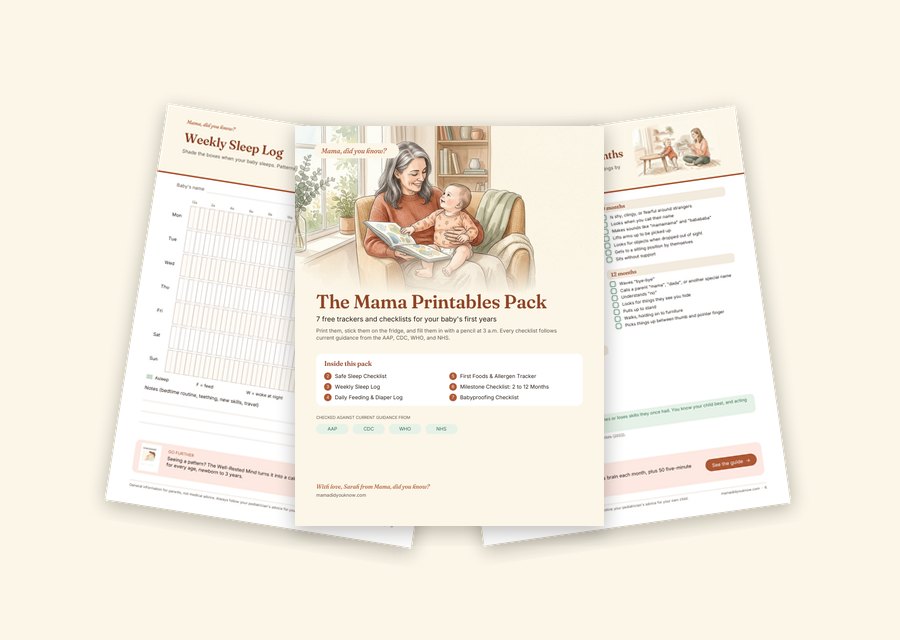
Free download
Free: safe sleep checklist and sleep log
Track naps and night wakings for a week and the pattern shows itself. Part of our free 7-page printables pack.
How do I fix split nights?
Rebalance the day so more of your child’s sleep need is left for the night. Change one thing at a time, and give each change about a week before judging it:
- Track for a few days. Write down nap start and end times, bedtime, the night waking, and morning wake-up. Add up the total. Patterns are much easier to see on paper.
- Trim the total daytime sleep a little. If naps add up to a lot, gently wake your baby from the longest nap a bit earlier, or shorten the last nap of the day.
- Protect the gap before bed. Leave enough awake time between the last nap and bedtime for your child’s age.
- Check the bedtime. If bedtime is very early and the night total is already long, try moving it 15 to 30 minutes later.
- Keep the morning wake-up steady. A consistent start to the day, with daylight soon after waking, helps anchor the body clock.
- Make the night boring. During the wake-up, keep lights off or very dim, voices low, and avoid play, screens, or bringing your baby into a bright room.
What should I do while my baby is awake at night?
Keep things calm, dark, and dull, and choose an approach you can repeat. There’s no single right answer here, and families handle it differently:
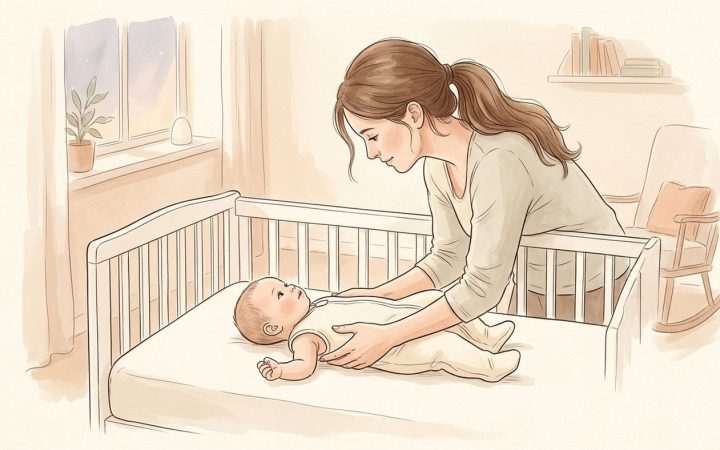
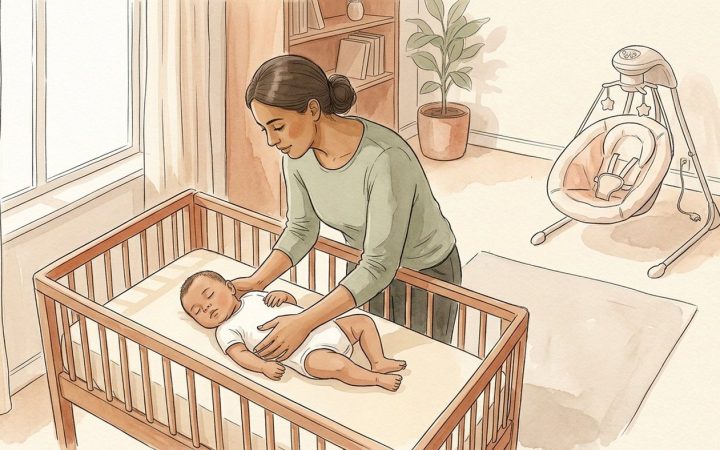
- If your baby is content in the crib, many parents simply let them babble, checking that they’re safe and on their back if they can’t yet roll both ways.
- If they’re upset, comfort them. Brief, quiet reassurance in the dark is a reasonable middle ground.
- If they may be hungry, feed them, especially younger babies. Keep it dim and calm.
If split nights keep happening even after you’ve adjusted the day, it may be worth looking at how your baby falls asleep at bedtime. Our post on whether sleep training works summarizes what the research says, without pressure either way.
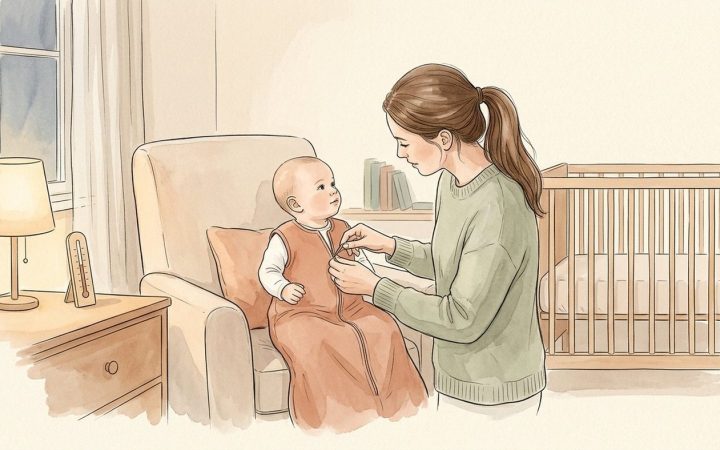
Long night wakings are exhausting, and that’s exactly when unsafe sleep can creep in. If you feed or comfort your baby at night, avoid doing it on a sofa or armchair where you might fall asleep with them. Put your baby back on their back in their own crib or bassinet, on a firm, flat surface with only a fitted sheet. The AAP recommends room-sharing, without bed-sharing, for at least the first 6 months.
Could split nights mean something is wrong?
Usually not, but it’s worth ruling out a few things. A child who wakes calm and happy is less likely to be in pain or unwell than one who wakes distressed. Teething, illness, and developmental leaps can all disrupt sleep for a few nights; our post on teething and baby sleep looks at how much teething really affects nights.
Sleep apnea is the main medical cause to know about. The AAP lists frequent snoring, breathing problems at night, daytime sleepiness, and behavior problems as possible signs in children. Young babies can have normal “periodic breathing,” with short pauses followed by quicker breaths, which the AAP says generally settles by about 6 months.
Talk to your pediatrician if:
- your child snores most nights, gasps or chokes in sleep, or seems to pause breathing
- night wakings come with pain, fever, ear pulling with illness, or a child who seems unwell
- your child seems very sleepy, irritable, or unlike themselves during the day
- you are struggling to cope with the lack of sleep
Call your local emergency number right away if your child stops breathing for more than 20 seconds or turns pale, blue, or gray.
Frequently asked questions
At what age do split nights happen?
Parents most often describe them from around 4 months into the toddler years, especially around nap transitions. There’s no research giving a typical age.
Are split nights caused by overtiredness or undertiredness?
Sleep consultants argue both ways. The sleep-pressure explanation points mostly to undertiredness, too much daytime sleep. A calm, happy wake-up fits that better than an upset one.
How long do split nights last?
Often they settle within a week or two of adjusting naps and bedtime. If they keep going, track sleep for a week and talk it through with your pediatrician.
Should I get my baby up when they’re awake for hours?
Most families find it helps to keep them in the dark, quiet sleep space rather than starting the day. Bright light and play tend to make it harder to fall back asleep.
Is it a sleep regression?
“Regression” isn’t a medical diagnosis either. A sudden change around a milestone can be part of it, but if the wakings are long and calm, check the daytime sleep total first.
Sources
- Borbély AA (1982). A two process model of sleep regulation. Human Neurobiology. pubmed.ncbi.nlm.nih.gov
- Paruthi S, Brooks LJ, D’Ambrosio C, et al. (2016). Recommended Amount of Sleep for Pediatric Populations: A Consensus Statement of the American Academy of Sleep Medicine. Journal of Clinical Sleep Medicine. pmc.ncbi.nlm.nih.gov
- Thorpe K, Staton S, Sawyer E, et al. (2015). Napping, development and health from 0 to 5 years: a systematic review. Archives of Disease in Childhood. adc.bmj.com
- American Academy of Pediatrics, HealthyChildren.org. Sleep Apnea in Children: Detection and Treatment. healthychildren.org
- American Academy of Pediatrics, HealthyChildren.org. How to Keep Your Sleeping Baby Safe: AAP Policy Explained. healthychildren.org
- Moon RY, Carlin RF, Hand I, et al. (2022). Sleep-Related Infant Deaths: Updated 2022 Recommendations for Reducing Infant Deaths in the Sleep Environment. Pediatrics. pubmed.ncbi.nlm.nih.gov