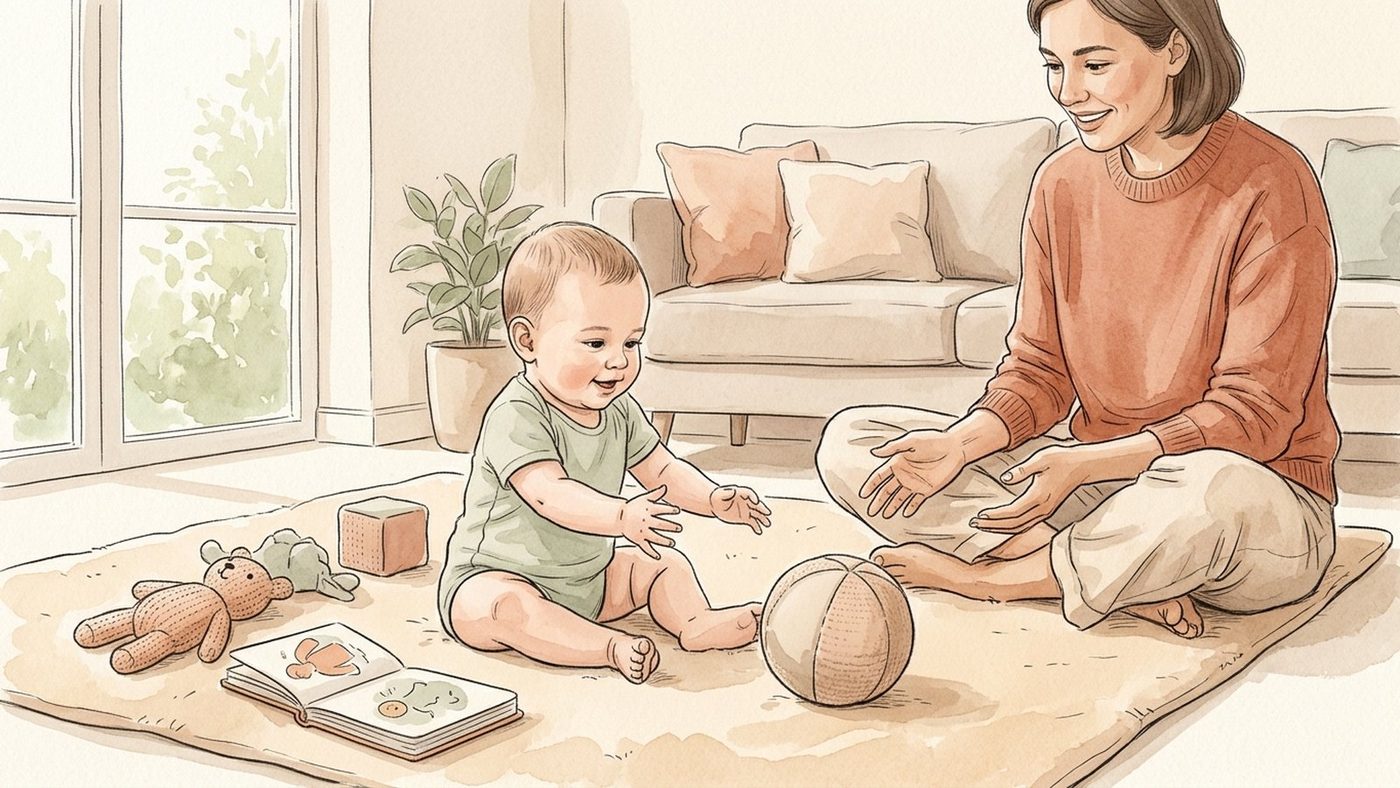
Short answer: Most babies sit up on their own at around 6 months, and in a large WHO study, healthy babies started sitting without support anywhere from about 3.8 to 9.2 months. By 9 months, the CDC expects babies to sit without support and to get into a sitting position by themselves.
Adam’s first wobbly tries at sitting on his own ended in gentle topples onto a cushion, and then a big grin. Here’s what to expect, and how to help.
Key takeaways
- Sitting comes in stages: held or propped, then tripod sitting (leaning forward on both hands), then sitting hands-free, and finally getting into sitting alone.
- In the WHO Motor Development Study, half of the babies sat without support by 5.9 months, 90% by 7.5 months, and 99% by 9.2 months.
- Head control and tummy time come first. Sitting is built on the floor, not in a seat.
- Never put an infant floor seat on a table, counter, or chair. The CPSC has reported skull fractures in babies who fell from them.
- If your baby isn’t sitting by themselves by 9 months, the AAP says to let your pediatrician know.
When do babies sit up on their own?
Usually around 6 months, with a healthy range from roughly 4 to 9 months.
The best numbers come from the World Health Organization’s Motor Development Study, part of its Multicentre Growth Reference Study. Trained fieldworkers followed 816 healthy children in Ghana, India, Norway, Oman, and the United States and recorded when each motor skill first appeared. To count as “sitting without support,” a baby had to sit up straight, head upright, for at least 10 seconds without using their arms or hands for balance.
Sitting had the narrowest window of the six skills tracked: from 3.8 months (1st percentile) to 9.2 months (99th percentile), with a median of 5.9 months.
The American Academy of Pediatrics puts it in everyday terms: by six to eight months, if you place your baby upright, they’ll stay sitting without leaning forward on their arms. The CDC’s milestone checklists, revised in 2022, list “Sits without support” at 9 months. That’s later than the average on purpose: since 2022, each CDC milestone sits at the age when at least 75% of children can do it, so a missed milestone is a clear reason to check in.
What the research says: the age range for sitting comes from a large WHO study with trained observers and standard definitions in 5 countries, and it lines up with the AAP’s guidance and the CDC’s evidence-informed checklists. The window describes typical development in healthy children, not a deadline.
What are the stages of sitting up?
Babies go from sitting with your help, to propping themselves on their hands, to sitting hands-free, to getting into and out of sitting on their own.
- Sitting with support. Your baby sits when you hold them or support their back. By 4 months, the CDC expects babies to hold their head steady without support while you’re holding them, which is the first building block.
- Tripod sitting. The AAP describes babies learning to “tripod”: leaning forward with both arms out in front to balance. The CDC’s 6-month checklist includes “Leans on hands to support herself when sitting.”
- Sitting without support. The hands come off the floor and your baby stays upright, at first for a few wobbly seconds, then for longer. Toppling over is part of the learning.
- Getting into sitting alone. Later, babies figure out how to push up from their tummy or side into a sit. The CDC lists “Gets to a sitting position by herself” at 9 months.

| Age | What you might see | Source |
|---|---|---|
| 4 months | “Holds head steady without support when you are holding him” | CDC |
| 4 to 7 months | Practices sitting with support, then learns to “tripod” on both hands | AAP |
| 6 months | “Leans on hands to support herself when sitting” | CDC |
| 5.9 months | Half of babies sit without support | WHO Motor Development Study |
| 6 to 8 months | Stays sitting without leaning on arms when placed upright | AAP |
| 7.5 months | 9 in 10 babies sit without support | WHO Motor Development Study |
| 9 months | “Sits without support”; “Gets to a sitting position by herself” | CDC |
| 9.2 months | 99% of babies sit without support | WHO Motor Development Study |
A baby who sits steadily at 5 months and one who gets there at 8 months can both be right on track. For the full picture of each checkup age, see Baby milestones by month.
Before 2022, the CDC’s 6-month checklist said “Begins to sit without support.” The revised checklist changed it to “Leans on hands to support herself when sitting,” and kept sitting without support at 9 months, so fewer healthy 6-month-olds get flagged as behind.
What helps a baby learn to sit up?
Strong head and neck control, upper-body strength from tummy time, and lots of practice on the floor.
The AAP describes the order of things: first babies lift and hold up their head while lying on their stomach, then they push up on their arms, and once they can raise their chest, they’re ready to practice sitting. Each step builds the neck, shoulder, back, and tummy muscles that keep a baby upright.
That’s why tummy time matters so much. The WHO recommends that babies who aren’t yet mobile get at least 30 minutes on their tummy, spread through the day while awake, as part of plenty of interactive floor-based play. If tummy time is a struggle at your house, here’s how much tummy time a baby needs and how to make it easier.
How can I help my baby sit up?
Give your baby daily floor time, a little support while they practice, and something interesting to reach for.
- Get on the floor every day. The CDC says playing on the floor or a play mat every day helps babies move, learn, and explore. Use a firm surface like a play mat or carpet, not a bed or cushion.
- Hold your baby up while they sit. The CDC suggests this at 6 months, with toys to look at so your baby can practice balancing. One NHS physiotherapy service suggests sitting your baby between your legs, facing away from you, with their hands resting on your knees.
- Prop safely, and stay right there. The AAP suggests supporting your baby’s back with pillows as they learn to balance. Do this on the floor, only while you’re beside them and they’re awake, and take the pillows away once practice is over.
- Put a toy in front, then a little farther. The AAP notes that interesting toys in front of a tripod-sitting baby give them a focus as they find their balance. Once they’re steadier, place toys just out of reach so they lean, reach, and recover.
- Keep sessions short and happy. A few minutes at a time is plenty. Stop when your baby gets tired or fussy.
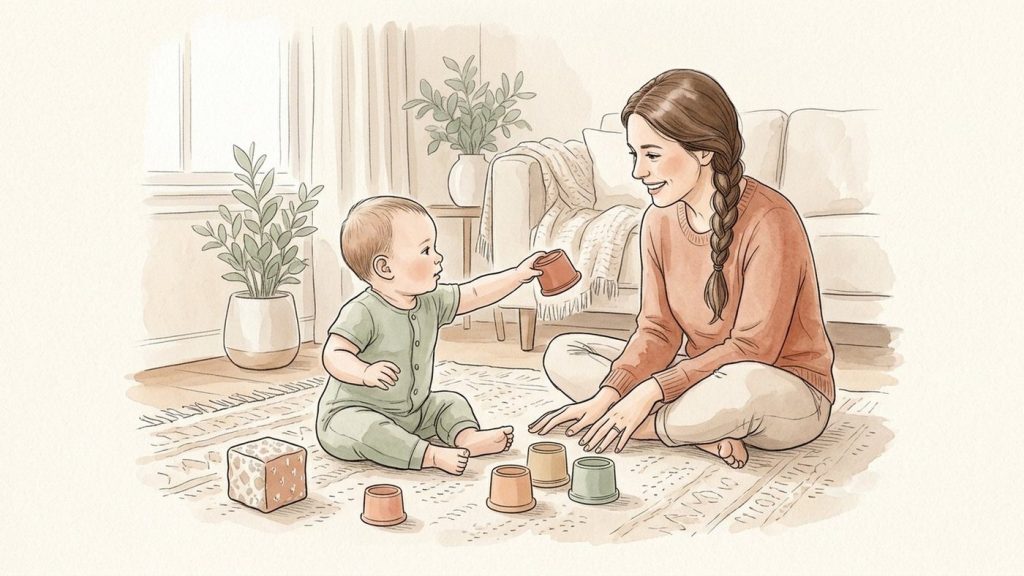
If you’d like a simple plan for each stage, The First-Year Mind has 50 research-based activities, 10 per stage of the first year, including floor games that build head control, sitting, and reaching, plus printable CDC milestone checklists for 2 to 12 months.
Do baby seats help babies sit up?
Not really. A seat holds your baby in position, so the muscles that do the balancing don’t get much practice.
Floor seats and bouncers can be handy for a few minutes while you cook. But the CDC suggests not keeping babies in swings, strollers, or bouncy seats for too long, and the WHO recommends that babies not be restrained for more than 1 hour at a time. Children’s physiotherapists at Whittington Health NHS Trust in London go a step further, noting that a lot of time in a very supportive chair can sometimes delay sitting. Walkers don’t help either. The AAP says they don’t teach walking and they cause serious falls; read more in Are baby walkers safe?
What the research says: advice to limit time in seats comes from expert guidance (the WHO, the CDC, and NHS physiotherapists), not from trials comparing babies who used sitting devices with babies who didn’t. We don’t know exactly how much seat time is too much. What we do know is that floor play is where the practice happens.
Never put an infant floor seat on a table, counter, chair, bed, or any raised surface. In 2011, the US Consumer Product Safety Commission (CPSC) reported at least 45 falls from Bumbo seats used on raised surfaces after an earlier recall, with 17 babies aged 3 to 10 months suffering skull fractures. It warned that babies as young as 3 months can escape the seat by arching backward, leaning, or rocking. After a 2012 recall that added a restraint belt, the CPSC said that even with the belt, the seat should never be used on any raised surface. Some falls happened on the floor too, so stay close whenever your baby is in a seat.
A baby who sits and reaches is usually on the move soon after. Here’s what comes next: When do babies crawl?
When do premature babies sit up?
Use your baby’s corrected age, also called adjusted age, rather than their age from birth.
To find it, the AAP says to take your baby’s age in weeks and subtract the number of weeks they were born early. For example, a baby born at 32 weeks was 8 weeks (2 months) early, so at 6 months old their corrected age is about 4 months. You’d expect sitting skills closer to those of a 4-month-old. So if most babies sit alone around 6 months, this baby might get there closer to 8 months after birth.
The AAP recommends using corrected age to track development until age 2, and notes that by 2 years most children born early have caught up to the typical milestone range. Steady progress is what matters. If your baby is behind even for their corrected age, or seems stuck, talk to your doctor.
When should I talk to the doctor about sitting?
If your baby isn’t sitting by themselves by 9 months, the AAP says to let your pediatrician know. Some signs are worth mentioning sooner.
- By 9 months (corrected age for babies born early), your baby doesn’t sit without support or can’t sit even with a little help
- By 4 months, your baby can’t hold their head steady while you’re holding them
- Your baby’s muscles seem very stiff or very floppy
- Your baby uses one side of their body much more than the other
- Your baby could sit and has stopped, or has lost any other skill they had
- You simply feel something isn’t right
The AAP lists stiff or floppy muscles, trouble holding the head and neck steady, and struggling to sit among the signs of a motor delay. It also says healthy movement means a baby is coordinating both sides of the body and using each arm and leg equally. Some NHS physiotherapy services in the UK suggest asking for advice a little earlier, if a baby isn’t showing signs of sitting alone by about 8 months.
Many babies who are a bit late catch up, but sometimes a delay is a sign of a health condition. The CDC’s advice is to act early: talk with your doctor, ask about developmental screening, and if you’re still concerned, contact your state’s early intervention program at cdc.gov/FindEI. You don’t need a doctor’s referral.
Frequently asked questions
Can babies sit up at 4 months?
Some can for a few seconds. In the WHO study, about 1 in 10 babies sat without support by 4.6 months. Most 4-month-olds are still working on steady head control and sitting with your support, which is right on track.
What is tripod sitting?
It’s when a baby sits leaning forward with both hands on the floor in front of them, like a tripod. The AAP describes it as a normal step on the way to sitting hands-free.
Is it bad to sit my baby up too early?
Short, supported practice is fine. The AAP suggests helping your baby practice sitting once they can raise their chest during tummy time, by holding them or supporting their back with pillows. Keep it brief, on the floor, and with you right there.
My baby is 7 months and not sitting yet. Should I worry?
Not necessarily. In the WHO study, about 1 in 4 babies weren’t sitting without support yet at 6.7 months, and the CDC milestone is at 9 months. Keep up the floor time, and mention it at your next checkup, sooner if you notice stiffness, floppiness, or one-sided movement.
Does my baby need to sit up before starting solids?
Your baby doesn’t need to sit fully alone, but the AAP says they should be able to sit in a high chair, feeding seat, or infant seat with good head control.
When can babies get into a sitting position by themselves?
Usually a little after they can sit once placed. The CDC lists “Gets to a sitting position by herself” at 9 months, and the AAP describes babies learning to roll onto their stomach and push back up into sitting.
Sources
- WHO Multicentre Growth Reference Study Group (2006). WHO Motor Development Study: windows of achievement for six gross motor development milestones. Acta Paediatrica Supplement 450, 86–95. doi.org
- World Health Organization. Motor development milestones: percentiles and mean in days and months for six gross motor milestones. who.int; percentiles table (PDF)
- Wijnhoven TMA, de Onis M, Onyango AW, et al. (2004). Assessment of gross motor development in the WHO Multicentre Growth Reference Study. Food and Nutrition Bulletin, 25(1 Suppl 1), S37–S45. doi.org
- CDC. Learn the Signs. Act Early.: milestones by 4, 6, and 9 months. 4 months, 6 months, 9 months
- Zubler JM, Wiggins LD, Macias MM, et al. (2022). Evidence-informed milestones for developmental surveillance tools. Pediatrics, 149(3), e2021052138. doi.org
- Kretch KS, Willett SL, Hsu LY, et al. (2022). “Learn the Signs. Act Early.”: updates and implications for physical therapists. Pediatric Physical Therapy, 34(4), 440–448. pmc.ncbi.nlm.nih.gov
- American Academy of Pediatrics. Movement: 4 to 7 months. HealthyChildren.org. healthychildren.org
- American Academy of Pediatrics. Movement: 8 to 12 months. HealthyChildren.org. healthychildren.org
- American Academy of Pediatrics. Is your baby’s physical development on track? HealthyChildren.org. healthychildren.org
- American Academy of Pediatrics. Corrected age for preemies, and Preemie milestones. HealthyChildren.org. Corrected age, Preemie milestones
- American Academy of Pediatrics. Baby walkers: a dangerous choice. HealthyChildren.org. healthychildren.org
- American Academy of Pediatrics. Starting solid foods. HealthyChildren.org. healthychildren.org
- US Consumer Product Safety Commission (2011). Serious head injuries to infants continue due to falls from Bumbo baby seats used on elevated surfaces. cpsc.gov
- US Consumer Product Safety Commission (2012). Baby seats recalled for repair by Bumbo International due to fall hazard. cpsc.gov
- World Health Organization (2019). Guidelines on physical activity, sedentary behaviour and sleep for children under 5 years of age. who.int
- Whittington Health NHS Trust, children’s physiotherapy. Early development. whittington.nhs.uk
- Cambridgeshire and Peterborough NHS Foundation Trust, Children’s Health. Learning to sit. cambspborochildrenshealth.nhs.uk