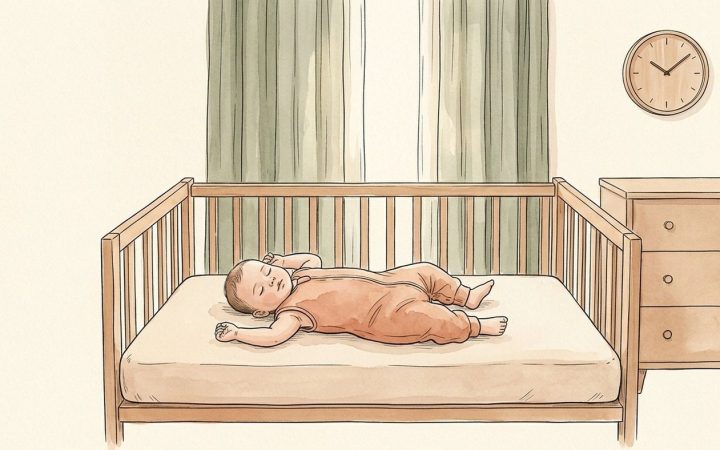
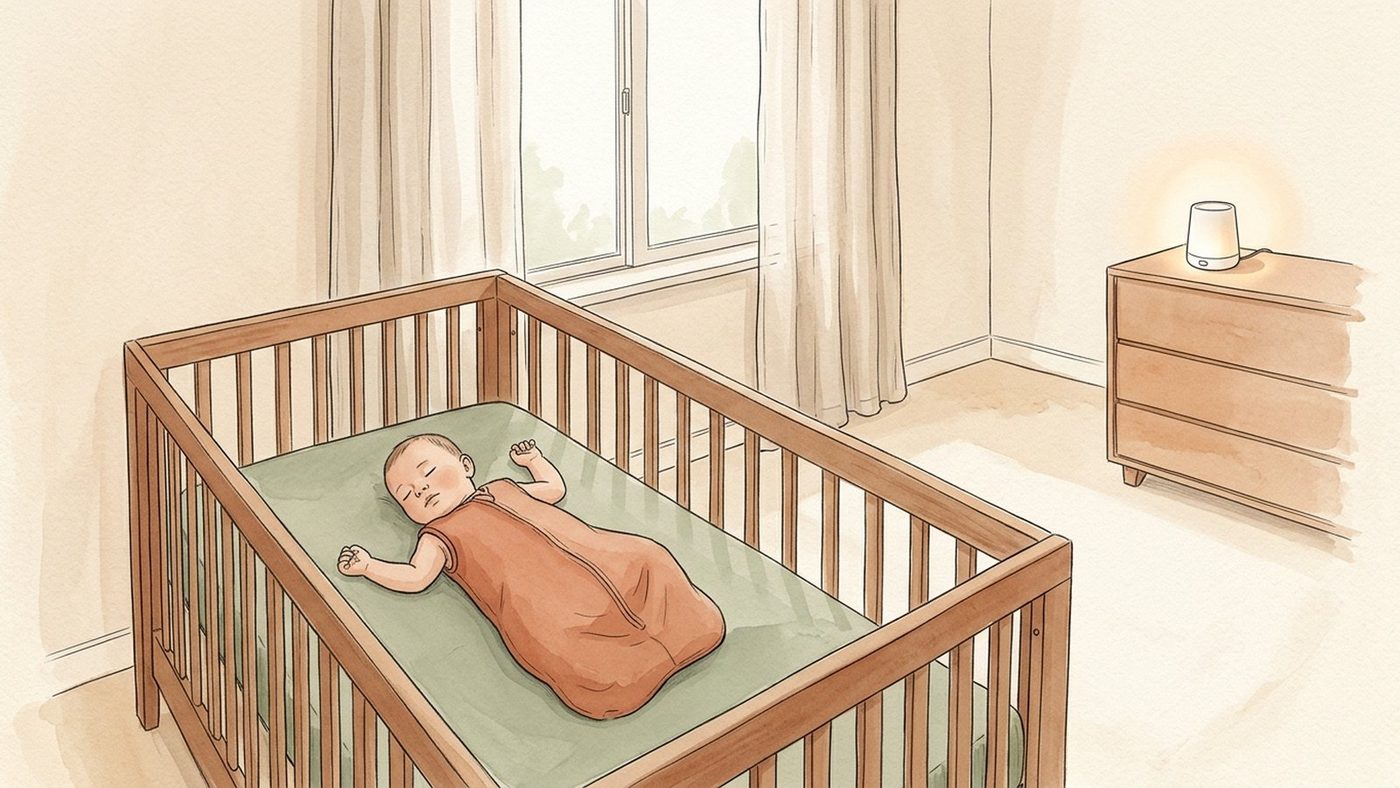
Short answer: White noise is generally safe for babies when it’s kept quiet and at a distance: place the machine across the room, not in or right next to the crib, and set it to the lowest volume that works, around the level of light rain (often quoted as 50 decibels or less at the crib). A 2014 study found that all 14 infant sleep machines tested were louder than 50 decibels at full volume up close, and three could reach levels that would exceed adult workplace limits over 8 hours. Sound can help babies settle, but volume and placement are what keep it safe.
Key takeaways
- Generally safe if quiet: keep it at the lowest effective volume, often quoted as 50 dB or less where your baby sleeps.
- Distance matters: the further away, the quieter at your baby’s ears. Never put the machine in the crib or attach it to the rails.
- Machines can be too loud: in a 2014 study, every machine tested exceeded 50 dB at full volume up close.
- There’s no official AAP decibel limit for sound machines that we could confirm, despite what many product pages say.
- It can help settling: a small 1990 trial found newborns fell asleep faster with white noise.
Is white noise safe for babies?
Yes, at a sensible volume and distance. The concern isn’t white noise itself but how loud it is at your baby’s ears and for how long. Babies’ ears are small, and sound that seems gentle to an adult standing across the room can be much louder for a baby lying right next to the speaker.
The best evidence on this comes from a study published in Pediatrics in 2014. They tested 14 infant sleep machines at maximum volume, measuring sound at 30 cm (about 1 foot), 100 cm (about 3 feet), and 200 cm (about 6.5 feet), and adjusted for the size of a 6-month-old’s ear canal. At 30 cm, every machine exceeded 50 decibels, the recommended noise limit for hospital nurseries. Three exceeded 85 decibels, a level that would go beyond adult occupational noise limits if a worker were exposed for more than 8 hours.
That study measured what the machines could do at full volume, not what babies actually hear at home, and it didn’t measure hearing damage in any baby. But its conclusion was practical: these devices can be loud enough to be a risk, so parents should use them carefully.
How loud should white noise be for a baby?
As quiet as still does the job. The figure you’ll see most often is 50 decibels (dB) at the crib, about the level of a quiet conversation, light rain, or a refrigerator hum. That number traces back to hospital nursery noise limits used in the 2014 study. Many hospital and product websites say the AAP recommends it. We couldn’t find a specific AAP limit for home sound machines in AAP’s own guidance, so treat 50 dB as a sensible, cautious target rather than an official rule. Some health sites suggest up to 60 dB.
| Sound level | Roughly like | For a sleeping baby |
|---|---|---|
| About 30–40 dB | A whisper, a quiet bedroom | Fine |
| About 50 dB | Light rain, a quiet conversation | The commonly suggested upper target at the crib |
| About 60 dB | Normal conversation | Upper end of what some sources suggest; better to stay lower |
| About 70 dB and up | Vacuum cleaner, loud TV | Too loud for sleep, especially for hours |
| 85 dB and up | Heavy traffic, a hair dryer up close | A level linked to hearing damage over long exposure |
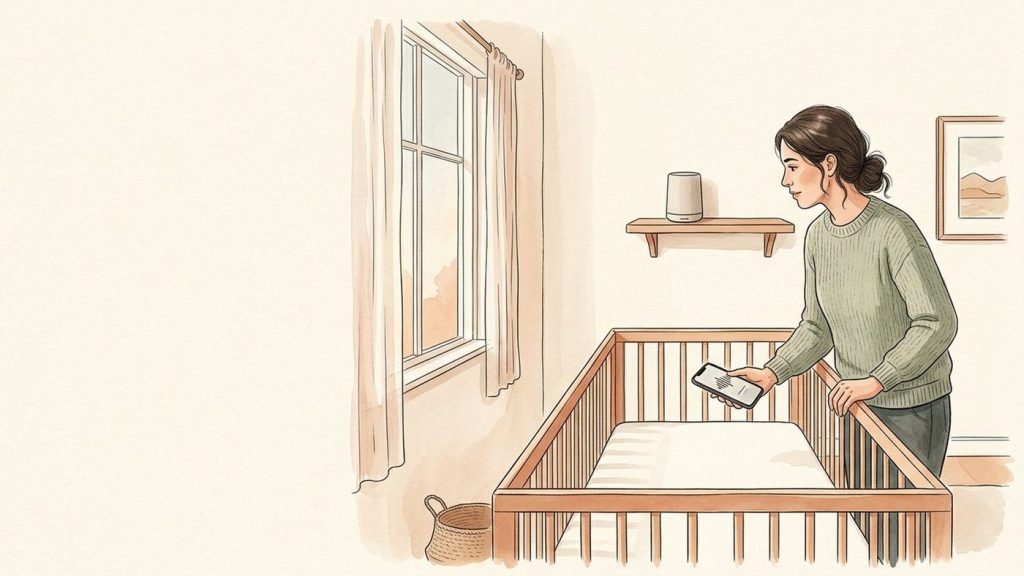
You can check with a free sound meter app on your phone. Put the phone where your baby’s head would be and adjust until it reads at or below about 50 dB. Phone apps aren’t perfectly accurate, but they’re good enough to catch a machine that’s far too loud. A simple rule of thumb: if you have to raise your voice to talk over it next to the crib, it’s too loud.
How should I use a white noise machine safely?
- Place it away from the crib. Advice on distance varies, from at least 2 feet to 7 feet. Across the room is a good default. Never place it inside the crib or attach it to the rails.
- Start with the lowest setting. Turn it up only until it masks household noise, then measure at the crib.
- Keep cords out of reach. Any cord should be well away from the crib, which also matters for safe sleep.
- Choose a steady sound. Continuous sounds like white, pink, or brown noise, a fan hum, or rain tend to work better than songs or sounds that change.
- Consider a timer. Some pediatric sources suggest turning it off once your baby is asleep or using an auto-off timer, though others keep it on all night at a low volume to mask early-morning noise. Either is reasonable if the volume is low.
- Recheck as things change. If you move the crib, switch rooms, or travel, measure the volume again.
White noise can be especially handy during naps in a busy house, when traveling, after the clocks change (see daylight saving time and baby sleep), or if street noise wakes your baby early (see baby waking at 5am).
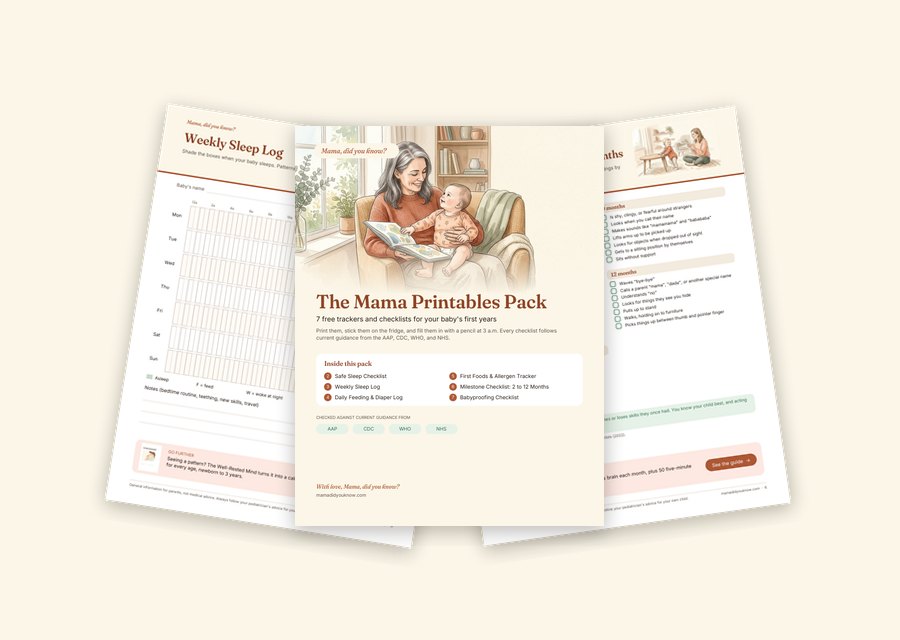
Free download
Free: safe sleep checklist and sleep log
Track naps and night wakings for a week and the pattern shows itself. Part of our free 7-page printables pack.
Does white noise actually help babies sleep?
It may help some babies settle, but the evidence is thin. The most-cited study is a small randomized trial from 1990 in the Archives of Disease in Childhood. Of 20 newborns aged 2 to 7 days who heard white noise, 16 (80%) fell asleep within five minutes, compared with 5 of 20 (25%) in the group without it. That’s a striking difference, but it was 40 babies in their first week, measured once.
Beyond that, most of what we know comes from parents’ experience. Steady sound may remind young babies of the womb, mask sudden noises like a door or a dog, and act as a sleep cue as part of a routine. But it isn’t a fix for every sleep problem. If your baby wakes often, look at the bigger picture, like daytime sleep and wake windows.
What the research says: evidence that white noise helps sleep comes mainly from one small newborn trial. Evidence about risk comes from lab measurements of how loud machines can get, not from studies of babies’ hearing. No study has shown that a low-volume machine placed across the room harms hearing or language development, and none has shown long-term benefits either.
Can white noise affect hearing or speech development?
Loud noise over long periods can damage hearing, which is why volume matters most. At low volume and a good distance, sound machines are considered unlikely to harm hearing, according to Children’s National Hospital.
Some pediatricians also suggest not masking all household sounds all the time, because babies learn language by hearing the voices and everyday sounds around them while awake. That’s a reason to use white noise for sleep rather than during awake time, not a reason to avoid it. Talking, singing, and reading with your baby during the day matter far more for language; see when babies start talking.
Will your child need white noise forever? Some families find it becomes part of the routine for years, alongside a bath, books, and a song (see our toddler bedtime routine), and that’s fine if it’s quiet. If you want to phase it out, lower the volume a little every few nights until it’s off.
Talk to your pediatrician about a hearing check if your baby:
- doesn’t startle at sudden loud sounds, or doesn’t turn toward your voice
- isn’t cooing or babbling by around 6 months, or responding to their name later in the first year
- seems to hear some sounds but not others
- didn’t pass, or missed, the newborn hearing screen
- sleeps poorly or snores loudly even with a calm, quiet sleep space
Frequently asked questions
Should white noise play all night?
It can, at a low volume and a good distance. Some pediatricians prefer a timer that switches off after your baby falls asleep. There’s no research showing one approach is better.
Is pink or brown noise better than white noise?
Pink and brown noise have more low-pitched sound, which many people find less harsh. There’s no good evidence that one color of noise is better for babies. Choose a steady sound your family likes, at a low volume.
Can I use a phone app instead of a machine?
Yes, but phone speakers can be harsh at higher volumes, and apps may play ads or loop with gaps. Use airplane mode, keep the phone out of the crib, and check the volume.
Is a fan safe instead of white noise?
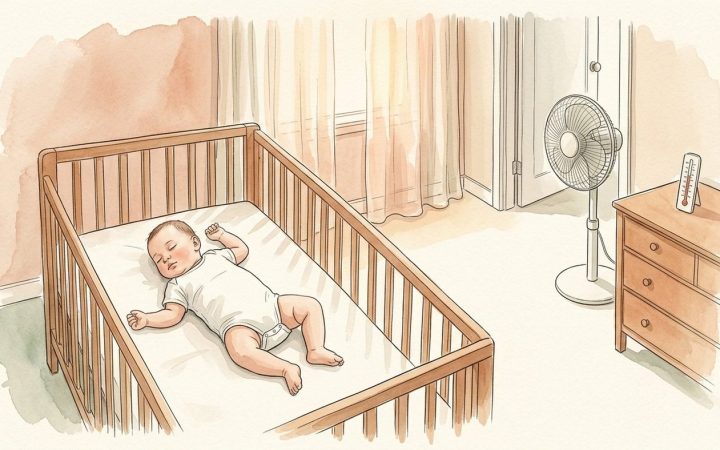
A fan can provide steady sound. Keep it out of reach, on a low setting, and pointed away from your baby so they don’t get chilled.
Does the AAP recommend white noise?
The AAP’s safe sleep guidance doesn’t require or recommend white noise. It’s an optional comfort tool. Safe sleep basics, like back sleeping in a bare crib, are what protect your baby.
Sources
- Hugh SC, Wolter NE, Propst EJ, Gordon KA, Cushing SL, Papsin BC (2014). Infant sleep machines and hazardous sound pressure levels. Pediatrics 133(4):677–681. pubmed.ncbi.nlm.nih.gov
- Spencer JA, Moran DJ, Lee A, Talbert D (1990). White noise and sleep induction. Archives of Disease in Childhood 65(1):135–137. pubmed.ncbi.nlm.nih.gov
- Children’s National Hospital, Rise and Shine. Baby sound machines and hearing loss. riseandshine.childrensnational.org
- Henry Ford Health (2026). Are White Noise Machines Safe For Your Baby? henryford.com
- American Academy of Pediatrics, HealthyChildren.org. How to Keep Your Sleeping Baby Safe: AAP Policy Explained. healthychildren.org