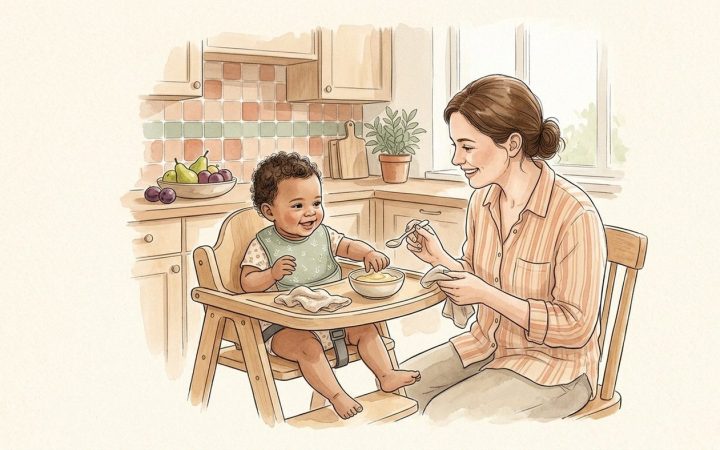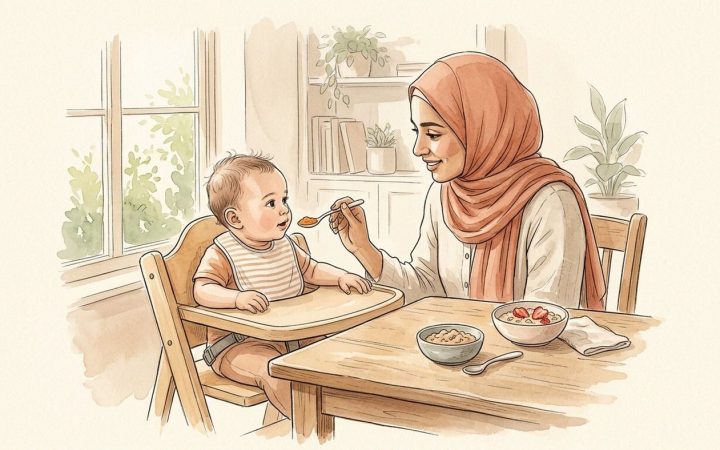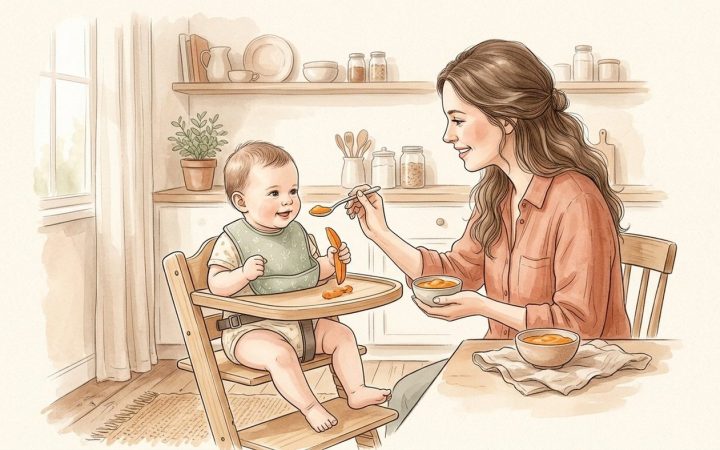
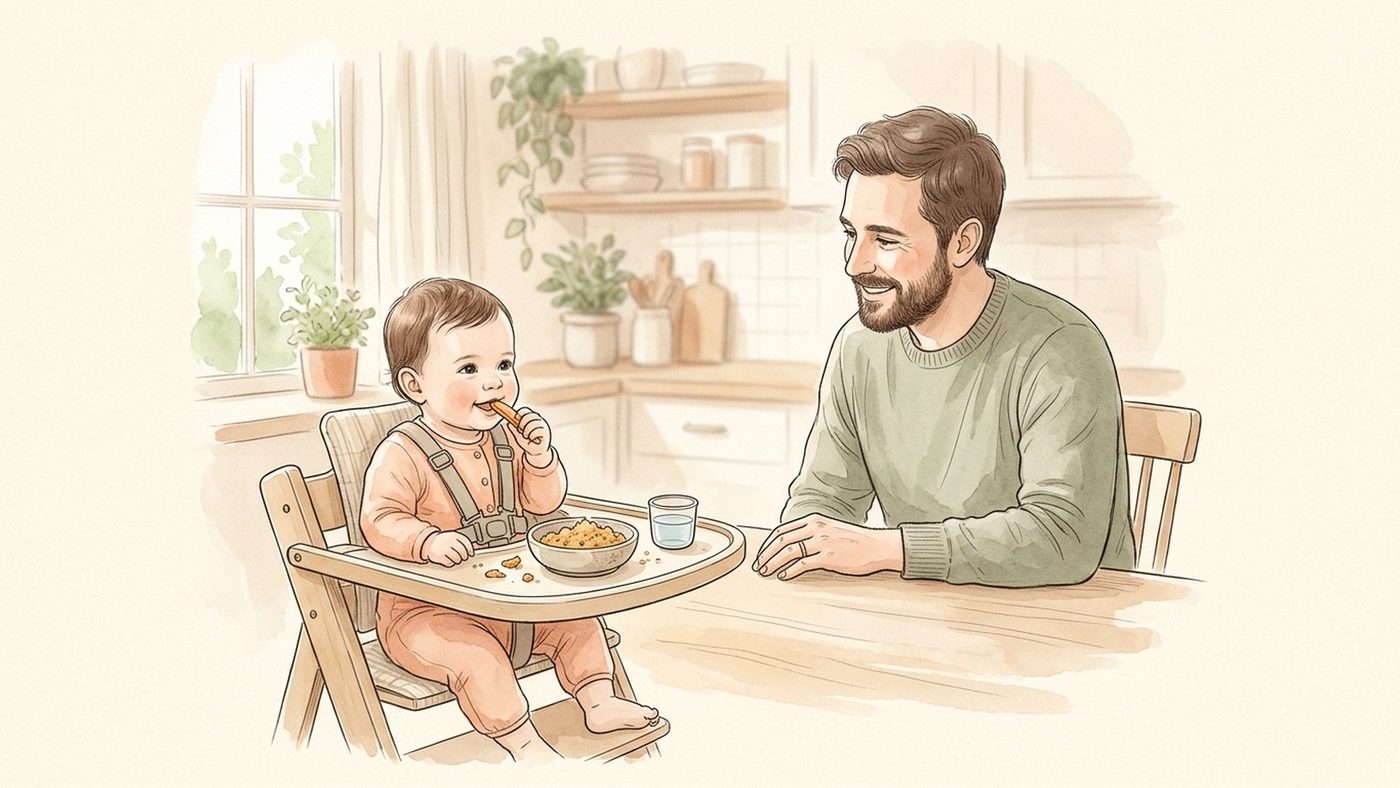
Short answer: Breast milk or formula is your baby’s main food until 12 months. Around 6 months, most babies start with 1–2 small meals a day alongside 4–5 milk feeds. By 7–8 months that grows to 3 meals, and by 12 months your child eats 3 meals and 2 snacks from the family table, with plain whole milk in a cup.
When Adam started solids, I stood in the kitchen with a tiny spoon and no idea how much or how often. This is the plan I wish I’d had that first week.
Key takeaways
- 6 months: 1–2 meals a day, plus 4–5 milk feeds. Formula-fed babies usually take about 6–8 oz (180–240 ml) per feed, up to about 32 oz a day.
- 7–8 months: 3 meals a day, with about 4 milk feeds and an iron-rich food at every meal.
- 9–11 months: 3 meals, an optional small snack, and 3–4 milk feeds.
- 12 months: 3 meals and 2 snacks, 2–3 cups (16–24 oz) of whole milk, and 1–4 cups of water a day.
- Clock times are examples. No health organization publishes official meal times, so follow your baby’s hunger cues and naps.
How many meals should a baby eat each month?
Meals grow slowly, from a few teaspoons once a day to three meals and snacks by the first birthday. The table below brings together the official guidance from the AAP, the NHS, the WHO, and Europe’s pediatric nutrition society (ESPGHAN). Every baby moves at their own pace, so treat each row as a guide, not a test.
| Age | Meals | Milk feeds | Water | Texture |
|---|---|---|---|---|
| 4–5 months (only if ready) | 0–1 tiny tastes | On demand: the main food | Not needed yet | Completely smooth, fairly runny |
| 6 months | 1–2 | 4–5 | Sips with meals | Smooth to thick purées, soft finger-length pieces |
| 7 months | 3 | About 4 | Sips with meals | Thick and mashed, soft lumps |
| 8 months | 3 | About 4 | With every meal | Lumpy, plus very soft small pieces |
| 9 months | 3 + 1 snack | 3–4 | With meals and snack | Minced and chopped, pea-sized pieces |
| 10–11 months | 3 + 1 snack | About 3 | With meals and snack | Soft chopped family food |
| 12 months | 3 + 2 snacks | Whole milk, 2–3 cups a day | 1–4 cups a day | Family food, cut safely |
From 6 to 12 months, water is about practice more than hydration: a few sips from an open cup with meals, up to 4–8 oz (120–240 ml) a day in total. Our guide on when babies can drink water explains the amounts age by age.
What does a 6-month-old’s feeding schedule look like?
One or two small meals a day, fitted between milk feeds and naps. The WHO, the CDC, the NHS, and the Dietary Guidelines for Americans all point to about 6 months as the time to start solids, and never before 4 months. Iron-rich foods come first, because a baby’s stored iron runs low around this age.
| Time | Sample day at 6 months |
|---|---|
| 7:00 a.m. | Wake up, milk feed |
| 9:00 a.m. | Nap (about 1–1½ hours) |
| 10:30 a.m. | Milk feed |
| 12:00 p.m. | Lunch: a vegetable, potato, and iron-food purée (for example, red lentil, carrot, and sweet potato), plus sips of water |
| 1:00 p.m. | Nap |
| 3:00 p.m. | Milk feed |
| 4:30 p.m. | Short nap |
| 5:30 p.m. | Dinner: iron-fortified oat cereal with pear, or a first peanut or egg meal, plus sips of water |
| 6:30 p.m. | Bath, bedtime routine, milk feed |
| 7:00 p.m. | Bedtime; night feeds as needed |
Start with a teaspoon or two and let your baby decide how much. Many families add the second meal a few weeks after the first. Peanut and well-cooked egg can come soon after a few first foods; our guide on when babies can eat peanut butter shows exactly how.
What does an 8-month-old’s feeding schedule look like?
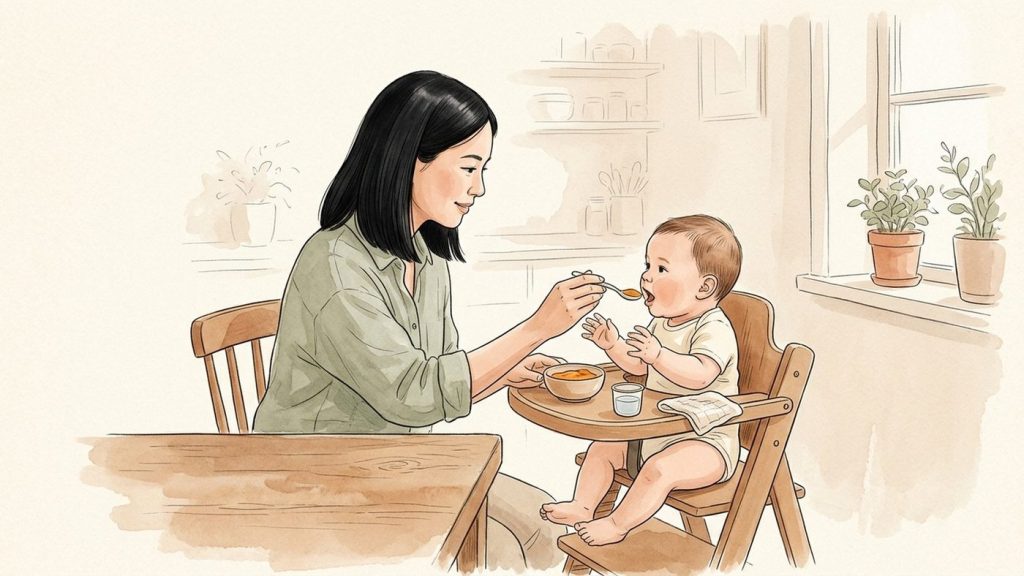
Three meals a day and about four milk feeds, with lumpier textures and soft finger foods. ESPGHAN says lumpy foods should be in place by 8–10 months at the latest, so this is a good month to keep moving forward.
| Time | Sample day at 8 months |
|---|---|
| 7:00 a.m. | Wake up, milk feed |
| 8:00 a.m. | Breakfast: soaked oats with pear, plus water |
| 9:30 a.m. | Nap |
| 11:00 a.m. | Milk feed |
| 12:00 p.m. | Lunch: vegetables, a starch, and an iron-rich protein (for example, salmon and pea pasta), plus water |
| 2:00 p.m. | Nap |
| 3:30 p.m. | Milk feed |
| 5:30 p.m. | Dinner: vegetables with a grain or dairy (for example, butternut squash mac and cheese), plus water |
| 6:30 p.m. | Bath, bedtime routine, milk feed |
| 7:00 p.m. | Bedtime |
The AAP’s own sample menu for 8 to 12 months has 3 meals, 2 snacks, and a milk feed before bed, with about 2–4 oz of each food at a meal. Gagging is common as textures get lumpier. It’s a normal reflex, and our guide to gagging vs. choking explains how to tell it apart from an emergency.
A 2020 review of napping studies found that from 8 to 12 months, babies’ naps tend to cluster around 9:30 a.m. and 2:00 p.m. That’s why the sample days here put lunch at noon, right between the two, when your baby is rested and ready to eat.
What does a 10-month-old’s feeding schedule look like?
Three meals, an optional afternoon snack, and about three milk feeds. Many babies now eat soft, chopped versions of the family meal, and milk feeds start to drop on their own as solids grow. The NHS suggests formula-fed babies may need around 400 ml (about 13 oz) a day at this age.
| Time | Sample day at 10 months |
|---|---|
| 7:00 a.m. | Wake up, milk feed |
| 8:00 a.m. | Breakfast: a grain, fruit, and egg or dairy (for example, scrambled egg, toast fingers, and soft pear), plus water |
| 9:30 a.m. | Nap |
| 12:00 p.m. | Lunch: a family-style meal with an iron-rich protein, plus water |
| 2:00 p.m. | Nap |
| 3:30 p.m. | Snack: fruit or vegetable with dairy or a grain, plus water |
| 5:30 p.m. | Dinner: a family-style meal, chopped soft, plus water |
| 6:30 p.m. | Bath, bedtime routine, milk feed |
| 7:00 p.m. | Bedtime |
Is the snack necessary? Not really. The NHS says babies under 12 months don’t need snacks, while the WHO’s guidance allows 1–2 nutritious snacks from 9 months. If you offer one, make it real food, not something sweet.
If you’d like every month planned for you, The Well-Fed Mind has a month-by-month plan from 4 to 12 months, with textures, example days, and 260 recipes.
What does a 12-month-old’s feeding schedule look like?
Three meals and two snacks from the family table, with plain whole milk in a cup. In the US, formula stops at 12 months and whole milk takes over at 2–3 cups (16–24 oz) a day. Keep milk under about 24 oz, because more can fill toddlers up and crowd out iron-rich foods. Breastfeeding can continue as long as you both want.
| Time | Sample day at 12 months |
|---|---|
| 7:00 a.m. | Wake up |
| 7:30 a.m. | Breakfast: a grain, fruit, and egg or dairy, with milk in a cup |
| 9:30 a.m. | Snack: fruit with dairy or a grain, plus water |
| 10:00 a.m. | Nap |
| 12:00 p.m. | Lunch: a family meal with an iron-rich protein, plus water |
| 2:00 p.m. | Nap (many children move to one nap between 12 and 18 months) |
| 3:30 p.m. | Snack: a vegetable or fruit with a protein or grain, plus water |
| 5:30 p.m. | Dinner: a family meal (for example, veggie-packed tomato pasta), with milk in a cup |
| 6:30 p.m. | Bath, bedtime routine |
| 7:00 p.m. | Bedtime |
Twelve months is also when honey becomes safe, though it still counts as added sugar. Our guide on whether babies can have honey explains why it has to wait.

What the research says: the big building blocks, like starting around 6 months, milk as the main food until 12 months, lumpy textures by 8–10 months, and whole milk limits after 1, come from consistent official guidance (AAP, WHO, NHS, ESPGHAN). The number of meals per month and the clock times are expert practice built on averages, not results from trials. Use them as a starting point and adjust to your baby.
How do European and American feeding schedules differ?
They share the same foundations but build meals in a different order. Both approaches work, and many families mix them.
- Germany follows a structured plan: a midday vegetable, potato, and meat purée comes first (between the start of the 5th and 7th month), then an evening milk and cereal meal about a month later, then an afternoon cereal and fruit meal. Each new meal replaces one milk feed.
- France allows starting from 4 months at whichever meal suits the family, with very soft pieces from 8 months and pieces to chew from 10 months.
- The UK starts around 6 months with finger foods from the beginning, and moves toward 3 meals a day from about 7 months.
- The US starts around 6 months with iron- and zinc-rich foods, introduces peanut and egg early, and follows the AAP’s 8–12 month sample day of 3 meals and 2 snacks.
Whichever you follow, the same four checks apply to every meal: an iron food, the right texture for the age, safe shapes, and milk in its place.
Talk to your pediatrician if your baby:
- isn’t gaining weight well, or is dropping across lines on the growth chart
- gags, vomits, or chokes with many different textures, or seems in pain or very distressed at meals
- still relies almost entirely on milk as the first birthday approaches
Frequently asked questions
Should I give milk or food first?
Either works. The AAP suggests a little milk first when you’re starting out; the NHS offers food before the milk feed. As your baby eats more solids, offering food first with milk afterward usually fits naturally.
How much should my baby eat at each meal?
Less than you might think. Start with a teaspoon or two at 6 months. By 8–12 months, the AAP’s sample menu uses about 2–4 oz of each food at a meal. Some days your baby will eat a lot and some days barely anything, and that’s normal. Stop when you see fullness signs like turning away or closing the mouth.
Do I have to follow these exact times?
No. No official body publishes clock times for baby meals. The sample days show one way the day can fit around typical naps. Shift everything earlier or later to suit your family.
Can I start solids at 4 months?
Only if your baby shows all the readiness signs: sitting with support and holding their head steady, reaching for food and bringing it to their mouth, and swallowing rather than pushing food back out. ESPGHAN and France allow starting from 4 months; the US and UK say around 6 months. Talk to your pediatrician before starting early.
Sources
- American Academy of Pediatrics, HealthyChildren.org. Sample One-Day Menu for an 8- to 12-Month-Old. healthychildren.org
- American Academy of Pediatrics, HealthyChildren.org. Amount and Schedule of Formula Feedings. healthychildren.org
- American Academy of Pediatrics, HealthyChildren.org. Starting Solid Foods. healthychildren.org
- NHS Best Start in Life. What to feed your baby: 7 to 9 months, and 10 to 12 months. nhs.uk (7–9 months); nhs.uk (10–12 months)
- World Health Organization (2023). Guideline for complementary feeding of infants and young children 6–23 months of age. who.int
- Fewtrell M, et al. (2017). Complementary Feeding: A Position Paper by the ESPGHAN Committee on Nutrition. J Pediatr Gastroenterol Nutr 64:119–132. espghan.org
- Germany’s official first-year feeding plan (Beikost einführen). kindergesundheit-info.de
- CDC. When, What, and How to Introduce Solid Foods. cdc.gov
- Staton S, et al. (2020). A systematic review and meta-analysis of napping in children aged 0 to 12 years. Sleep Med Rev 50:101247. pmc.ncbi.nlm.nih.gov