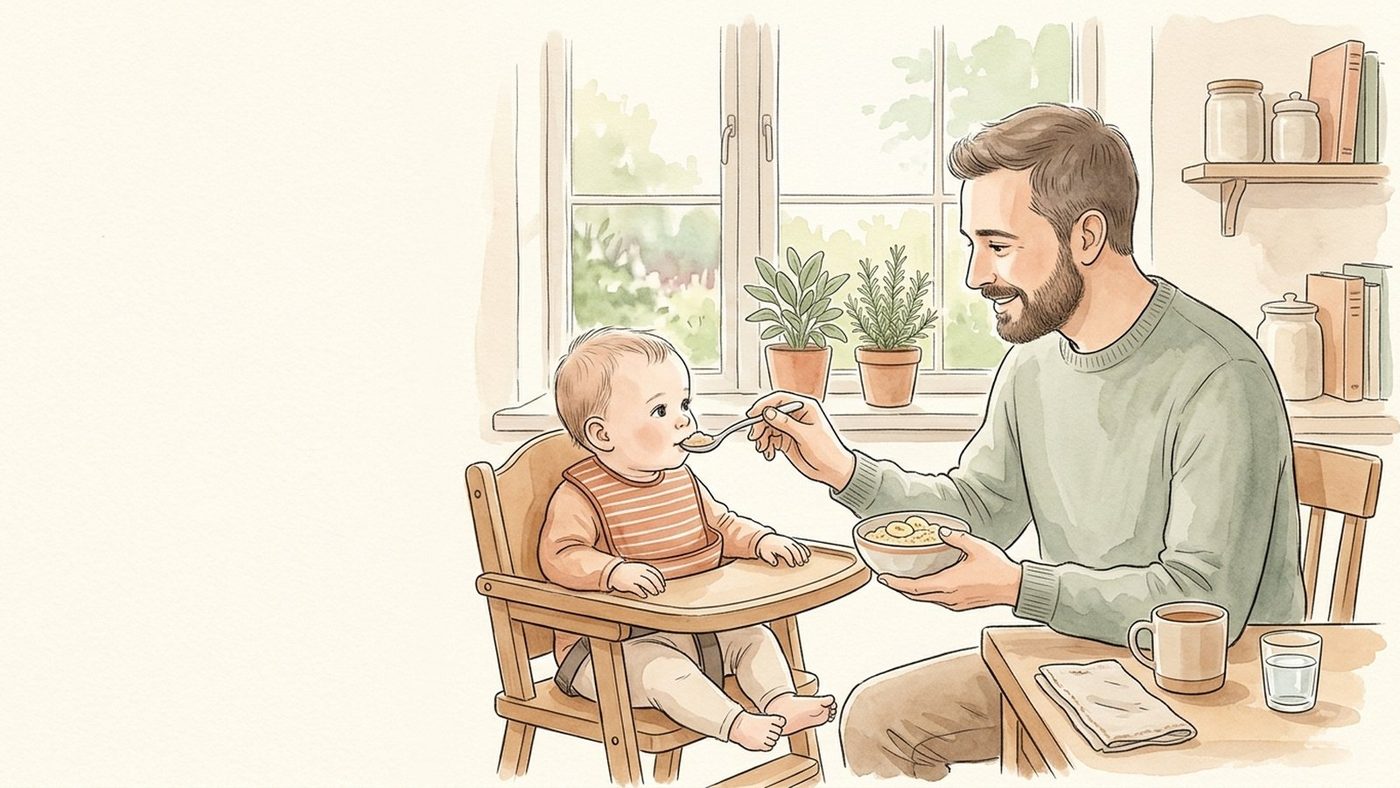
Short answer: No. Babies shouldn’t have honey in any form until after their first birthday, because honey can carry spores of the bacteria that cause infant botulism, a rare but serious illness. From 12 months, honey is safe, but it counts as added sugar, so keep it occasional.
My mother-in-law offered Adam a taste of honey on her finger, and I had to explain why it has to wait. This article is exactly why.
Key takeaways
- 0–12 months: no honey at all: not in food, water, formula, or on a pacifier, and not in products made with it.
- From 12 months: honey is safe, but it’s an added sugar. US guidelines say to avoid added sugars through early childhood; the NHS says up to age 4.
- For a cough after age 1: the AAP says 2–5 ml (about ½ to 1 teaspoon) of honey as needed is an option.
- Know the signs: constipation, poor feeding, a weak cry, and drooping eyelids in a baby need a doctor right away.
Why can’t babies have honey before 12 months?
Because honey can contain spores of Clostridium botulinum, the bacteria behind botulism, and a baby’s gut can’t yet keep them in check. The CDC explains that infant botulism happens when the spores get into a baby’s intestines, where they grow and make a toxin that causes the illness.
Babies are more vulnerable than adults because their guts are still developing, explains Australia’s NSW Health. Infant botulism is rare, and with early diagnosis and hospital care, babies are expected to fully recover. But because it is serious and honey is easy to skip, every major health body agrees on the same rule.
| Organization | What it says |
|---|---|
| CDC (US) | Don’t give honey before 12 months, including in food, water, formula, or on a pacifier |
| AAP (US) | Don’t give infants under 1 year honey |
| NHS (UK) | Don’t give honey until your child is over 1 year old |
| ESPGHAN (Europe) | No honey before 12 months, unless the spores have been destroyed by industrial high-pressure, high-temperature treatment |
What the research says: the no-honey rule is one of the most consistent pieces of infant feeding advice in the world, shared by the CDC, the FDA, the AAP, the NHS, and ESPGHAN. It rests on the known biology of infant botulism and on real cases, rather than on trials, which would never be ethical here.
Is honey in baked goods or cereal OK for babies?
Not before 12 months, according to US guidance. The CDC says not to give infants honey “or products made with it,” and Australian health authorities also advise avoiding processed foods that contain honey. The spores are heat-resistant, so ordinary home cooking or baking isn’t treated as a safe exception.
Here is where Europe differs slightly. ESPGHAN makes one exception: honey whose spores have been destroyed by industrial high-pressure, high-temperature processing. A label rarely tells you that, though, so the practical rule on both sides of the Atlantic is the same: check ingredient lists on teething biscuits, cereals, crackers, and yogurts, and skip anything with honey until the first birthday.
Honey on a pacifier is not a harmless old trick. The CDC reports that several babies in Texas became ill with infant botulism after using honey-filled pacifiers.

What are the signs of infant botulism?
Constipation is often the first sign parents notice, followed by weakness. Not every baby has every sign. The CDC notes that most cases of infant botulism can’t be prevented, so these signs matter even if your baby has never had honey.
The CDC says botulism is an emergency. See a doctor or go to the emergency room right away if your baby has:
- constipation together with poor feeding
- a weak cry that sounds different than usual
- drooping eyelids, or a face that shows less expression than usual
- floppiness, poor head control, trouble swallowing, or trouble breathing
My baby already had honey. What should I do?
Take a breath. Infant botulism is rare. Don’t give any more, call your pediatrician to let them know what happened, and keep an eye out for the signs above. If any appear, seek care right away and mention the honey.
This happens to lots of caring families, often through a well-meaning relative or a snack with honey in the ingredients. Now you know what to look for.
If you’d like a clear list of what’s off the menu each month, and what to serve instead, The Well-Fed Mind covers honey, salt, sugar, and other foods to avoid, with 260 month-by-month recipes sweetened only with fruit.
When can babies have honey, and how much?
Any time after the first birthday, but as an occasional extra rather than an everyday sweetener. Once the botulism risk has passed, honey is treated like any other added sugar.
| Age | Honey | Why |
|---|---|---|
| 0–12 months | None, in any form | Risk of infant botulism |
| 1–4 years | Safe, but keep it rare | Counts as added sugar. The 2025–2030 Dietary Guidelines for Americans say to avoid added sugars through early childhood; the NHS says children 4 and under should avoid them. |
| 1 year and up, for a cough | 2–5 ml (about ½ to 1 teaspoon) as needed | The AAP lists honey as a home remedy for coughs from age 1 |
The NHS also points out that honey is a sugar, so going easy on it helps prevent tooth decay. Twelve months is a big feeding milestone in other ways too; our baby feeding schedule by month shows what a 1-year-old’s day can look like.
How can I sweeten my baby’s food without honey?
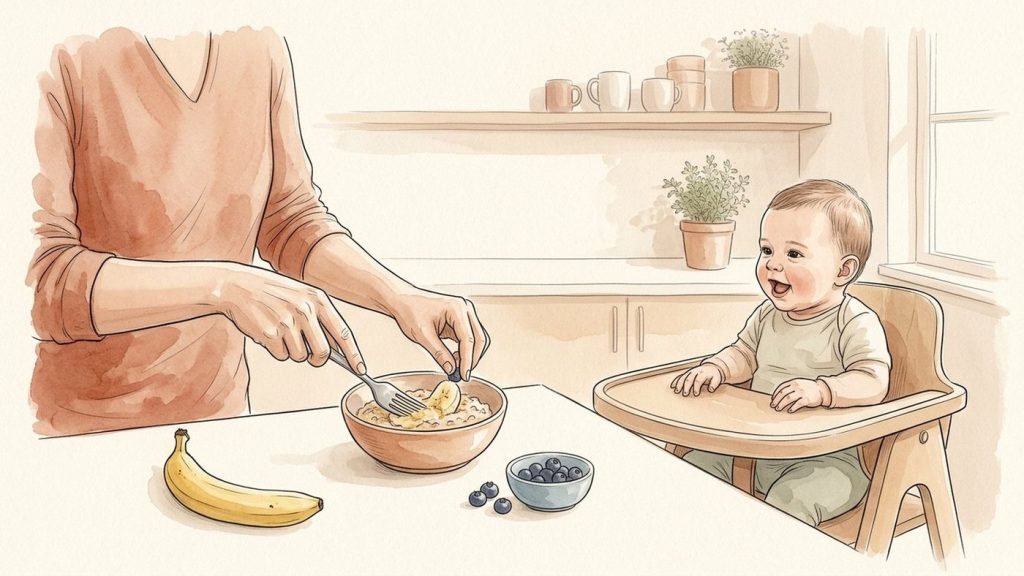
Use fruit. In the first year, sweetness should come only from fruit and vegetables: no honey, sugar, or syrups.
- Stir mashed ripe banana, grated apple, or pear purée into oatmeal or plain yogurt.
- Mash a few soft berries into cereal. Squash blueberries flat for safety.
- Add a pinch of cinnamon, which brings warmth without sugar.
- For baking, swap honey or syrup for mashed banana or fruit purée.
Peanut and egg, on the other hand, are foods to offer early rather than delay. See our guide on when babies can eat peanut butter.
Frequently asked questions
Is raw, organic, or local honey safer for babies?
No. The guidance from the CDC, the AAP, and the NHS applies to all honey, with no exception for raw, organic, or local honey. The only exception anywhere is ESPGHAN’s, for honey treated industrially to destroy the spores, and labels rarely say that.
Why is 12 months the cutoff?
Infant botulism usually only occurs in babies under 12 months, whose guts are still developing. That’s why the CDC, the AAP, the NHS, and ESPGHAN all draw the line at the first birthday.
Can I give my baby honey for a cough?
Not under 12 months. For a baby with a cough, talk to your pediatrician. From age 1, the AAP says 2–5 ml of honey as needed can help soothe a cough.
Is maple syrup or agave OK instead?
Skip them too. Syrups are added sugars, and US and UK guidance say babies and young children shouldn’t have added sugar. Fruit is the best sweetener.
Sources
- CDC. Preventing Botulism. cdc.gov
- CDC. Botulism: Signs and Symptoms. cdc.gov
- CDC. Foods and Drinks to Avoid or Limit (infant and toddler nutrition). cdc.gov
- American Academy of Pediatrics, HealthyChildren.org. Coughs and Colds: Medicines or Home Remedies? healthychildren.org
- NHS. Foods to avoid giving babies and young children. nhs.uk
- Fewtrell M, et al. (2017). Complementary Feeding: A Position Paper by the ESPGHAN Committee on Nutrition. espghan.org
- US Food and Drug Administration. Food Safety for Moms to Be: Once Baby Arrives. fda.gov
- NSW Health (Australia). Infant botulism fact sheet. health.nsw.gov.au
- US Department of Agriculture and Department of Health and Human Services. Dietary Guidelines for Americans, 2025–2030. dietaryguidelines.gov