
Short answer: The CDC’s milestone checklists cover 2, 4, 6, 9, 12, 15, 18, 24, and 30 months, then 3, 4, and 5 years. Since 2022, each milestone is something at least 75% of children can do by that age, so if your baby hasn’t reached one, it’s a reason to talk to your doctor, not a reason to panic or to wait and see.
At Adam’s last checkup, I caught myself comparing him with a friend’s baby the same age. These lists reminded me how wide normal really is.
Key takeaways
- The 2022 revision moved milestones to the age when 75% or more of children reach them. The older lists were closer to the average age, when only about half of children had the skill.
- There are now 12 checklists with 159 milestones in total, including new ones at 15 and 30 months.
- Crawling is no longer on the list. Many healthy babies skip it or move in other ways.
- Checklists help you notice. They don’t diagnose anything, and they don’t replace the developmental screening the AAP recommends at 9, 18, and 30 months.
What changed in the CDC milestones in 2022?
The big change is timing: each milestone now sits at the age when most children (75% or more) can do it, so a missed milestone is a clearer signal to check in.
In 2022, an expert group convened by the American Academy of Pediatrics (AAP) with funding from the CDC’s “Learn the Signs. Act Early.” program rewrote the checklists. The experts explained that lists based on the average age “might encourage a wait-and-see approach,” because half of children aren’t expected to have the skill yet at that age. Moving to 75% means that when a milestone is missing, it’s worth a conversation.
A few other changes worth knowing:
- Fewer, clearer milestones. The set went from 216 milestones on 10 checklists to 159 on 12. Vague words like “may” and “begins” were removed, so each item is something you can answer with yes, not yet, or not sure.
- New ages. Checklists were added at 15 and 30 months.
- No separate “warning signs.” Missing a milestone now does the same job.
- Some skills moved later. About a third of the milestones that stayed moved to a different age, most of them to an older age.
What are the baby milestones by month?
Here is a selection of milestones from each CDC checklist, in the CDC’s own words; each full checklist has more.
| By age | Moving | Talking and connecting | Learning and thinking |
|---|---|---|---|
| 2 months | “Holds head up when on tummy”; “Moves both arms and both legs” | “Smiles when you talk to or smile at her”; “Makes sounds other than crying” | “Watches you as you move” |
| 4 months | “Holds head steady without support when you are holding him”; “Pushes up onto elbows/forearms when on tummy” | “Makes sounds like ‘oooo’, ‘aahh’ (cooing)”; “Chuckles (not yet a full laugh) when you try to make him laugh” | “Looks at her hands with interest” |
| 6 months | “Rolls from tummy to back”; “Leans on hands to support herself when sitting” | “Laughs”; “Takes turns making sounds with you” | “Reaches to grab a toy she wants” |
| 9 months | “Sits without support”; “Gets to a sitting position by herself” | “Makes different sounds like ‘mamamama’ and ‘babababa’”; “Looks when you call his name” | “Looks for objects when dropped out of sight (like his spoon or toy)” |
| 12 months | “Pulls up to stand”; “Walks, holding on to furniture” | “Waves ‘bye-bye’”; “Calls a parent ‘mama’ or ‘dada’ or another special name” | “Puts something in a container, like a block in a cup” |
| 15 months | “Takes a few steps on his own” | “Points to ask for something or to get help” | “Stacks at least two small objects, like blocks” |
| 18 months | “Walks without holding on to anyone or anything”; “Scribbles” | “Tries to say three or more words besides ‘mama’ or ‘dada’” | “Plays with toys in a simple way, like pushing a toy car” |
| 2 years | “Kicks a ball”; “Runs” | “Says at least two words together, like ‘More milk.’” | “Plays with more than one toy at the same time, like putting toy food on a toy plate” |
| 30 months | “Jumps off the ground with both feet” | “Says about 50 words” | “Uses things to pretend, like feeding a block to a doll as if it were food” |
| 3 years | “Uses a fork” | “Talks with you in conversation using at least two back-and-forth exchanges” | “Draws a circle, when you show him how” |
The CDC switches between “he” and “she” from item to item; every milestone applies to every child. You’ll find the complete checklist for each age, plus play ideas, on the CDC’s “Learn the Signs. Act Early.” pages listed in the sources below.
There is no CDC checklist for 1 month. The first one is at 2 months, and its first movement milestone, “Holds head up when on tummy,” is exactly what tummy time helps babies practice.
Why isn’t crawling on the milestone list anymore?
Crawling was left off because it varies so much between healthy babies, and some never crawl at all.
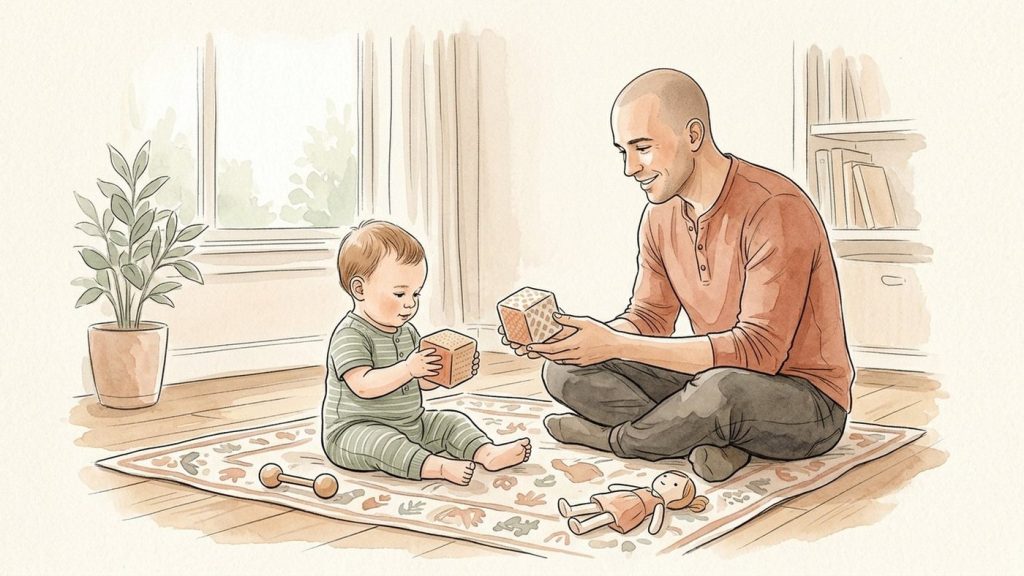
The current 9-month movement milestones are about sitting, and the 12-month ones are pulling up to stand and walking while holding on to furniture. Some babies crawl on hands and knees, some scoot on their bottoms, some roll everywhere, and a few go straight to pulling up. We explain the research in When do babies crawl?
What if my baby misses a milestone?
Talk to your baby’s doctor and ask about developmental screening; you don’t need to wait for the next checkup.
Because the milestones now reflect what 75% or more of children do, missing one doesn’t mean something is wrong. It means it’s worth a closer look. The CDC’s advice is to “act early” if your child isn’t meeting one or more milestones, has lost skills they once had, or if you have any other concerns. Its pages put it plainly: “Don’t wait.”
- Talk to your child’s doctor. Share what you’ve noticed, what your child enjoys, and anything that might matter, such as being born early.
- Ask about developmental screening. This is a short, standardized questionnaire. The AAP recommends it for all children at the 9-, 18-, and 30-month visits, and any time there’s a concern.
- If you’re still concerned, ask for a referral to a specialist who can evaluate your child.
- Call your state’s early intervention program. For children under 3, you can call yourself: the CDC says a doctor’s referral is not necessary, and services are free or low cost for eligible children. Find yours at cdc.gov/FindEI.
- Your child hasn’t reached one or more milestones for their age
- Your child has lost a skill they used to have, like babbling, smiling, or sitting
- Something just doesn’t feel right to you, even if every box is ticked
Are milestone checklists a test for my baby?
No: they’re a tool for noticing and starting conversations, not a test, a score, or a diagnosis.
The 2022 paper behind the checklists says they “should not replace universal developmental screening,” and the CDC says its materials are not a substitute for standardized, validated screening tools. Think of the checklist as your notes for the next visit. If you like to track things in one place, our book The First-Year Mind includes printable CDC milestone checklists for 2 to 12 months, alongside 50 play activities (10 for each stage of the first year).
What the research says: the 2022 revision was built on a review of 1,027 articles, of which 34 met the criteria, plus expert consensus. About 80% of the final milestones had normative data behind them, and the experts flagged 22 (about 14%) as needing more research. Social-emotional and thinking milestones had the least data. That’s solid for a parent tool, but it’s why the checklists are paired with formal screening rather than used alone.
How can I support my baby’s development at home?
Everyday back-and-forth play does most of the work: talking, reading, floor time, and responding when your baby “talks” to you.
Every CDC checklist ends with simple tips, and they’re refreshingly ordinary. Respond when your baby babbles, as if you’re having a conversation. “Read” picture books together and name what you see. Give plenty of safe floor time, and at 6 months, put toys just out of reach so your baby has a reason to roll toward them. Around 1 year, let your baby push a sturdy box or push toy to practice walking. The CDC advises against baby walkers. It also suggests limiting screen time to video calls before age 2.

Frequently asked questions
Are the CDC milestones the same as the AAP’s?
Yes. The 2022 checklists were written by an expert group the AAP convened for the CDC, and they were published in the AAP’s journal, Pediatrics.
My baby was born early. Which checklist should I use?
The CDC asks parents to tell the doctor if their baby was born early. Your doctor can tell you how to read the checklists for your baby.
Why does my old baby book list different milestones?
Many older lists used the average age for each skill, and some included crawling. The 2022 checklists use the age when 75% or more of children have the skill, so some items appear later than you may remember.
Is there a CDC milestone app?
Yes. The CDC offers a free Milestone Tracker app with the same checklists, photos and videos of each milestone, and reminders about recommended developmental screenings.
Sources
- Zubler JM, Wiggins LD, Macias MM, et al. (2022). Evidence-informed milestones for developmental surveillance tools. Pediatrics, 149(3), e2021052138. doi.org
- CDC. Learn the Signs. Act Early.: milestones by 2, 4, 6, 9, and 12 months. 2 months, 4 months, 6 months, 9 months, 1 year
- CDC. Learn the Signs. Act Early.: milestones by 15 months to 3 years. 15 months, 18 months, 2 years, 30 months, 3 years
- Lipkin PH, Macias MM, et al. (2020). Promoting optimal development: identifying infants and young children with developmental disorders through developmental surveillance and screening. Pediatrics, 145(1), e20193449. Summary at healthychildren.org
- CDC. Learn the Signs. Act Early.: Find early intervention, and the Milestone Tracker app. cdc.gov/FindEI, cdc.gov
- Kretch KS, Willett SL, Hsu LY, et al. (2022). “Learn the Signs. Act Early.”: updates and implications for physical therapists. Pediatric Physical Therapy, 34(4), 440–448. pmc.ncbi.nlm.nih.gov