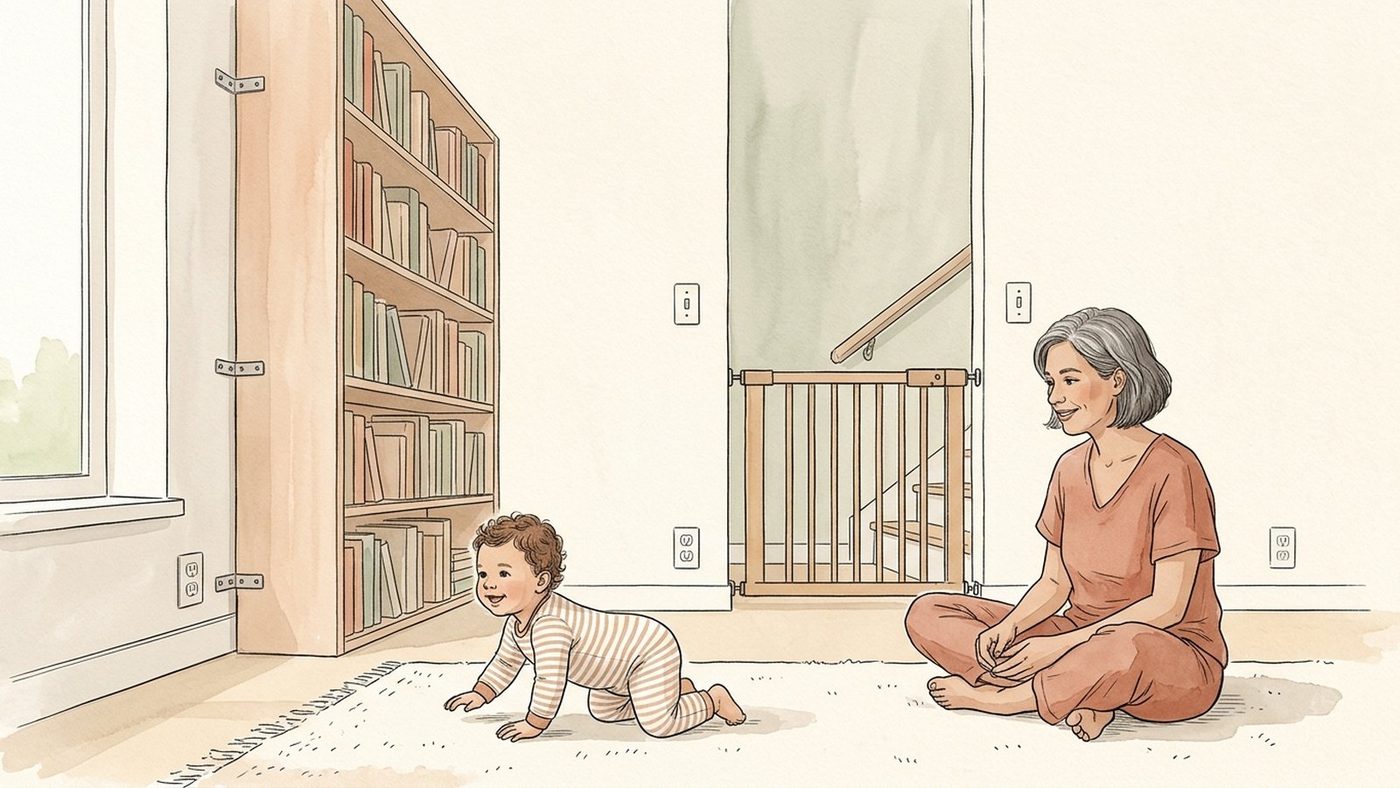
Short answer: Babyproof in stages, staying one step ahead of your baby. From birth, focus on safe sleep, bath safety, and never leaving your baby on a raised surface. By 4 to 6 months, clear the floor of small objects. By 6 to 9 months, add stair gates, outlet plugs, cabinet locks, and anchor furniture and TVs. By 9 to 12 months, lock away medicines, secure windows, and check anything your baby can pull up on.
The day Adam rolled across the living room rug to the bookshelf, I knew babyproofing couldn’t wait. This is the checklist I now keep one step ahead of him.
Key takeaways
- You don’t need to do everything on day one. Babyproof for the next skill, a little before it arrives.
- Some rules never change: back to sleep in a bare crib, a hand on your baby in the bath, and no babies left alone on beds, sofas, or changing tables.
- Anything small enough to fit through a toilet-paper tube is a choking risk once your baby can grab.
- Anchoring TVs and furniture is one of the highest-impact jobs on the list, and most kits cost under $20.
- Save Poison Help in your phone: 800-222-1222.
When should I start babyproofing?
Start with sleep and bath safety from day one, then childproof each new zone a few weeks before your baby can reach it.
Babies don’t send a calendar invite before they roll or crawl for the first time. So instead of one giant weekend project, think in stages. Here’s what each one tends to look like:
| Stage | What your baby is starting to do | Babyproofing focus |
|---|---|---|
| Birth to 3 months | Lifting their head, kicking, wriggling | Safe sleep, bath safety, changing table, smoke alarms, water temperature |
| 4 to 6 months | Rolling, reaching, mouthing everything | Small objects off the floor, toys with loose parts, button batteries |
| 6 to 9 months | Sitting, scooting, often crawling | Stair gates, outlets, cords, cabinet locks, anchored furniture and TVs |
| 9 to 12 months | Pulling up, cruising, climbing | Medicines and cleaners locked away, windows, hot drinks, toilets and buckets |
Every baby moves on their own timeline, so watch your baby, not the calendar. If you’re curious what’s coming next, see Baby milestones by month and When do babies crawl?
What do I need to babyproof from birth to 3 months?
Mostly the places your baby sleeps, gets changed, and takes a bath.
- Safe sleep: on the back for every nap and night, on a firm, flat surface, with a fitted sheet only. The AAP says no pillows, blankets, bumpers, or toys in the crib, and suggests room sharing (not bed sharing) for at least the first 6 months.
- The crib itself: slats no more than 2 3/8 inches (6 cm) apart, and a mattress that fits with no gaps. Keep the crib away from windows and cords.
- Changing table: sturdy, with a 2-inch guardrail on all four sides. Keep one hand on your baby, and never leave them on a raised surface, even for a moment.
- Bath: set your water heater so the hottest water at the tap is no more than 120°F, and test the water with your wrist or elbow. Keep a hand on your baby the whole time.
- Alarms: smoke and carbon monoxide alarms on every level and outside every bedroom, checked monthly.
The AAP says to take down a crib mobile once your baby can get up on their hands and knees, or at 5 months, whichever comes first.
What changes at 4 to 6 months?
Your baby can roll and grab, so the floor and everything on it becomes the new safety zone.
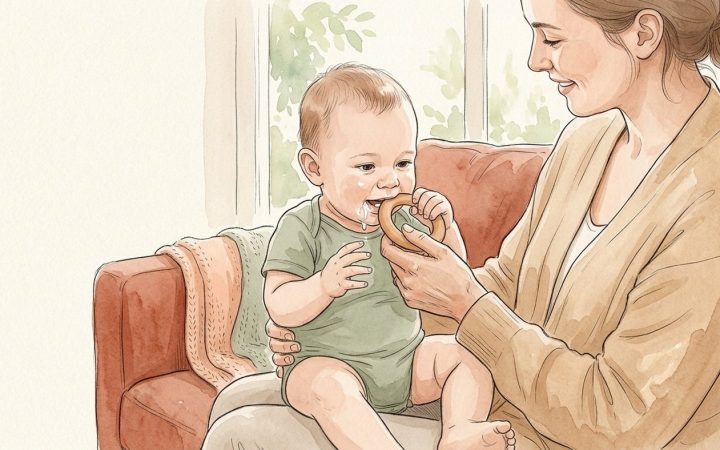
Mouthing is how babies explore, and that’s a good thing. Your job is to make sure what they find is safe. The US Consumer Product Safety Commission (CPSC) uses a small-parts test cylinder about 1.25 inches wide, roughly the width of a toilet-paper tube, to decide what’s too small for children under 3. Anything that fits through a tube like that should stay off the floor.
- Sweep the floor for coins, buttons, hair ties, pet food, and older siblings’ toys.
- Check toys for loose eyes, beads, or parts that could come off.
- Keep button batteries and magnets completely out of reach. Read why in Button batteries and magnets.
- Rolling babies can move faster than you expect, so floor play, including tummy time, is safest on a clear patch of floor.
What should I babyproof at 6 to 9 months?
This is the big one: gates, outlets, cords, cabinets, and anchoring heavy furniture.
- Stair gates at the top and bottom of stairs. The AAP advises gates firmly mounted to the wall studs, and avoiding accordion-style gates, which can trap an arm or neck.
- Outlets: cover unused outlets with safety plugs that aren’t a choking hazard themselves, and keep electrical cords out of reach.
- Window cords: the CPSC recommends cordless window coverings when possible. If you have cords, keep them taut and out of reach.
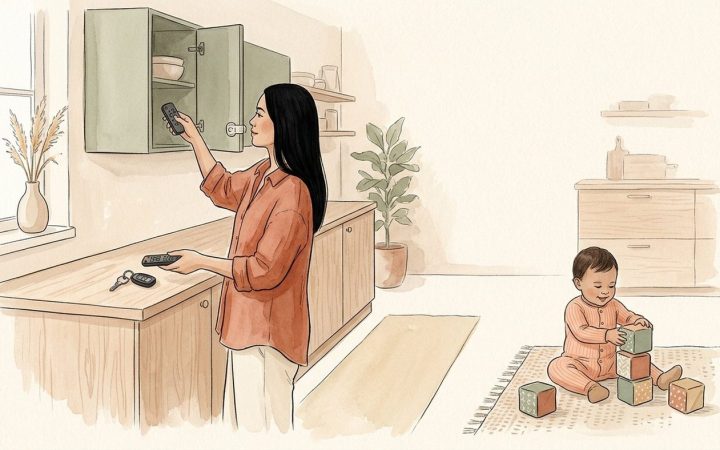
- Cabinets: safety locks on any cabinet with cleaning products or other dangerous items.
- Furniture and TVs: anchor bookcases, dressers, and TV stands to the wall, and put TVs on a low, sturdy base pushed back as far as possible.
What the research says: CPSC national data show why anchoring matters. Since 2000, there have been 581 tip-over deaths involving furniture, TVs, or appliances, and 472 of them (81%) were children. Televisions were involved in 71% of those child deaths. The CPSC says most anti-tip kits cost less than $20 and take under 20 minutes to install.
Babyproofing is what makes free floor play possible, and floor play is where so much learning happens. Our book The First-Year Mind has a simple safety checklist for each stage of the first year, right alongside 50 activities to do on that safe patch of floor.

What should I babyproof at 9 to 12 months?
Think higher and wetter: anything your baby can pull up on, climb toward, or tip into.
- Medicines: store them high, in a locked cabinet, including the ones in your bag. The AAP points out that safety caps are child-resistant, not childproof.
- Alcohol, nicotine, and cannabis edibles: locked away. Empty unfinished drinks right away.
- Windows: open them from the top if you can. If they open from the bottom, the AAP suggests window guards that only an adult can open. A screen isn’t strong enough to stop a fall. Move chairs and sofas away from windows.
- Bathroom: a toilet lid lock, and hair dryers and razors unplugged and stored away.
- Water around the house: empty buckets, wading pools, and coolers when you’re done with them.
- Hot drinks kept well out of reach, and fireplaces and heaters screened off.
- No baby walkers. The CDC advises against them. Here’s why: Are baby walkers safe?
How do I check my home from my baby’s point of view?
Get down on the floor, at your baby’s height, and look around each room.
From down there, you’ll spot the dangling lamp cord, the dishwasher pod under the sink, and the coin under the sofa that you’d never notice standing up. Do it again each time your baby learns a new way to move. With my own baby, the floor check found more than any shopping list did, and it cost nothing.
And go easy on yourself. No home is perfectly babyproofed, and that’s not the goal. The goal is fewer hazards within reach, plus a grown-up nearby.

Never leave your baby alone in or near water, even for a moment: the AAP warns that babies can drown in as little as 1 or 2 inches of water. Bath seats don’t prevent drowning. If you think your child swallowed something harmful, call Poison Help at 800-222-1222, and for a button battery, go to the ER immediately.
Frequently asked questions
When do I need stair gates?
The AAP recommends gates at the top and bottom of stairs when your child is learning to crawl or walk. Installing them a little before that is easiest.
Do I need to babyproof the whole house?
Focus first on the rooms your baby spends time in, plus stairs, the bathroom, and the kitchen. Close doors or use gates to keep your baby out of rooms you haven’t checked.
Do I really need to anchor furniture if it looks stable?
Yes. The CPSC notes that children can use drawers to climb, and a dresser or TV that tips can land on a small child. The CPSC recommends anchoring TVs, bookcases, and dressers to the wall.
What temperature should my water heater be?
The AAP recommends setting it so the hottest water at the faucet is no more than 120°F (49°C), to help prevent scalds.
Sources
- American Academy of Pediatrics. Home safety: tips for families with young children. HealthyChildren.org. healthychildren.org
- American Academy of Pediatrics. Make baby’s room safe: parent checklist. HealthyChildren.org. healthychildren.org
- American Academy of Pediatrics. A parent’s guide to safe sleep. HealthyChildren.org. healthychildren.org
- American Academy of Pediatrics. Bathroom safety tips for infants and young children. HealthyChildren.org. healthychildren.org
- American Academy of Pediatrics. Infant drowning prevention and water safety. HealthyChildren.org. healthychildren.org
- US Consumer Product Safety Commission (2022). CPSC injury and fatality report on TV and furniture tip-overs. Anchor It! anchorit.gov
- US Consumer Product Safety Commission. Small parts for toys and children’s products. cpsc.gov
- CDC. Learn the Signs. Act Early.: milestones by 1 year. cdc.gov