Short answer: Babies start “talking” long before their first word. Most coo by 4 months, take turns making sounds with you by 6 months, and babble “mamamama” and “babababa” by 9 months. By 12 months, most call a parent “mama,” “dada,” or another special name. By 18 months, most try to say three or more other words, and by 2 years, most put two words together, like “More milk.”
Key takeaways
- Cooing, babbling, and gestures like waving are real steps in learning to talk, not just warm-ups.
- The CDC’s milestones show what most babies (75% or more) do by each age, so some babies get there earlier.
- The best-tested way to help is simple: talk with your baby in warm, sing-song “parentese,” and take turns.
- Two languages at home won’t confuse your baby or cause a delay.
- If your baby misses a milestone or loses a skill, talk to your doctor and ask about a hearing check. Don’t wait and see.
When do babies say their first word?
Most babies say a first real word around their first birthday, usually a special name for a parent.
The CDC’s milestone for 12 months is “Calls a parent ‘mama’ or ‘dada’ or another special name.” That’s different from babbling “mamamama,” which most babies do by 9 months as they play with sounds. The difference is meaning: a first word is aimed at a person or thing. Understanding also runs ahead of speaking. By 12 months, most babies understand “no,” pausing or stopping briefly when you say it, and by 15 months, most look at a familiar object when you name it.
What are the language milestones from birth to 3 years?
Here are the CDC’s language and communication milestones, in their exact words, for each checkup age.
| By this age | Most children (CDC) |
|---|---|
| 2 months | “Makes sounds other than crying”; “Reacts to loud sounds” |
| 4 months | “Makes sounds like ‘oooo’, ‘aahh’ (cooing)”; “Makes sounds back when you talk to him”; “Turns head towards the sound of your voice” |
| 6 months | “Takes turns making sounds with you”; “Blows ‘raspberries’”; “Makes squealing noises” |
| 9 months | “Makes different sounds like ‘mamamama’ and ‘babababa’”; “Lifts arms up to be picked up” |
| 12 months | “Waves ‘bye-bye’”; “Calls a parent ‘mama’ or ‘dada’ or another special name”; “Understands ‘no’” |
| 15 months | “Tries to say one or two words besides ‘mama’ or ‘dada’”; “Points to ask for something or to get help” |
| 18 months | “Tries to say three or more words besides ‘mama’ or ‘dada’” |
| 2 years | “Says at least two words together, like ‘More milk.’” |
| 3 years | “Talks with you in conversation using at least two back-and-forth exchanges”; “Talks well enough for others to understand, most of the time” |
Since 2022, the CDC lists skills that 75% or more of children have by each age, so a missed milestone is a reason to check in, not a diagnosis. You can see every area of development in Baby milestones by month.

How can I help my baby learn to talk?
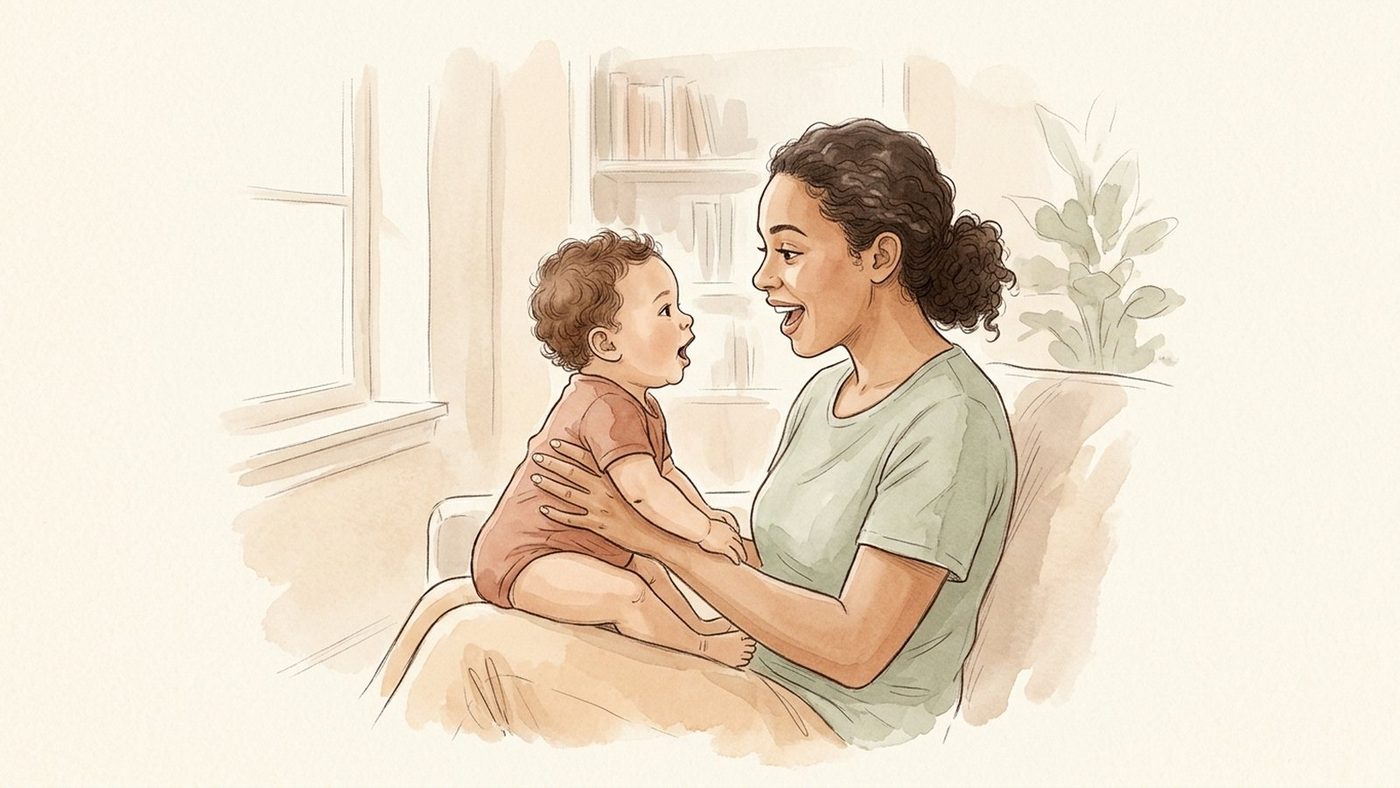
Talk with your baby all day in warm “parentese,” and treat every coo or babble as their turn in a conversation.
- Use parentese. That’s the slower, higher, sing-song voice most of us use with babies naturally, with stretched-out vowels and real words. It isn’t nonsense baby talk.
- Serve and return. When your baby makes a sound, answer, then pause and give them time to “reply.” The back-and-forth matters more than the number of words.
- Repeat and add. The AAP suggests that when your baby says a syllable, you say it back, then add simple words with that sound: “Ba! Ball! Here’s your ball.”
- Narrate your day. Describe what you’re doing and what your baby is looking at. When they point, name the thing.
- Read and sing every day. Books give you new things to name and talk about together. See Reading to your baby for ideas by age.
What the research says: two randomized trials from the University of Washington coached parents to use more parentese and conversational turns, starting when babies were 6 months old. In the first, coached babies babbled more and produced more words at 14 months. In the second, by 18 months, children of coached parents had a parent-reported vocabulary of about 100 words, compared with about 60 for the other group. These are strong study designs, but both came from one research group with modest numbers of families.
With my son Adam, I felt a bit silly narrating the grocery store out loud at first. Now it’s just how we shop, and the pauses for babbled “answers” are my favorite part.
Does baby sign language help babies talk sooner?
There’s no good evidence that it speeds up talking, but it doesn’t hurt and many families enjoy it.
In the first randomized trial of baby signing, published in 2013, babies whose mothers modeled signs did not differ in language from other babies by 20 months. Mothers who signed did become more tuned in to their baby’s nonverbal cues, which is lovely in itself. The CDC still suggests teaching gestures like waving “bye-bye” around 9 months. So sign “more” and “all done” if you like, just as a fun extra, not a shortcut.
Our book The First-Year Mind has a whole chapter on talking your baby into language, plus simple daily habits for each stage of the first year.
Will two languages delay my baby’s talking?
No. The AAP says learning more than one language does not cause language delays or confusion.
Mixing words or grammar from two languages is normal and doesn’t mean your child is confused. The AAP suggests speaking the language or languages you’re most comfortable with, since warm, natural talk is what helps most.
For bilingual toddlers, the AAP says to count words in both languages together. A 2-year-old with 25 English words and 25 Spanish words has the same total as a child with 50 words in one language.

When should I talk to the doctor about my baby’s speech?
Whenever your baby misses a milestone, loses a skill, or you simply have a feeling something’s off.
Hearing is the first thing to check. The CDC says all babies should have a hearing screening by 1 month, and if you ever think your child may not hear well, ask the doctor for a hearing test as soon as possible. The AAP notes that hearing loss can be partial, so a baby may still react to loud noises or turn to your voice.
- Your baby doesn’t babble or imitate any sounds by about 7 months
- Your baby isn’t reaching the language milestones in the table for their age
- Your baby has lost words, sounds, or gestures they used to have
- You’re worried about your baby’s hearing, or they’ve had lots of ear infections
If you’re still concerned, the CDC suggests asking for a referral to a specialist and calling your state’s early intervention program. You don’t need a diagnosis to ask.
Frequently asked questions
Is “mama” at 7 months a first word?
Usually it’s babbling, which is wonderful too. The CDC lists “mamamama” and “babababa” sounds by 9 months, and calling a parent “mama” or “dada” with meaning by 12 months.
Do babies understand words before they can say them?
Yes. Understanding comes first. By 15 months, most children look at a familiar object when you name it and follow simple directions given with a gesture and words.
Can videos or apps help my baby talk?
Babies learn language from back-and-forth with people. The AAP advises avoiding screens other than video chat before 18 months. More in Screen time for babies.
Is baby talk bad for my baby?
Not the warm, sing-song kind. Parentese uses real words and full sentences in a happy, stretched-out voice, and it’s the style studied in the coaching trials. Just skip made-up words in place of real ones.
Sources
- CDC. Learn the Signs. Act Early.: milestones by 2, 4, 6, and 9 months. cdc.gov
- CDC. Learn the Signs. Act Early.: milestones by 1 year. cdc.gov
- CDC. Learn the Signs. Act Early.: milestones by 15 months, 18 months, 2 years, and 3 years. cdc.gov
- Zubler JM, Wiggins LD, Macias MM, et al. (2022). Evidence-informed milestones for developmental surveillance tools. Pediatrics, 149(3), e2021052138. doi.org
- Ferjan Ramírez N, Lytle SR, Fish M, Kuhl PK (2019). Parent coaching at 6 and 10 months improves language outcomes at 14 months: a randomized controlled trial. Developmental Science. doi.org
- Ferjan Ramírez N, Lytle SR, Kuhl PK (2020). Parent coaching increases conversational turns and advances infant language development. PNAS. nih.gov
- Kirk E, Howlett N, Pine KJ, Fletcher BC (2013). To sign or not to sign? The impact of encouraging infants to gesture on infant language and maternal mind-mindedness. Child Development, 84(2), 574–590. whiterose.ac.uk
- American Academy of Pediatrics. Young children learning multiple languages: parent FAQs. HealthyChildren.org. healthychildren.org
- American Academy of Pediatrics. Language development: 4 to 7 months. HealthyChildren.org. healthychildren.org
- CDC. Hearing loss in children: screening and diagnosis. cdc.gov