
Short answer: Take puffy winter coats and snowsuits off before you buckle your child into a car seat. The American Academy of Pediatrics warns that bulky padding compresses in a crash, leaving the harness too loose to hold your child. Dress them in thin layers, tighten the harness until you can’t pinch any slack at the shoulder, then put a blanket or their coat over the buckled straps.
The first properly cold morning this fall, I zipped Adam into his puffy snowsuit, carried him to the car, and then stood at the open door wondering whether it was actually safe. Here’s what I found when I looked it up.
Key takeaways
- No puffy layers under the harness: the AAP says bulky coats and snowsuits shouldn’t be worn underneath car seat straps.
- Why: in a crash the padding flattens instantly, leaving space between your child and the harness.
- The pinch test: once your child is buckled, you shouldn’t be able to pinch any slack in the strap at the shoulder.
- Warmth goes on top: thin layers underneath, then a blanket, a backwards coat, or a poncho over the buckled harness.
Can my baby wear a winter coat in a car seat?
Not a bulky one. The AAP’s parenting site says bulky clothing, including winter coats and snowsuits, should not be worn underneath the harness of a car seat. The US National Highway Traffic Safety Administration (NHTSA) gives the same advice in its winter driving tips: heavy coats can interfere with a proper harness fit, so choose thin, warm layers and add coats or blankets after the harness is snug.
This applies to every type of seat with a harness: rear-facing infant carriers, convertible seats, and forward-facing seats for toddlers. The AAP adds that adults shouldn’t wear puffy coats under a seat belt either, for the same reason.
A thin fleece or a close-fitting jacket is usually fine. The question isn’t “coat or no coat” so much as “how much air and padding is between my child and the straps?” The test in the next section answers that for any coat you own.
Why are puffy coats unsafe in car seats?
Because the padding squashes flat in a crash. A puffy coat is mostly trapped air. When you tighten the harness over it, the straps feel snug, but they’re snug against the coat, not against your child. The AAP explains that in a crash the padding immediately flattens out from the force, leaving extra space under the harness, and a child can slip through the straps and be thrown from the seat.
Car seats are designed and crash-tested with the harness close to the body. The AAP’s car seat guidance says the harness should be snug enough that you cannot pinch any slack between your fingers when you test the straps over your child’s shoulders. A thick coat makes that check unreliable, because you’re pinching coat, not strap.

How do I do the pinch test for a winter coat?
Buckle your child in with the coat on, tighten, then try again without it. This version of the test is published by Colorado’s Department of Transportation and repeated by many car seat technicians. Do it once at home, in a warm room, for each coat or snowsuit you’re unsure about:
- Coat on, buckle up. Put the coat on your child, place them in the car seat, buckle the harness, and fasten the chest clip.
- Tighten until snug. Pull the harness tight until you can’t pinch any slack in the strap at the shoulder.
- Don’t loosen anything. Unbuckle and lift your child out without touching the harness adjuster.
- Coat off, buckle again. Take the coat off and buckle your child back in at exactly the same harness setting.
- Pinch at the shoulder. If you can now pinch a fold of strap between your thumb and finger, the coat is too bulky to wear under the harness.
While you’re there, check the rest of the fit. The AAP says the chest clip should sit at the center of the chest, even with your child’s armpits. For a rear-facing seat, the shoulder straps come out of the slots at or below your child’s shoulders; for a forward-facing seat, at or just above.
| What your child is wearing | Under the harness? | Why |
|---|---|---|
| Puffy coat or snowsuit | No | Padding compresses in a crash and leaves the harness loose |
| Thick sweater or heavy fleece | Do the pinch test | Some are thin enough, some aren’t |
| Thin fleece jacket | Usually yes | The AAP suggests one as a top layer under the straps |
| Leggings, long-sleeved bodysuit, pants and top | Yes | Close-fitting layers don’t create slack |
| Hat, mittens, socks or booties | Yes | They add warmth without touching the straps |
| Blanket, backwards coat or poncho | On top only | Added over the buckled harness, not under it |
Free download
Free: babyproofing and safe sleep checklists
Room-by-room babyproofing and the safe sleep basics on the fridge. Part of our free 7-page printables pack.
How do I keep my baby warm in the car seat without a coat?
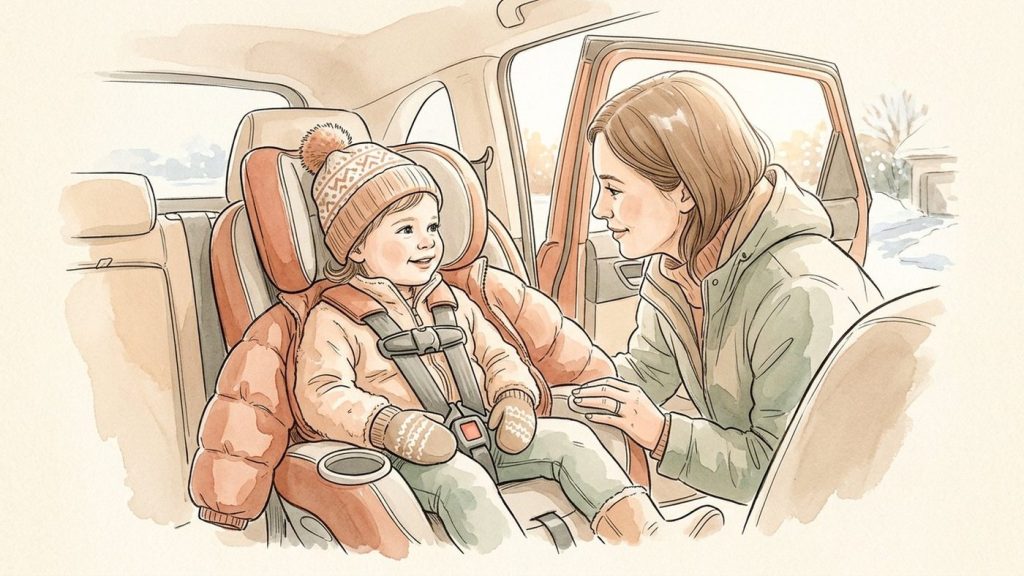
Layer thin underneath and add warmth on top. The AAP’s winter car seat tips suggest close-fitting bottom layers like tights, leggings, or a long-sleeved bodysuit, then pants and a warmer top, with a thin fleece jacket over that if needed. Long underwear helps in very cold weather. Hats, mittens, and socks or booties keep extremities warm without getting in the way of the straps.
Once your child is buckled and the harness passes the pinch test, you can add the warm layer over the top:
- A blanket over the harness. Tuck it over your child’s lap and body after buckling. Keep it off their face.
- The coat on backwards. For toddlers, buckle first, then slide their arms into the sleeves from the front so the coat sits over the straps like a cozy apron.
- A poncho or flip-over jacket. The AAP mentions zip-down ponchos and jackets that flip over the harness as options.
- Keep the infant carrier indoors. The AAP suggests storing the carrier part of an infant seat inside when it’s not in use, so your baby isn’t placed into a freezing-cold seat.
One more AAP tip: the top layer should be easy to remove. Cars warm up fast, and a baby bundled under a blanket next to a blasting heater can get too hot. If the back of their neck feels sweaty, take a layer off. Our guide to dressing your baby by temperature explains how to check for overheating.
Are car seat covers and bunting bags safe?
Only the kind that goes over the top, with nothing behind or under your baby. The AAP says to use a car seat cover only if it does not have a layer under the baby. Shower-cap style covers that stretch over the outside of an infant carrier don’t touch the harness, so they don’t change the fit. Bunting bags and thick liners that sit behind your baby’s back or thread through the harness slots do.
The broader rule from the AAP is to avoid aftermarket car seat products altogether unless they came with the seat or are specifically approved by the seat’s manufacturer. Items sold separately haven’t been crash-tested with your seat. The AAP also says never to use stroller accessories or sleeping-bag inserts in a car seat.
Whatever you use on top, keep your baby’s face uncovered, and don’t drape a blanket over the whole infant carrier. Colorado’s transportation safety office warns that covering the entire seat can restrict airflow. Babies can also overheat quickly under extra layers once the car heats up. When you arrive, take your baby out of the car seat; car seats aren’t a safe place for routine sleep, as we explain in baby sleep in a swing or car seat.
What about toddlers who refuse to take their coat off?
Make the coat part of the routine, not a battle. These are the ideas parents and car seat technicians share most often:
- Warm the walk, not the ride. Wear the coat from the house to the car, take it off at the car door, and put it on backwards once buckled.
- Start the car first, if you safely can. A warmer car makes taking the coat off much less dramatic. Never leave a child alone in the car while it warms up.
- Give them a job. Let your toddler “help” pull the blanket up or choose which one to bring.
- Leave early. The AAP suggests allowing extra time on winter mornings so you aren’t tempted to skip steps.
The AAP also recommends keeping toddlers rear-facing for as long as possible, until they reach the highest weight or height their convertible seat allows. That’s worth knowing in winter too, since every step down in seat type is a step down in protection.
What the research says: the coat advice rests on how harnesses work and on crash-test demonstrations, and it’s consistent across the AAP, NHTSA, Safe Kids Worldwide, and state transportation departments. We couldn’t find a large study counting injuries linked to coats specifically, so there isn’t a precise risk figure. But the underlying principle, that a snug harness protects better than a loose one, is the foundation of the AAP’s child passenger safety policy.
The AAP suggests a winter emergency bag for the car with extra blankets, dry clothes, hats, gloves, and non-perishable snacks. It’s useful if you get stuck in traffic or your toddler gets soaked in the snow.
Call your pediatrician or local emergency number if:
- your baby seems very cold and isn’t warming up, is unusually floppy or hard to wake, or has pale, cold, stiff skin
- your baby is hot, flushed, breathing fast, or very drowsy after a car ride, which can be signs of overheating
- your child was in a car crash, even a minor one, and seems hurt or unwell. Ask your car seat’s manufacturer whether the seat needs replacing.
For more ways to keep little ones safe as they get mobile, our babyproofing checklist by age covers the home, and our post on toddler sleep on vacation helps with holiday road trips.
Frequently asked questions
Is a thin fleece jacket OK in a car seat?
Usually, yes. The AAP lists a thin fleece jacket as a suitable top layer under the harness. If you’re unsure, do the pinch test with and without it.
Are “car seat safe” coats really safe?
We couldn’t find any official standard behind that marketing label. Judge any coat with the pinch test instead: if you can pinch slack at the shoulder after removing it, it’s too bulky to wear under the straps.
Can I put a blanket over my baby in the car seat?
Yes, over the buckled harness, never under it. Keep it away from your baby’s face, and don’t cover the whole carrier.
Does the coat rule apply to short trips?
Yes. A crash can happen on any trip, however short, so the harness needs to be snug every time.
Is a snowsuit OK if I loosen the straps enough to buckle?
No. Loosening the straps to fit over a snowsuit is exactly what creates the dangerous gap. Take the snowsuit off and use a blanket on top instead.
Sources
- American Academy of Pediatrics, HealthyChildren.org. Winter Car Seat Safety Tips. healthychildren.org
- American Academy of Pediatrics, HealthyChildren.org. Car Seats: Information for Families. healthychildren.org
- Durbin DR, Hoffman BD; AAP Council on Injury, Violence, and Poison Prevention (2018). Child Passenger Safety. Pediatrics. doi.org
- National Highway Traffic Safety Administration. Winter Driving Tips. nhtsa.gov
- National Highway Traffic Safety Administration. Car Seats and Booster Seats. nhtsa.gov
- Safe Kids Worldwide. Ask an Expert: Winter Coats and Car Seats. safekids.org
- Colorado Department of Transportation (2025). Winter coats and car seat safety. codot.gov