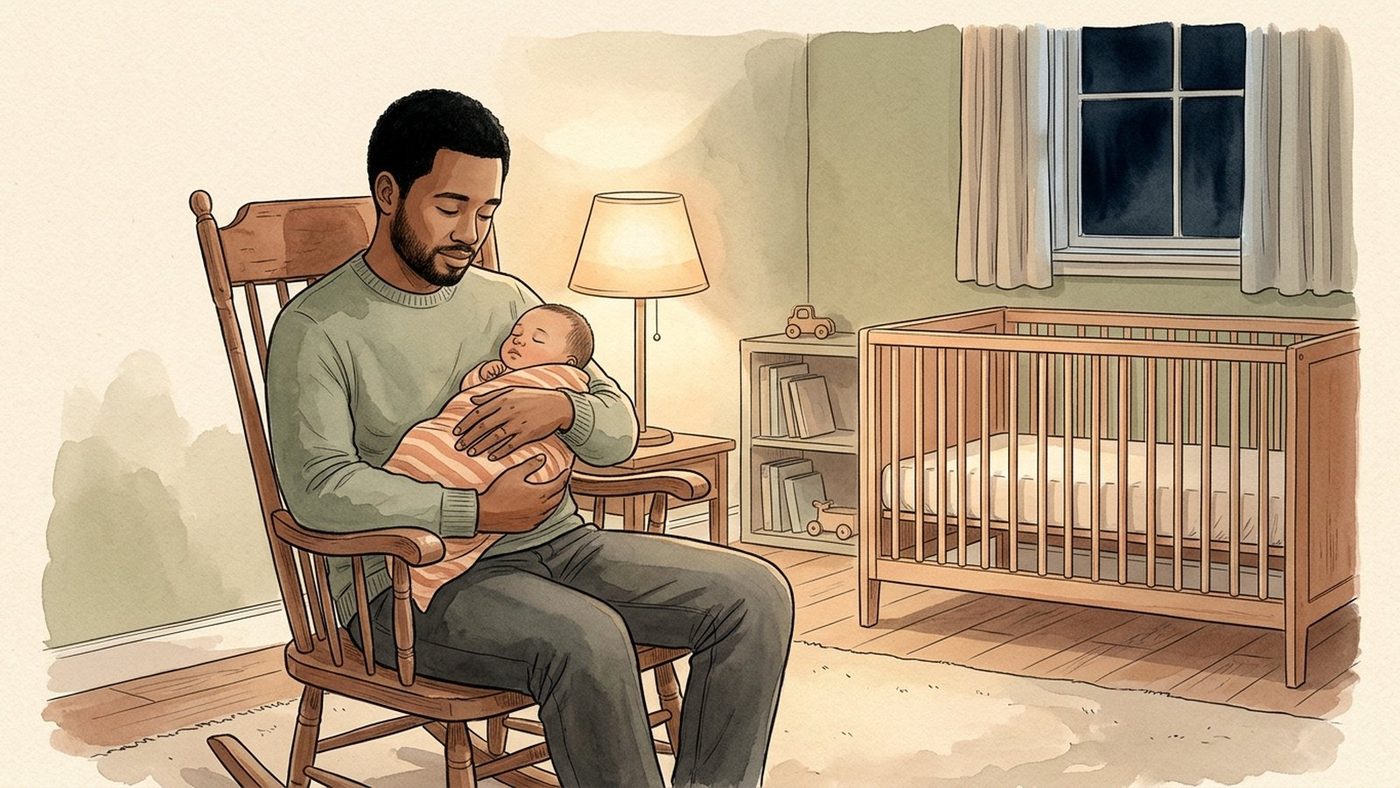
Short answer: Many parents notice sleep getting rougher around 4 months, but no peer-reviewed study has documented a universal “4-month sleep regression.” What research does show is that baby sleep swings a lot from night to night, and that a lot is changing at this age. A rough patch usually passes, and a steady bedtime routine plus putting your baby down awake are the best-tested ways to help.
Around four months, Adam suddenly went from long stretches of sleep to waking every two hours. I was exhausted and confused, so I dug into what was really going on.
Key takeaways
- No study has defined or measured a predictable “4-month regression.” The name comes from parent experience and popular advice, not research.
- Big swings are normal: in two weeks of diaries for 44 six-month-olds, half never once slept 8 hours straight.
- Sleep is still improving overall: between 3 and 6 months, night wakings average under one a night, and the longest stretch grows by about 40 minutes a month.
- Rolling usually starts around 3–4 months. Stop swaddling at the first signs, and always place your baby on their back.
Is the 4-month sleep regression real?
Not as a proven, universal event. When we searched the medical literature, we couldn’t find a single peer-reviewed study that defines or tests a “4-month sleep regression.” That doesn’t mean your rough nights aren’t real. It means science hasn’t shown that all babies’ sleep reliably falls apart at 4 months.
The closest thing to a test came from economist Emily Oster, who looked at sleep logged in a large parenting app. She found that the expected 4-month pattern, with shorter stretches and more wakings, doesn’t show up clearly in the data. The overall trend was toward more sleep, but noisy, with a baby’s nightly sleep sometimes shifting by about two hours from one night to the next. That analysis isn’t peer-reviewed, so treat it as a useful clue rather than proof.
Why does sleep get worse around 4 months?
Often it’s ordinary night-to-night variation, sometimes with an illness, a growth spurt, or a new skill on top. Peer-reviewed research shows that variation is big. When mothers kept two-week sleep diaries for 44 six-month-olds, half the babies never slept 8 hours straight in that time, and about three in four had highly variable nights. A string of bad nights after some good ones fits right inside that normal pattern.
A lot is also changing around this age:
- The body clock is maturing. Over roughly the first three to four months, babies develop their own day-night rhythm, including their own nighttime melatonin. Studies disagree on the exact timing.
- Rolling begins. The AAP says rolling usually happens around 3 to 4 months, and it can happen earlier. That often means dropping the swaddle, which can take a few nights to adjust to.
- Sleep keeps consolidating. A review of 34 studies found that night wakings average about 0.8 a night at 3–6 months, and the longest stretch grows by roughly 40 minutes a month between 1 and 6 months. The overall direction is better sleep, even when individual weeks feel worse.
Teething gets blamed for a lot of bad nights, but in a study of 849 babies whose sleep was measured by video, teething nights looked no different from other nights, even though more than half of parents believed teething disrupted sleep.

How long does the 4-month sleep regression last?
There’s no research-based answer, because no study has measured it. Any specific number of weeks you see online is a guess. What we can say is that rough patches usually pass on their own, especially when the routine stays steady.
A simple way to see the real trend is to jot down bedtime, wakings, and morning wake-up for two weeks. Single nights mislead; a two-week view shows whether things are actually getting better, worse, or just bouncing around.
What helps a 4-month-old sleep better?
Gentle habits that build skills, not quick fixes. These have the best research behind them at this age:
- Start a short bedtime routine. In a trial of 405 families, babies 7–18 months on a nightly routine (bath, massage, quiet time, lights out) went from a longest stretch of 6.9 to 8.5 hours within two weeks. A large study of over 10,000 children found that starting younger seemed to help more.
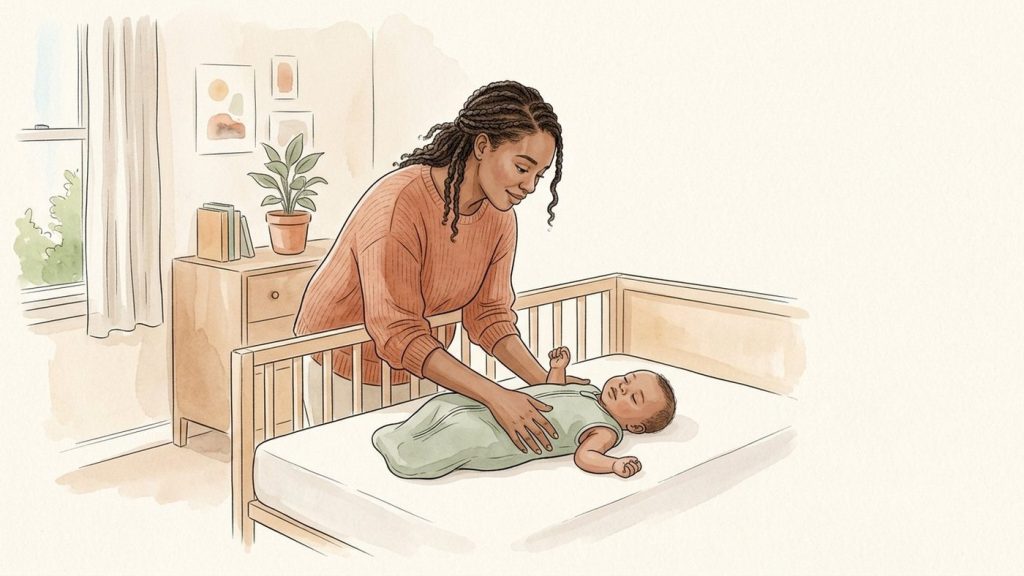
- Put your baby down awake more often. In one study, parents taught at the 4-month checkup to put their baby down awake saw fewer wakings at 9 months: 2.5 a week versus 3.9.
- Move the last feed earlier in the routine. Feed, then bath, pajamas, and a song, so the last thing before sleep is the crib, not the breast or bottle.
- Keep days bright and nights dull. Open curtains in the morning, get outside when you can, and keep night feeds dim, quiet, and brief.
Just as important is what to skip: try not to add new sleep habits during a rough week that you’ll want to undo later. Our guide The Well-Rested Mind walks through each of these habits for the 4–6-month stage, with a routine card and tracker you can print.
Should I start sleep training at 4 months?
There’s no rush, and the evidence starts later. Sleep training trials enrolled babies from about 6 months. A review of studies in the first 6 months found that early sleep programs did not reduce crying, prevent later sleep problems, or protect against postnatal depression. In a trial of 781 families given sleep advice from 4 weeks, babies’ sleep ended up no different, although parents’ mood improved.
So at 4 months, the routine and “down awake” practice above are the right tools. If you’re thinking ahead, read does sleep training work? for what the trials found from 6 months on, and check how much sleep is typical at each age in our baby sleep chart by age.
What the research says: there is no peer-reviewed evidence for a predictable 4-month sleep regression. The strongest related evidence shows large night-to-night swings in normal infant sleep, and steady improvement on average over the first six months. The habits that help (a routine and putting down awake) have trial support, mostly in slightly older babies.
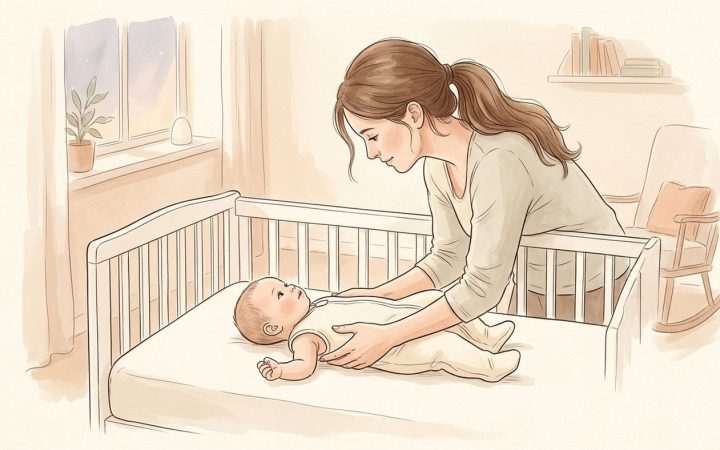
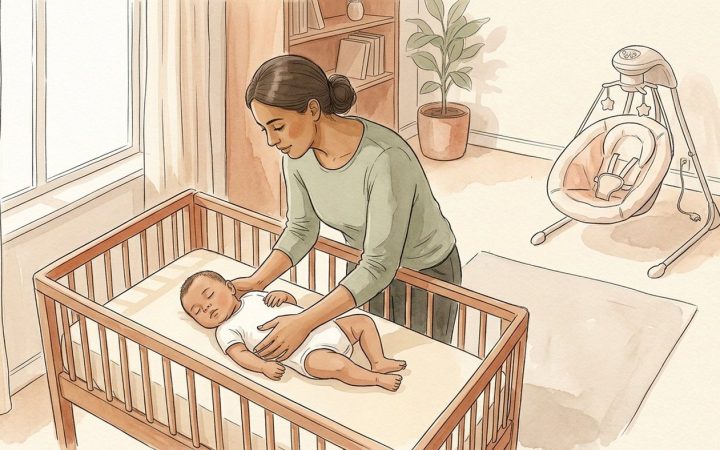
Once your baby shows any sign of trying to roll, stop swaddling and switch to a non-weighted wearable blanket with arms free. Keep placing your baby on their back for every sleep until age 1, on a firm, flat surface with only a fitted sheet. Once your baby can roll both ways easily, the AAP says you don’t need to keep turning them onto their back, as long as the sleep space is clear.
Call your pediatrician if sleep changes come with:
- fever, ear-pulling with illness, poor feeding, or frequent vomiting
- loud snoring, gasping, or pauses in breathing
- crying that sounds different from usual, or anything that worries you
Frequently asked questions
Is there an 8-month or 12-month sleep regression too?
These haven’t been studied as distinct events either. Separation anxiety and new motor skills are real parts of development, but we found no research showing a predictable sleep crash at those ages.
Will starting solids help my 4-month-old sleep?
Not much. In a large UK trial, babies who started solids around 4 months slept, at most, about 17 minutes more per night than babies who started around 6 months, based on parent reports. Official advice is still to start solids at around 6 months.
Does rice cereal in the bottle help?
No. In a trial of 106 babies, cereal in the bedtime bottle made no real difference to sleeping through the night, and it isn’t recommended.
Did I cause this by rocking or feeding to sleep?
No. Rocking and feeding to sleep are normal, loving ways to settle a baby. If you’d like your baby to settle more on their own, practice putting them down awake once a day and build from there. There’s no deadline.
Sources
- Pennestri MH, et al. (2020). Sleeping through the night or through the nights? Sleep Medicine. pubmed.ncbi.nlm.nih.gov
- Galland BC, et al. (2012). Normal sleep patterns in infants and children: a systematic review of observational studies. Sleep Medicine Reviews. pubmed.ncbi.nlm.nih.gov
- Oster E. Are sleep regressions real? ParentData (not peer-reviewed). parentdata.org
- Kahn M, et al. (2025). Does Teething Disrupt Infant Sleep? A Longitudinal Auto-Videosomnography Study. Journal of Pediatrics. pubmed.ncbi.nlm.nih.gov
- Paditz E (2024). Postnatal Development of the Circadian Rhythmicity of Human Pineal Melatonin Synthesis and Secretion (Systematic Review). Children. pmc.ncbi.nlm.nih.gov
- Mindell JA, et al. (2009). A nightly bedtime routine: impact on sleep in young children and maternal mood. Sleep. pmc.ncbi.nlm.nih.gov
- Mindell JA, et al. (2015). Bedtime routines for young children: a dose-dependent association with sleep outcomes. Sleep. pubmed.ncbi.nlm.nih.gov
- Adair R, et al. (1992). Reducing night waking in infancy: a primary care intervention. Pediatrics. pubmed.ncbi.nlm.nih.gov
- Douglas PS, Hill PS (2013). Behavioral sleep interventions in the first six months of life do not improve outcomes for mothers or infants: a systematic review. Journal of Developmental and Behavioral Pediatrics. pubmed.ncbi.nlm.nih.gov
- Hiscock H, et al. (2014). Preventing early infant sleep and crying problems and postnatal depression: a randomized trial. Pediatrics. pubmed.ncbi.nlm.nih.gov
- American Academy of Pediatrics, HealthyChildren.org. How to Keep Your Sleeping Baby Safe: AAP Policy Explained. healthychildren.org