Short answer: Toddler biting at daycare is common and usually a phase. It peaks between ages 1 and 2, often because a toddler has big feelings but not yet the words for them, and it tends to fade as language grows. The best response is the same at home and at daycare: comfort the bitten child first, give the biter a short, calm “No biting, biting hurts,” then teach words or actions to use instead.
Key takeaways
- It’s common: in one child care study, about half of the children were bitten at least once over a year. Toddler rooms see the most bites.
- It’s usually communication: frustration, teething, excitement, or wanting a toy, from a child who can’t yet say so.
- Respond calmly and briefly: care for the bitten child first, then a short “No biting,” then teach an alternative. Never bite back.
- Most bites are minor: few break the skin, and serious infection from a young child’s bite is rare. Wash with soap and water.
- Talk to your pediatrician if biting is frequent, getting worse, or continuing past about age 3 to 4.
Is biting at daycare normal for toddlers?
Yes. Biting is one of the most common behaviors in toddler rooms, and on its own it doesn’t mean your child is aggressive or that the daycare is doing something wrong. KidsHealth, the pediatric site run by Nemours, says biting is most common between the first and second birthdays, is slightly more common in boys, and tends to ease as language improves.
The numbers from child care research back this up. A Canadian Paediatric Society review of biting in child care summarized two studies: in one, 46% of 224 children were bitten over a year; in another, half of 133 children were bitten over three and a half years, with toddlers having the highest rates. The review estimates that a full-time center caring for 60 children under 3 might expect roughly one biting episode a day.
So if you get the “your child bit someone” call, or the “your child was bitten” note, you’re in very large company. Group settings make biting more likely: lots of small children, shared toys, noise, and not much personal space.
Why do toddlers bite?
Usually because biting does a job that words can’t do yet. A 15-month-old who wants a truck back has very few ways to say “that’s mine.” Biting is fast, and it works. KidsHealth lists these common reasons, and most childhood development guides agree:
| Why it happens | What it can look like | What helps |
|---|---|---|
| Frustration, no words yet | Biting during a toy grab or when crowded | Teach “Mine,” “Stop,” “My turn”; more adult support at busy moments |
| Teething or mouthing | Chewing on hands, toys, or a friend’s arm with no anger | Offer safe things to chew; see our teething guide |
| Exploring cause and effect | Bites, then watches the reaction | Keep your reaction short and dull |
| Wanting attention | Bites when adults are busy elsewhere | Give lots of attention for gentle behavior, very little for biting |
| Overexcitement or tiredness | Biting during rough play, late in the day, or before nap | Calmer activity, a rest, a snack |
| Fear or self-defense | Bites when pushed, cornered, or hugged too hard | Give space; teach “Stop” and “Help” |
Many toddlers genuinely don’t understand that biting hurts. That’s one reason KidsHealth says punishment usually isn’t needed for a first or occasional bite. What the child needs is a clear limit and a better tool. If your child is also hitting, the same thinking applies; see why does my toddler hit me.
What should happen right after a bite?
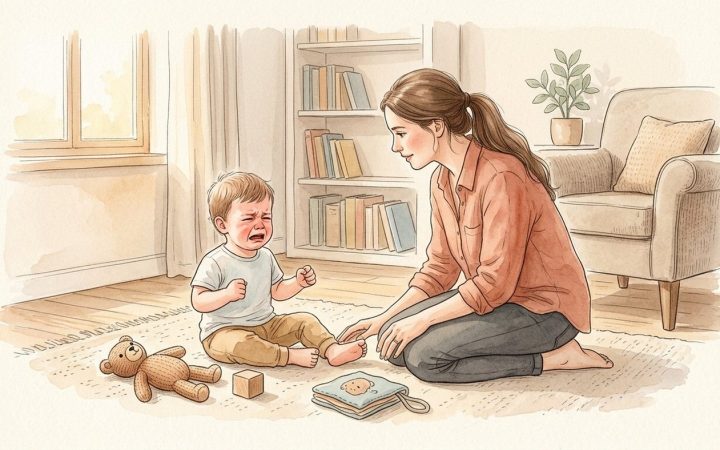
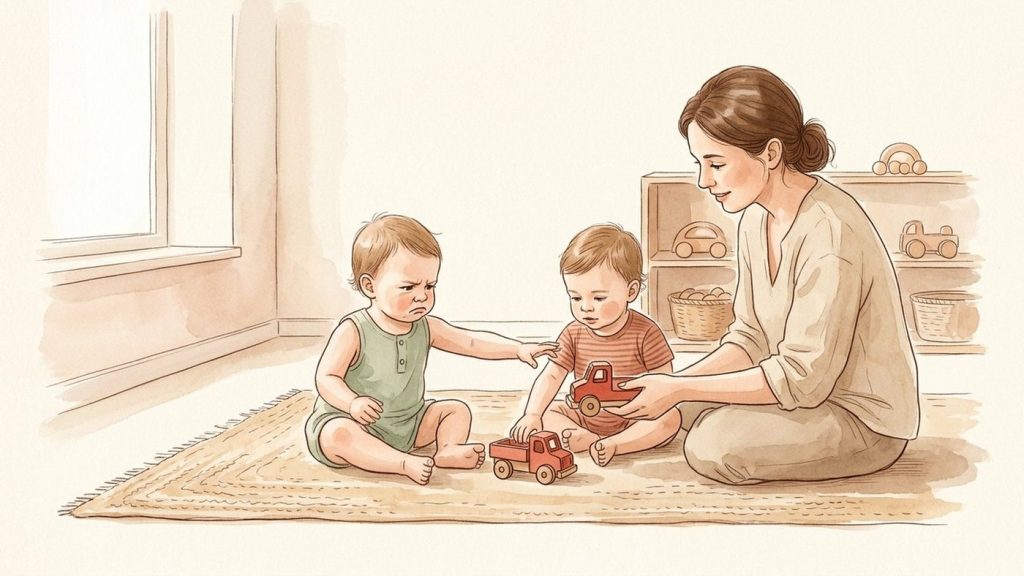
The bitten child gets the attention first. This is the most consistent piece of advice from child care and pediatric sources, and it also takes away some of the “reward” a toddler might get from a big reaction. Here is the sequence that works at daycare and at home:
- Comfort the bitten child. Check the skin and give first aid (see below). The biter sees that the hurt child gets the attention.
- Say a short, calm phrase to the biter. “No biting. Biting hurts.” Get down to their level and keep your voice low and firm. Skip the lecture; toddlers can’t follow it.
- Move the biter away briefly if needed. A short break from the play area helps everyone settle. It isn’t a punishment, just a reset.
- Teach the replacement, once calm. Practice words or signs: “Stop,” “Mine,” “Help.” Show how to get a grown-up’s attention instead.
- Redirect. Move to a calmer activity, such as a book, water play, or a walk outside.
Two things to avoid: never bite your child back “so they know how it feels,” and don’t use physical punishment. KidsHealth and other pediatric sources warn that this teaches the very thing you’re trying to stop, that hurting people is a way to solve problems. Big, emotional reactions can also backfire, because for some toddlers any strong reaction is interesting enough to repeat.
Free download
Free: milestone checklist, 2 to 12 months
The CDC milestones on one page, to tick off as your baby grows. Part of our free 7-page printables pack.
What if my child was the one who got bitten?
Most daycare bites look worse than they are. In one child care study cited by the Canadian Paediatric Society, only 4 of 224 bites (about 2%) broke the skin, and the society says bacterial infection from young children’s bites is very rare, especially with prompt cleaning. Usual first aid:
- Skin not broken: wash with soap and water, use a cold compress for swelling, and offer comfort. A bruise or teeth marks are common.
- Skin broken: let it bleed gently without squeezing, wash well with soap and water, and cover it. Watch for redness, swelling, warmth, or pus over the next few days.
- Deep or bleeding bites: KidsHealth advises getting medical care for a bite that is deep or bleeding.
Many parents worry about blood-borne infections like hepatitis B or HIV. The Canadian Paediatric Society says transmission in child care is very unlikely, and notes that no HIV or hepatitis C transmission in child care has been reported. Hepatitis B can’t pass through saliva on unbroken skin. If a bite breaks the skin, it’s reasonable to call your pediatrician, who may check your child’s immunization record.
It’s also normal to feel angry, and to want the name of the child who bit. Many daycares don’t share it. That policy protects every family, including yours if roles are reversed next month. The more useful question is what the staff are doing to prevent it from happening again.
How can parents and daycare stop the biting together?
By using the same short script in both places and looking for the pattern behind the bites. Consistency matters more than any single technique. Toddlers learn rules through repetition, and mixed messages slow that down.
Ask your child’s teachers these questions:
- When do the bites happen? Before lunch, before nap, during free play, at drop-off? Tiredness and hunger are common triggers.
- Where and with whom? Crowded corners, one popular toy, or one particular child can all be patterns.
- What happened right before? A toy grab, a push, being hugged too tightly?
- What’s the plan? Shadowing the child at high-risk times, more duplicate toys, smaller play groups, quiet corners, and praise for gentle hands are all common strategies.
At home, you can help by:
- Building words. Name feelings out loud (“You’re mad. He took the ball.”). Teach a few simple signs for “stop” and “help.” Reading and talking every day helps too; see our post on when babies start talking.
- Protecting sleep and snacks. A well-rested, fed toddler bites less. Watch the late afternoon.
- Praising gentle behavior. “You used your words, that was great.” KidsHealth recommends rewarding the good behavior rather than giving attention to the bad.
- Offering a safe chew if teething or sensory mouthing seems to be part of it.
- Keeping drop-off calm. A short, predictable goodbye routine helps anxious toddlers settle; see toddler crying at daycare drop-off.
If biting keeps happening despite this, a brief calm-down break can help some toddlers. Whether that looks like a classic time-out or sitting together until they’re calm is a family choice; we compare both in time-out vs time-in.
What the research says: how common biting is in child care comes from a handful of observational studies, mostly older and from single centers. The advice on how to respond (calm limit, care for the victim first, teach alternatives, stay consistent) is based on expert consensus and child development principles, not trials comparing one method with another. It’s sensible and low-risk, but no one has proven a single best approach.
Can a daycare ask my child to leave for biting?
Some can, but it shouldn’t be the first step. Policies vary by center and by local rules, so ask to see the written biting policy. The Canadian Paediatric Society advises that frequent biters be managed individually, with behavior strategies, changes to the room, and specialist advice if needed. It says temporary exclusion or a different setting may be needed only for continued, frequent aggressive biting. KidsHealth also notes that a calmer, smaller setting can help some children who bite a lot in a busy group.
If the center raises it, ask for a meeting, a written plan, and a few weeks to try it. A shared plan is often all it takes for the phase to pass.
Talk to your pediatrician if:
- biting continues past about age 3 to 4, is frequent, or is getting worse rather than better
- biting comes with other worrying behaviors, few words for their age, or trouble connecting with others
- your child was bitten and the skin is broken, or the bite becomes red, swollen, warm, or has pus
- a bite is deep, won’t stop bleeding, or may need stitches. For heavy bleeding, call your local emergency number.
Frequently asked questions
At what age do toddlers stop biting?
Most grow out of it as their language improves. KidsHealth says biting should stop by about age 3 or 4, and suggests talking to your doctor if it continues past then.
Should I punish my toddler for biting at daycare when they get home?
No. Toddlers can’t connect a consequence at 5 p.m. with a bite at 10 a.m. The response needs to happen in the moment. At home, practice the words and praise gentle behavior instead.
Is biting a sign of autism or a behavior problem?
Biting on its own is a normal toddler behavior. It’s worth raising with your pediatrician if it’s frequent, lasts past preschool age, or comes with other concerns such as limited words, little eye contact, or losing skills.
Why won’t the daycare tell me who bit my child?
Many centers keep the biter’s name confidential to protect both families and avoid conflict between parents. You can still ask what happened and what the plan is.
My toddler only bites me, not at daycare. Is that different?
Not really. Toddlers often save their biggest feelings for the people they feel safest with. Use the same short “No biting, biting hurts,” put them down or step back, and redirect.
Sources
- Nemours KidsHealth. Biting. kidshealth.org
- Moore DL, Canadian Paediatric Society, Infectious Diseases and Immunization Committee (2008). A bite in the playroom: Managing human bites in child care settings. Paediatrics & Child Health 13(6):515–519. pmc.ncbi.nlm.nih.gov
- Eastern Ontario Health Unit. Human Bites in Child Care Settings. eohu.ca
- Extension Child Care (extension.org). What Should I Do When My Child is Bitten in Child Care? childcare.extension.org
- UNC Healthy Child Care. Biting in Child Care. healthychildcare.unc.edu
- Head Start Early Childhood Learning & Knowledge Center. Biting Fact Sheet for Families. headstart.gov
- Cincinnati Children’s. The ABCs of Biting in Infants and Toddlers. blog.cincinnatichildrens.org
- Centers for Disease Control and Prevention. Milestones by 2 Years. cdc.gov