Short answer: A late talker is a toddler, usually around age 2, who says fewer words than expected (a common cutoff is fewer than 50 words and no two-word phrases at 24 months) but is otherwise developing typically. About half to two-thirds catch up with their peers by preschool or early school age, and research shows most score in the average range by ages 5 to 7. Because you can’t tell in advance who will catch up, the advice is to get a hearing test and an evaluation now rather than wait and see.
Key takeaways
- It’s common: the American Speech-Language-Hearing Association (ASHA) estimates 10% to 20% of 2-year-olds are late to talk.
- Many catch up: ASHA says about 50% to 70% catch up by late preschool or school age.
- Understanding matters most: toddlers who understand a lot and use plenty of gestures tend to do better than those who also struggle to understand.
- Don’t wait and see alone: get a hearing test and ask about early intervention. Evaluation is free in the US for children under 3, and no diagnosis is needed.
- Talk, read, and play: everyday conversation at home helps every child, late talker or not.
What is a late talker?
A late talker is a toddler whose spoken language starts late while everything else, including understanding, play, movement, and social connection, is on track. Speech-language specialists call this “late language emergence.” ASHA says a commonly used definition is fewer than 50 words and no two-word combinations by 24 months.
The CDC’s milestone checklists give useful checkpoints. They were updated in 2022 to show what most children (75% or more) can do by each age, so missing one is a reason to talk to your doctor, not a reason to panic:
| Age | CDC language milestone (most children) | What a late talker might look like |
|---|---|---|
| 18 months | Tries to say 3 or more words besides “mama” or “dada”; follows one-step directions without gestures | Few or no words, but understands “give it to me” and points to show you things |
| 2 years | Says at least two words together, like “more milk”; points to things in a book when asked | Single words only, or under about 50 words, but understands well and uses gestures |
| 30 months | Says about 50 words; says two or more words together with an action word, like “doggie run” | Still mostly single words; may still be catching up |
For the full picture of the early months, see our guide to when babies start talking, and for the 18-month checkpoint, how many words at 18 months.
Will my late talker catch up?
Most likely, yes, though not all, and not always completely. ASHA’s summary of the research is that about 50% to 70% of late talkers catch up to their peers by late preschool or school age. In one study it cites, about 1 in 5 children with a late-talking history had a language impairment at age 7, compared with about 1 in 10 children without that history.
Leslie Rescorla, a psychologist who has followed late talkers for decades, reviewed the long-term studies in 2011. Her conclusion was that most late talkers reach language scores in the average range by age 5, 6, or 7. But as a group, they still score somewhat lower than children who started talking on time, on most language measures, well into adolescence. Her studies also suggest vocabulary tends to catch up sooner than grammar, so sentence length and complexity may lag a bit longer.
In plain terms: “average” is the usual outcome, and many children are indistinguishable from their friends by school. Some children have lasting language difficulties, though, and some go on to have reading problems. That’s why specialists suggest keeping an eye on language and early reading even after your child catches up.
What the research says: the catch-up figures come from several long-term cohort studies, many of them small, using different definitions of “late talker” and different outcome tests. That’s why sources quote ranges rather than one number. The direction is consistent: most improve, a minority don’t, and no single early sign reliably predicts which group a child will be in.
How can I tell if it’s “just late” or something more?
You can’t be sure on your own, but some signs are more reassuring than others. A 2017 meta-analysis of 20 samples and more than 2,000 children found that the size of a toddler’s spoken vocabulary, their receptive language (how much they understand), and family socioeconomic status predicted later expressive language. Gender, family history, and whether the child used phrases did not reach significance in that analysis. ASHA adds that late bloomers tend to use more gestures and are less likely to have trouble understanding.
- More reassuring: understands simple directions and lots of words, points to show you things, waves, nods, shakes their head, plays pretend, enjoys back-and-forth games, and keeps adding new words.
- Worth a closer look: seems not to understand words or follow simple directions, few gestures, limited eye contact or interest in sharing attention, little babbling or few consonant sounds, or frequent ear infections.
- Needs prompt attention: losing words or skills they used to have, at any age.
The American Academy of Pediatrics notes that a language delay can sometimes be a sign of hearing loss, a wider developmental delay, or autism, which is why the first steps are usually a hearing test and a look at all areas of development. If only expressive language (talking) is delayed, the outlook is generally better than when understanding is delayed too. ASHA also notes that late talking is about three times more common in boys, though sex didn’t predict outcome in the 2017 meta-analysis.
What about children learning two languages? Bilingualism doesn’t cause language delay, but it can make the word count look smaller if you only count one language. We cover this in bilingual toddler speech delay.
Free download
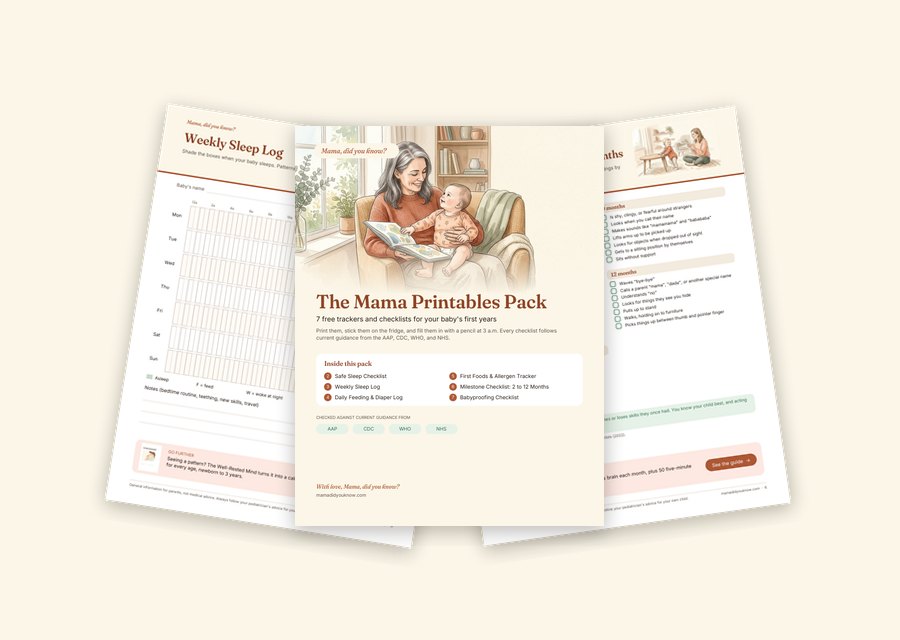
Free: milestone checklist, 2 to 12 months
The CDC milestones on one page, to tick off as your baby grows. Part of our free 7-page printables pack.
Should I wait and see, or get an evaluation?
Get an evaluation. The AAP’s HealthyChildren site says to have your child evaluated if you’re concerned about their language, and the CDC’s “Learn the Signs. Act Early.” program says simply: don’t wait. An evaluation doesn’t commit you to therapy. It gives you information, and for many late talkers the outcome is a plan to monitor and some ideas for home.
- Talk to your pediatrician. Bring a rough list of the words your child says and the gestures they use. Ask about developmental screening.
- Ask for a hearing test. Even a child who passed the newborn hearing screen can have hearing problems later, for example with fluid in the ears.
- Contact early intervention. In the US, every state has a program for children under 3 (often called “Birth to Three” or Part C). You can refer your child yourself, and the AAP notes you don’t need a formal diagnosis to get an evaluation. After age 3, contact your local school district.
- See a speech-language pathologist if one is recommended. They’ll look at understanding, speech sounds, gestures, and play.
- Recheck regularly. ASHA suggests reviewing late talkers’ progress at regular intervals, such as every 6 months, even if no therapy is started.
Experts don’t fully agree here. Some late talkers clearly catch up with no help at all, and for a child with only an expressive delay and strong understanding, ASHA describes regular monitoring, often with parent coaching, as a typical first approach. Others argue that because we can’t predict who will catch up, offering early support to everyone is the safer bet. Both sides agree on not ignoring it.
How can I help my late talker at home?
By talking with your child a lot, in short, simple, back-and-forth ways, during everyday routines. You don’t need flashcards or special apps. These are common strategies speech-language pathologists teach parents:
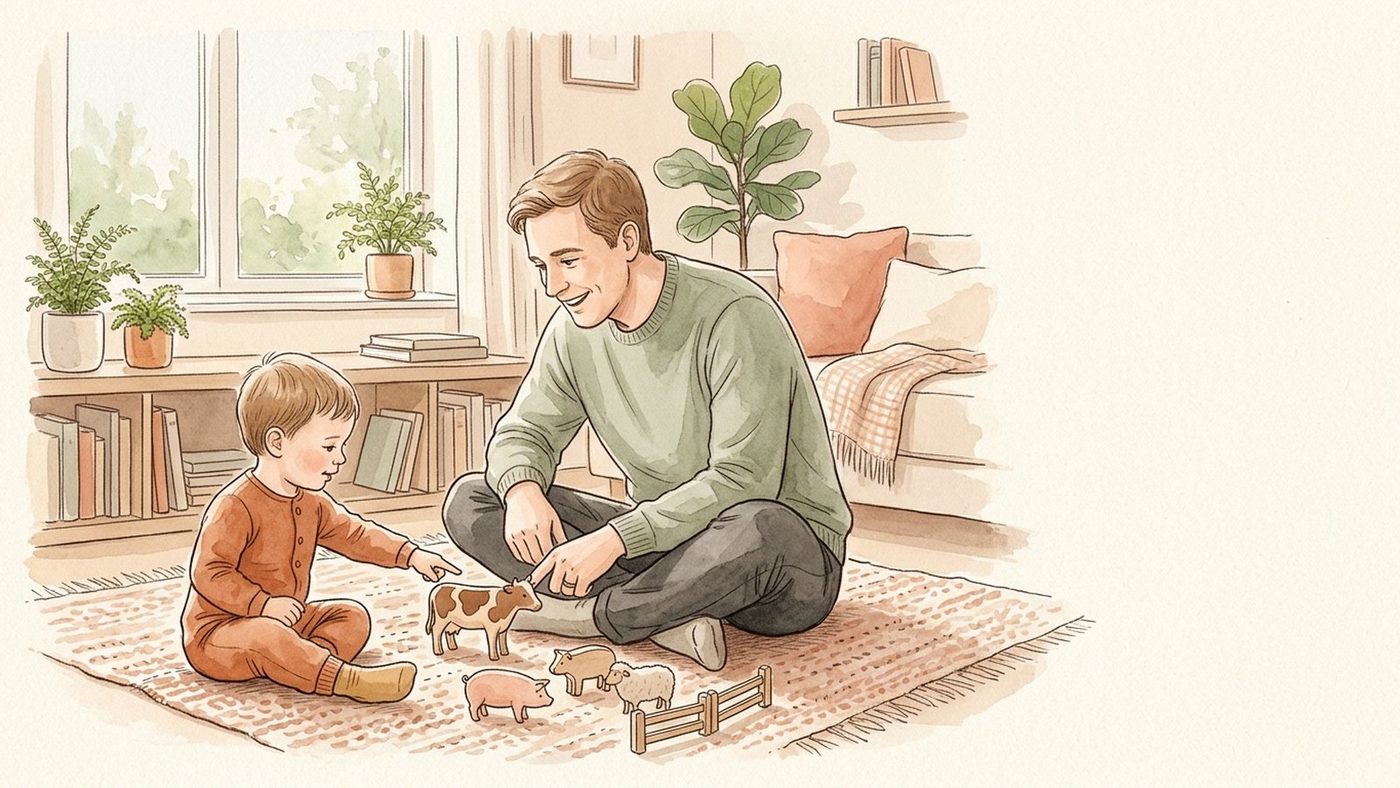
- Follow their lead. Talk about what your child is looking at or playing with, not what you want them to notice.
- Say it one step up. If they say “ball,” you say “big ball” or “throw ball.” If they point, you name it.
- Pause and wait. Leave a few seconds of quiet after you speak so they have a turn. Count to five in your head.
- Offer choices. “Apple or banana?” gives them a word to copy right when they want something.
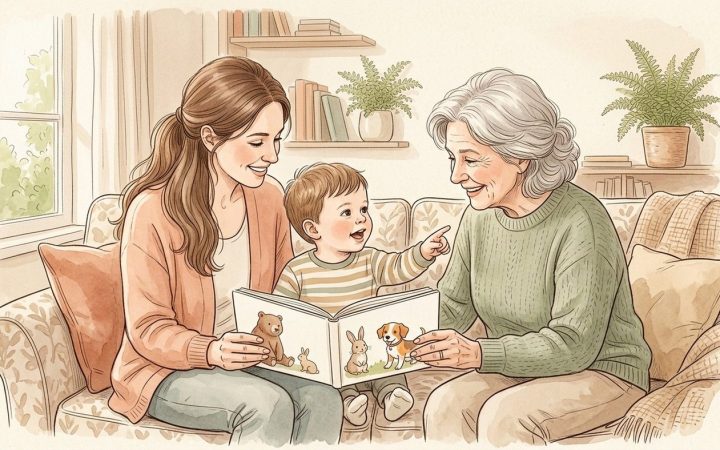
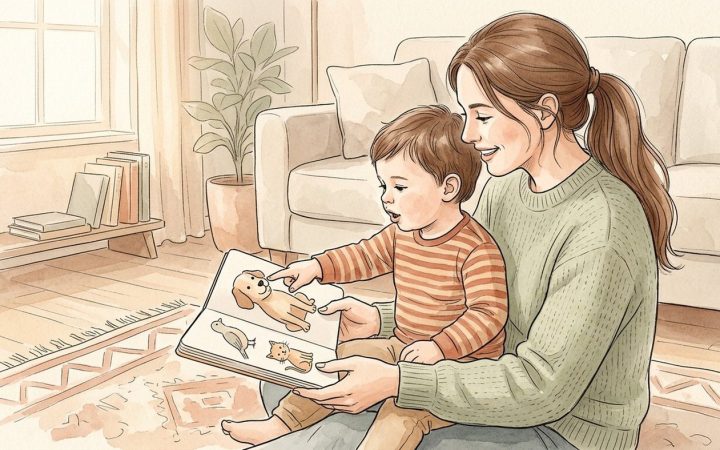
- Read together every day. Point, name, and let them turn pages. Our post on reading to your baby has ideas that work for toddlers too.
- Welcome gestures and signs. HealthyChildren encourages communicating with gestures and sounds, not just words. Signs don’t slow down speech; they’re a bridge to it.
- Keep screens in their place. Background TV cuts into conversation time. See screen time for babies for the current guidance.
Try not to pressure your child to “say it” before they get something. Model the word, wait, and give it to them either way. Keeping talk fun keeps them trying.
Talk to your pediatrician soon if your child:
- isn’t trying to say 3 or more words by 18 months, or isn’t putting two words together by age 2
- doesn’t seem to understand simple words or follow one-step directions
- doesn’t point, wave, or use other gestures, or shows little interest in sharing attention with you
- doesn’t respond to sounds or their name, or has frequent ear infections
- loses words or skills they used to have, at any age. Tell the doctor right away.
Frequently asked questions
Is a late talker the same as a speech delay?
Not exactly. “Late talker” usually means a toddler whose spoken words are delayed while other development is typical. “Speech delay” is often used loosely for any delay in talking, and “speech” can also mean trouble making sounds clearly. An evaluation helps sort out which applies.
Is being a late talker a sign of autism?
Not on its own. Most late talkers aren’t autistic. A delay that comes with limited gestures, little eye contact, not responding to their name, or limited interest in sharing attention is worth raising with your pediatrician, who can screen for autism.
Einstein was a late talker. Doesn’t that mean it’s fine?
Stories like that are memorable, but they can’t tell you about your child. Many late talkers do catch up, and some need help. A free evaluation is the quickest way to know which group your child is in.
Do boys talk later than girls?
On average, slightly. ASHA notes boys are about three times as likely as girls to be late talkers. But a boy who is clearly behind the milestones still deserves an evaluation, not a “he’s just a boy.”
Will speech therapy hurt if my child would have caught up anyway?
No. Early language support for toddlers is mostly play-based and often coaches parents. If your child would have caught up anyway, the main cost is time.
Sources
- American Speech-Language-Hearing Association. Late Language Emergence (Practice Portal). asha.org
- Rescorla L (2011). Late talkers: Do good predictors of outcome exist? Developmental Disabilities Research Reviews 17(2):141–150. talkbank.org
- Fisher EL (2017). A systematic review and meta-analysis of predictors of expressive-language outcomes among late talkers. Journal of Speech, Language, and Hearing Research 60(10):2935–2948. pubs.asha.org
- American Academy of Pediatrics, HealthyChildren.org. Language Delay. healthychildren.org
- Centers for Disease Control and Prevention. Milestones by 18 Months. cdc.gov
- Centers for Disease Control and Prevention. Milestones by 2 Years. cdc.gov
- Centers for Disease Control and Prevention. Milestones by 30 Months. cdc.gov
- Zubler JM, Wiggins LD, Macias MM, et al. (2022). Evidence-Informed Milestones for Developmental Surveillance Tools. Pediatrics 149(3):e2021052138. doi.org