Short answer: Toddlers hit because big feelings arrive years before the words and self-control to handle them. Hitting is a normal phase: research tracking children from infancy shows physical aggression rises during the second year and usually starts to decline from around age 3. Parents get hit most because you’re the safest, closest person. Calmly block the hit, name the feeling, state the rule (“I won’t let you hit”), and show what to do instead. Spanking or hitting back tends to increase aggression.
Key takeaways
- It’s developmental, not a character flaw: large studies find most toddlers show some physical aggression, rising in the second year and falling from about age 3.
- You’re the target because you’re safe: toddlers let out frustration with the people they trust most and spend the most time with.
- Block, name, redirect: stop the hit gently but firmly, put the feeling into words, and offer another way to show it.
- Don’t hit back: the AAP says spanking often increases aggression and anger in children.
- Prevent where you can: hunger, tiredness, and transitions are the biggest triggers.
Why does my toddler hit me?
Because they feel something strongly and don’t yet have a better way to show it. The AAP explains that toddlers often lack the self-control to handle anger, so they may lash out by hitting or biting when frustrated. The parts of the brain that put the brakes on impulses develop slowly over the preschool years, while emotions such as anger and frustration are fully online much earlier.
The most common reasons a toddler hits a parent are:
- Frustration. You said no, a tower fell down, or a shoe won’t go on.
- Not enough words. A 1- or 2-year-old who can’t say “I’m angry” or “stop” may use their hands instead.
- Tiredness, hunger, or overstimulation. The AAP lists these as common triggers for outbursts.
- Testing cause and effect. A big reaction from you is fascinating, and toddlers often repeat what gets a response.
- Excitement or play. Some hitting is rough play that hasn’t learned its limits yet.
- Big changes. A new sibling, a move, or starting daycare can make toddlers more unsettled for a while.
Parents often get the worst of it for a simple reason: you’re the person your toddler feels safest with. Many toddlers hold it together at daycare or with grandparents and then fall apart, sometimes with fists, as soon as they’re home with you.
Is it normal for toddlers to hit?
Yes. Hitting, kicking, pushing, and biting are a normal part of toddler development. A large Quebec study led by Richard Tremblay, which followed about 570 families from when their babies were 5 months old, notes that by 17 months most children were physically aggressive toward siblings, peers, or adults. Across 17, 30, and 42 months, about 28% of children showed little or no physical aggression, about 58% showed modest aggression that rose over time, and about 14% showed high levels.
A Dutch study of more than 2,000 children, published in Child Development in 2006, found the same pattern from a different angle: physical aggression rose during the second year of life and declined from the third birthday onward. Researchers often describe this as an “aggression curve,” with a peak somewhere between about age 2 and 4 and a decline as children learn language and self-control.
| Age | What’s typical | What helps most |
|---|---|---|
| Around 12 months | Occasional grabbing, swatting, hair-pulling, often without anger | Gently move hands away; “Gentle touch,” and show how |
| 12 to 24 months | Hitting rises, often in frustration or over toys | Block, name the feeling, redirect; prevent hunger and tiredness |
| 2 to 3 years | Often the peak; hitting during tantrums or conflicts | Clear, calm rule; teach words and other outlets; praise gentle moments |
| 3 years and older | Usually declining as language and self-control grow | Problem-solving, apologizing, repairing; brief time-outs if needed |
Language matters a lot here. Toddlers with fewer words have fewer tools for frustration, which is one reason hitting tends to ease as speech takes off. If you’re also wondering about talking, see how many words at 18 months.
What the research says: the rise and fall of physical aggression in early childhood is consistent across large longitudinal studies in Canada and the Netherlands. These studies rely on parent reports, and the exact peak age varies by study, so treat any single number (like “8 in 10 children hit at 18 months,” which circulates online) with caution. We couldn’t trace that figure to a primary study.
What should I do when my toddler hits me?
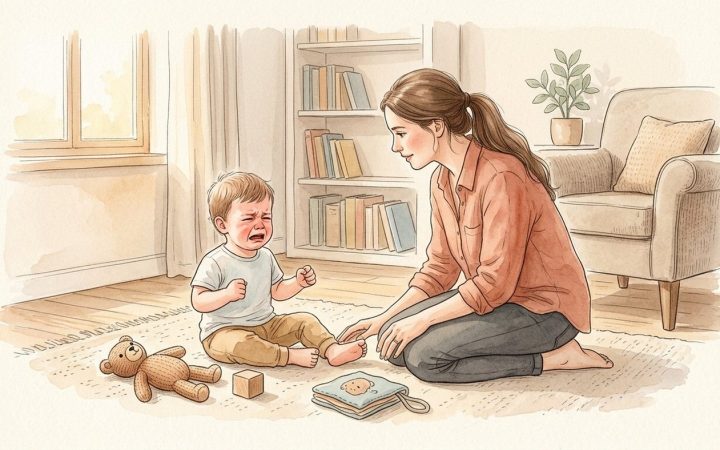
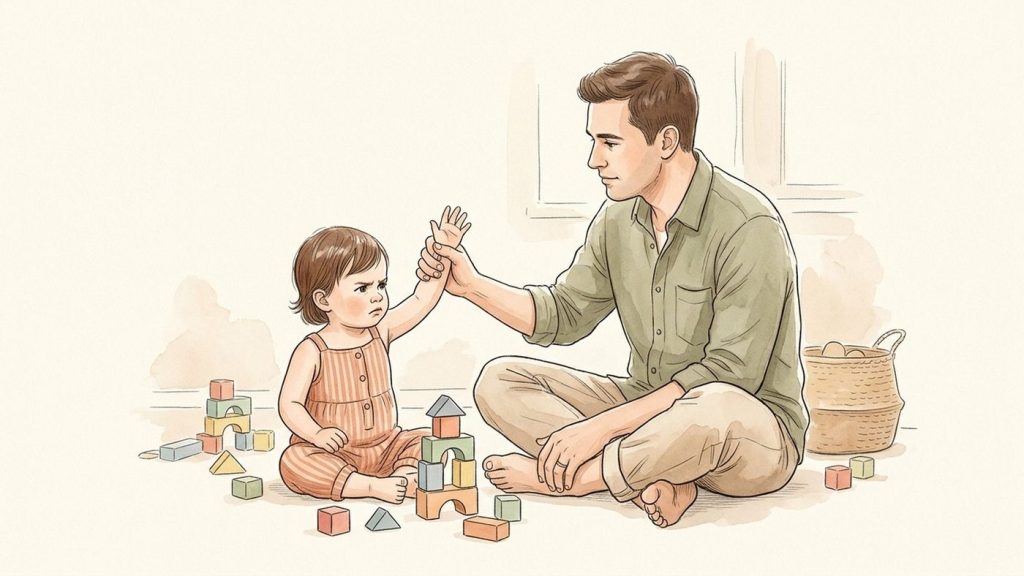
Stop the hit calmly and right away, then teach what to do instead. The AAP advises not ignoring hitting and stepping in immediately, while staying calm, because children copy how adults handle anger. Here’s a simple sequence that follows that guidance:
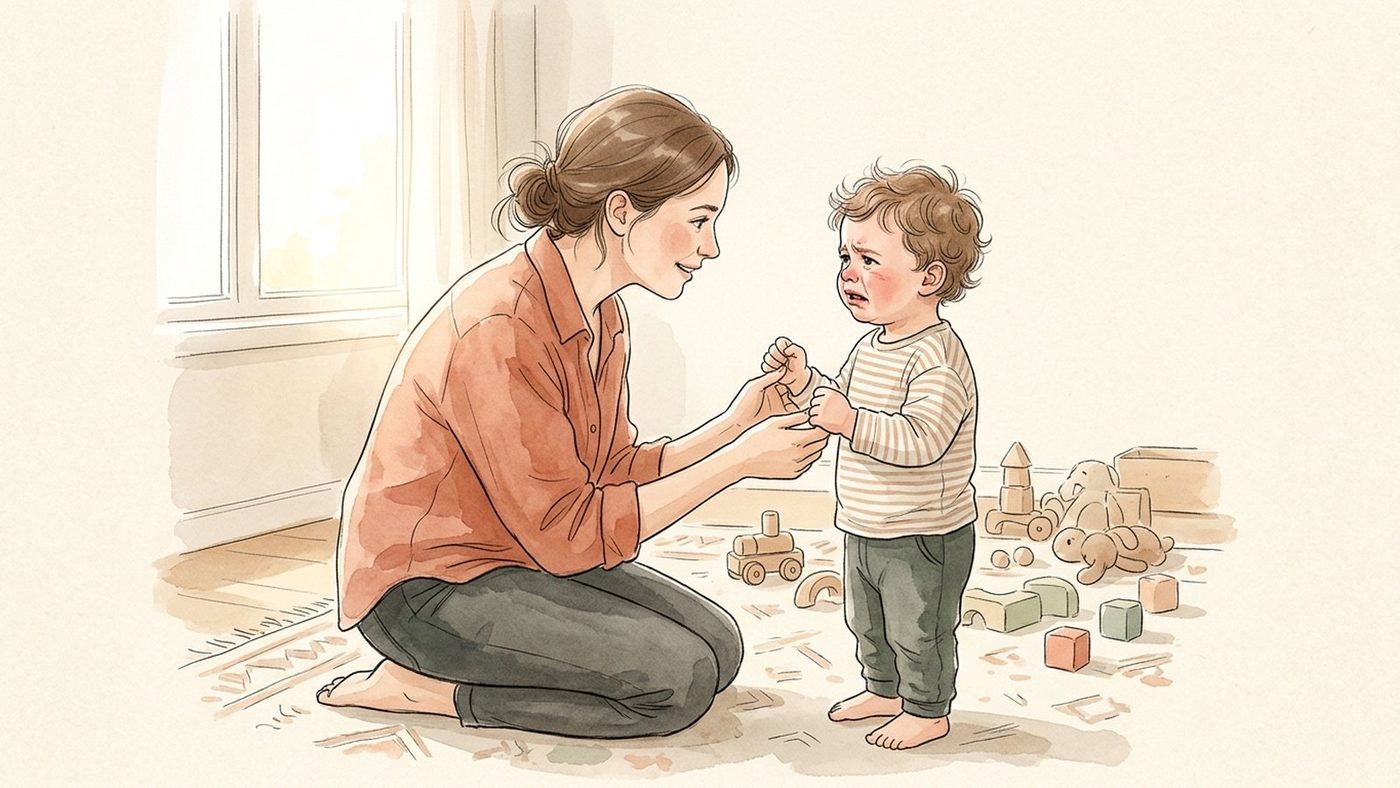
- Block the hit. Gently catch or hold your toddler’s hand, or step back out of reach. Keep your face and voice calm.
- State the rule simply. “I won’t let you hit. Hitting hurts.” Keep it short; long explanations are lost on an upset toddler.
- Name the feeling. “You’re so angry that we have to leave the park.” Naming the feeling helps your child connect the emotion with words.
- Offer another way. Stomp feet, squeeze a pillow, say “Mad!”, or come for a hug. Show it, don’t just say it.
- Follow through. If hitting continues, calmly end the game or move your child to a quieter spot until they settle. The AAP suggests time-outs only as a last resort for this age.
- Reconnect afterwards. Once everyone is calm, a hug and a quick “Let’s try gentle hands” closes the loop. Then praise the next gentle touch you see.
Consistency matters more than any single script. Responding the same calm way every time is what teaches the rule. If you’re deciding between time-outs and staying close to your child, time-out vs time-in looks at what the evidence says about each.
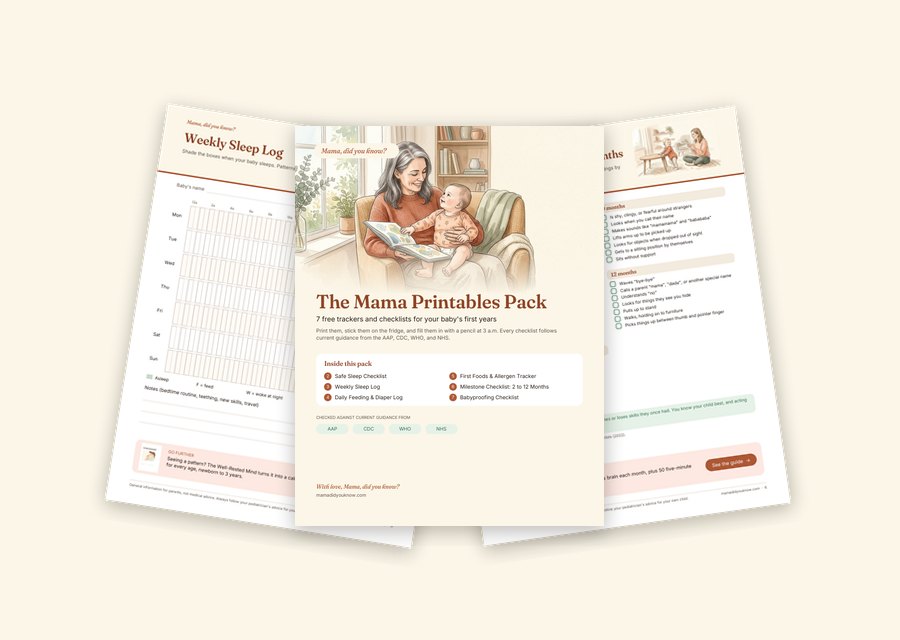
Free download
Free: milestone checklist, 2 to 12 months
The CDC milestones on one page, to tick off as your baby grows. Part of our free 7-page printables pack.
What should I avoid when my toddler hits?
Avoid hitting back, yelling, or long lectures. The AAP says spanking often increases aggression and anger in children, and its 2018 policy statement on discipline found that harsh strategies, including corporal punishment, yelling, and shaming, are minimally effective in the short term and not effective in the long term. Hitting a child to teach them not to hit also sends a confusing message.
- Don’t “show them how it feels.” Toddlers learn from what you do, not what you intend.
- Don’t laugh or make it a game. A big, playful reaction can make hitting more fun to repeat.
- Don’t demand an apology mid-meltdown. Wait until your child is calm; a toddler can help “make it better” with a gentle pat or hug.
- Don’t bribe. The AAP advises redirecting attention without offering treats to stop behavior.
How can I prevent hitting before it starts?
By spotting the patterns. Most hitting happens in predictable moments, and a little planning goes a long way:
- Watch the clock. Plan errands after naps and snacks, not right before them.
- Warn before transitions. “Two more slides, then shoes” gives your toddler time to adjust.
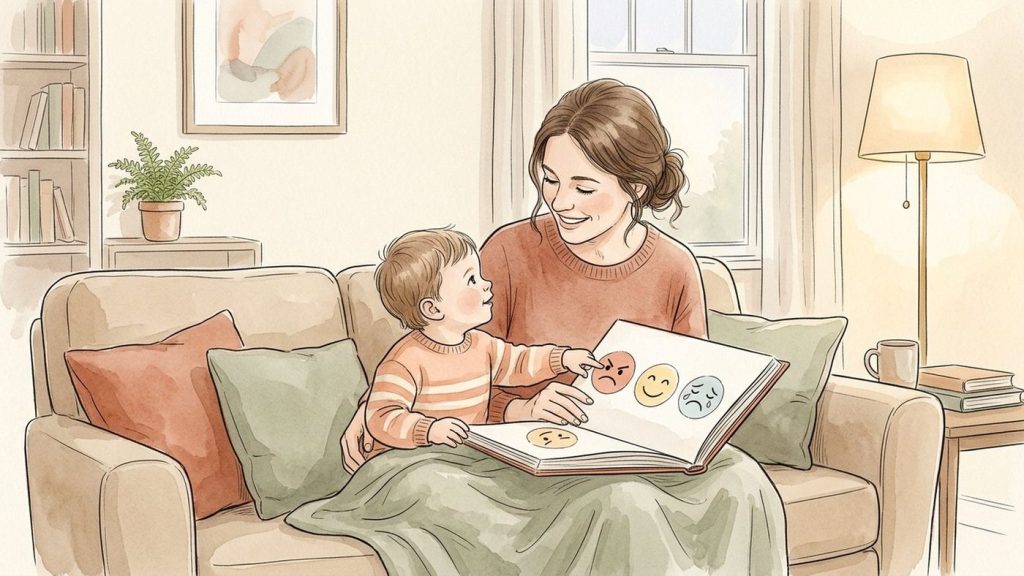
- Teach feeling words in calm moments. Books, songs, and naming your own feelings (“I feel frustrated, so I’m taking a deep breath”) all help.
- Praise gentle hands. The AAP stresses that discipline works best as an ongoing habit, including noticing good behavior, not only reacting to bad.
- Look after yourself. It’s much easier to stay calm when you’re rested. Tag out with another adult when you can.
If hitting started around a big change, such as a new sibling, it often settles as your child adjusts. Our guide on preparing a toddler for a new baby has ideas for that transition. And if hitting comes mainly during meltdowns, are daily tantrums normal? explains what’s typical. Biting follows a similar pattern and is covered in toddler biting at daycare.
If your toddler hits a baby or younger sibling, separate them right away and keep them apart until your toddler is calm. Never leave a toddler alone with a newborn, even for a moment.
Talk to your pediatrician if:
- your child is unusually aggressive for more than a few weeks and you can’t manage it on your own
- they cause injuries such as bite marks, bruises, or head injuries to themselves or others
- they regularly attack adults, or daycare has asked you to keep them home
- hitting comes with a loss of words or skills they had, very limited speech, or little interest in people
- you feel close to losing your temper or are worried about anyone’s safety
Asking for help is not a failure. Pediatricians can refer families to parenting programs that have good evidence behind them.
Frequently asked questions
Why does my toddler hit me and no one else?
Because you’re their safe person. Toddlers often save their biggest feelings for the parent they trust most. It’s tiring, but it usually means your bond is strong, not weak.
My toddler hits me and laughs. What does that mean?
Often they’re testing your reaction or still treating it as play. Stay neutral, block the hit, say “Hitting hurts, I won’t let you,” and move on to something else without a big show.
At what age does hitting stop?
Research shows physical aggression usually starts to decline from around age 3, as language and self-control improve. Many children still hit occasionally at 3 or 4, but it should become less frequent.
Is my toddler hitting because of something I did?
Almost always no. Most toddlers hit at some point. What you can influence is how quickly they learn alternatives, mainly through calm, consistent responses.
Should I use time-out for a 1-year-old who hits?
Under 2, time-out usually doesn’t make much sense to the child. Blocking, a short firm “no hitting,” and redirecting to another activity tend to work better at this age.
Sources
- American Academy of Pediatrics, HealthyChildren.org. 10 Tips to Prevent Aggressive Behavior in Young Children. healthychildren.org
- American Academy of Pediatrics, HealthyChildren.org. What’s the Best Way to Discipline My Child? healthychildren.org
- American Academy of Pediatrics, HealthyChildren.org. Top Tips for Surviving Tantrums. healthychildren.org
- Sege RD, Siegel BS; AAP Council on Child Abuse and Neglect, Committee on Psychosocial Aspects of Child and Family Health (2018). Effective Discipline to Raise Healthy Children. Pediatrics. pubmed.ncbi.nlm.nih.gov
- Tremblay RE, Nagin DS, Séguin JR, et al. (2004). Physical aggression during early childhood: trajectories and predictors. Pediatrics. pubmed.ncbi.nlm.nih.gov
- Alink LRA, Mesman J, van Zeijl J, et al. (2006). The early childhood aggression curve: development of physical aggression in 10- to 50-month-old children. Child Development. doi.org