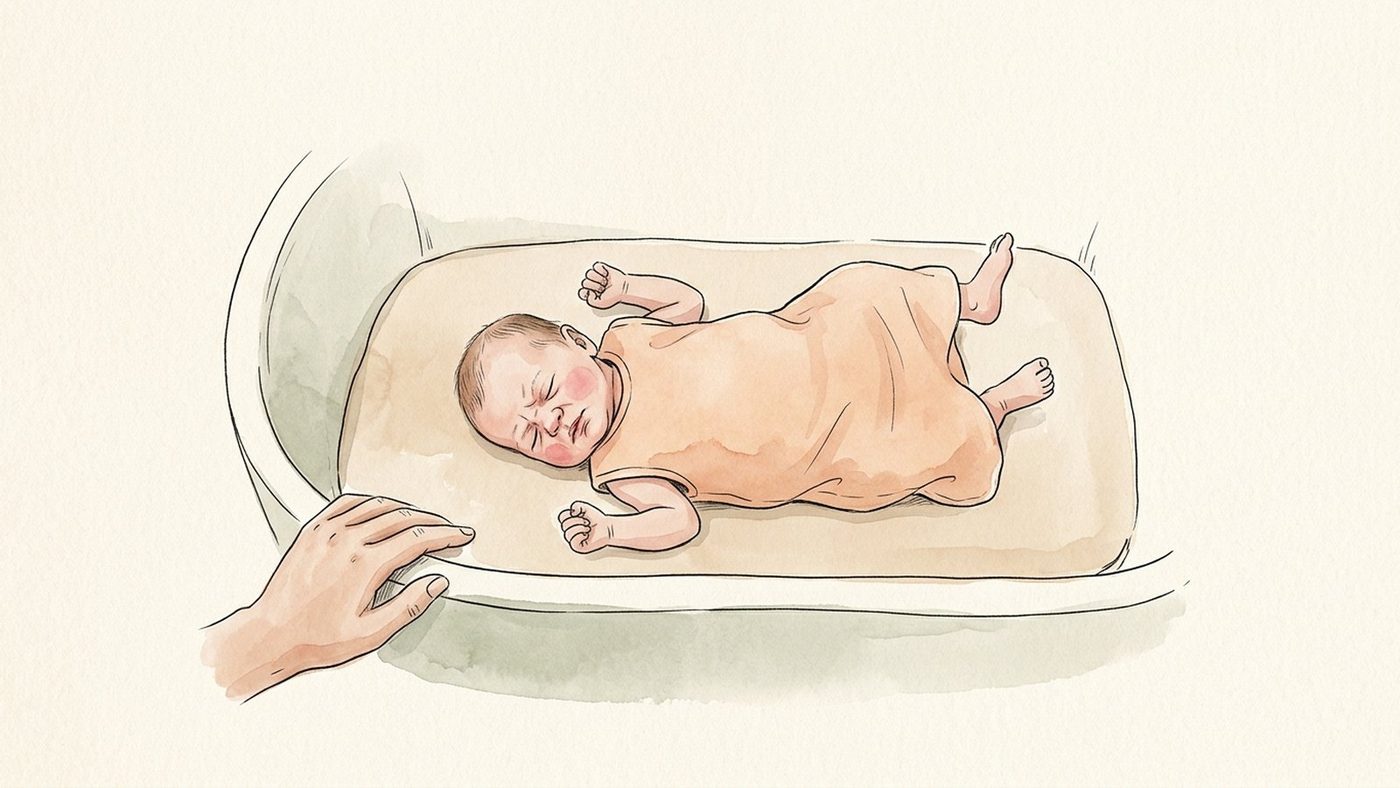
Short answer: Grunting in sleep is very common in newborns and is usually normal. Most of the time it’s digestive: your baby is learning to push out gas or poop, and hasn’t yet coordinated tummy muscles with relaxing the bottom, which doctors call infant dyschezia. It also happens during active (REM) sleep, when breathing is naturally irregular. Grunting with every breath, fast or labored breathing, or blue or gray lips is different: that’s a sign of breathing trouble and needs emergency help.
In Adam’s first weeks, his night-time grunts woke me far more often than his cries. He sounded like a tiny weightlifter, and I lay there wondering whether he was uncomfortable or just noisy. This is what I learned.
Key takeaways
- Usually digestive: babies often grunt when they’re trying to pass gas or poop.
- Normal noisy sleep: newborns spend about half their sleep in active sleep, with twitches, noises, and irregular breathing.
- It passes on its own: infant dyschezia usually resolves without treatment, and laxatives and rectal stimulation aren’t needed.
- Emergency signs: a grunt with every breath, sucking in at the ribs or tummy, breathing that looks hard or very fast, or blue, gray, or pale lips.
Why does my newborn grunt in their sleep?
Usually because they’re working on passing gas or poop. Texas Children’s Hospital sums it up in two words: “usually digestive.” Newborns have to learn something adults do without thinking, which is to push with the tummy muscles while relaxing the muscles of the bottom at the same time. Until those two actions are coordinated, babies bear down against a closed exit, and the result is grunting, straining, and a red face.
There’s a second, overlapping reason: the way newborns sleep. The AAP says newborn sleep is about equally divided between REM (active) sleep and non-REM sleep. In active sleep, babies twitch, their eyes move under their lids, and breathing is often irregular, sometimes pausing for 5 to 10 seconds. Grunts, squeaks, and snuffles fit right into that picture. Noisy doesn’t mean awake, and it doesn’t mean distressed.
What is infant dyschezia?
Infant dyschezia is the medical name for a healthy baby straining and crying before passing soft poop. It’s one of the functional gut conditions defined by the Rome IV criteria, the international standard published in 2016. According to those criteria, it applies to babies under 9 months who have at least 10 minutes of straining and crying before a successful or unsuccessful attempt to pass soft stools, with no other health problems.
The Rome IV authors describe babies who strain for many minutes, scream, cry, and turn red or purple in the face with each effort, usually for 10 to 20 minutes, while still passing stool several times a day. They explain the cause as a failure to coordinate increased pressure in the tummy with relaxing the pelvic floor. In a Dutch population study they cite, dyschezia was present in 3.9% of babies at 1 month and 0.9% at 3 months.
Not every grunting baby meets the full definition. Many just grunt and squirm for a bit without crying. But the explanation is the same, and so is the outlook: it improves as your baby learns.
| What you notice | Likely meaning | What to do |
|---|---|---|
| Grunting, squirming, red face, then gas or soft poop | Digestive grunting or infant dyschezia | Normal; comfort and wait |
| Grunts and squeaks with twitching, eyes moving under lids | Active (REM) sleep | Normal; no need to pick up |
| Short pauses in breathing, then quick breaths, baby pink and well | Periodic breathing, common in young babies | Usually normal; mention at checkup |
| Hard, pellet-like stools or blood in the poop | Not dyschezia | Call your pediatrician |
| Grunt with every breath, fast or labored breathing, ribs or tummy pulling in | Breathing difficulty | Emergency: call your local emergency number |
How can I help my grunting baby?
Mostly with patience. The Rome IV authors say the main treatment is reassurance for parents, and they specifically advise against rectal stimulation (such as using a thermometer or cotton swab to “help things along”) because it can create artificial sensations and may teach a baby to wait for stimulation. They say laxatives are unnecessary.
Gentle things many parents find soothing, which are harmless even though they haven’t been tested in studies:
- Wait a moment before picking up. If your baby is asleep and grunting, give it a minute. Many settle on their own, and picking up can wake them fully.
- Burp during and after feeds. Less swallowed air may mean less to push out later.
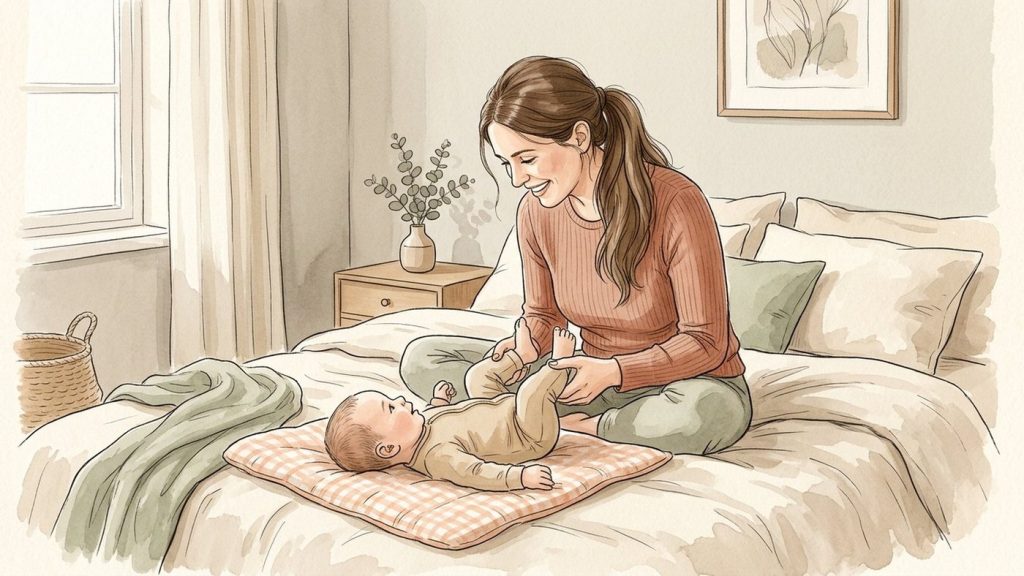
- Try leg movements while awake. Gently bend your baby’s knees toward the tummy or do slow “bicycle” legs during a diaper change.
- Give daily tummy time while awake and watched. It’s good for development, and some parents feel it helps with gas. See how much tummy time a baby needs.
- Keep sleep safe. Put your baby back down on their back in their own sleep space, even if the grunting continues.
If you’re tempted by gas drops or gripe water, our post on gripe water vs gas drops looks at what the evidence actually shows. Ask your pediatrician or pharmacist before giving any remedy to a newborn.
What the research says: infant dyschezia is a recognized condition with agreed diagnostic criteria (Rome IV, 2016), and its natural course is to resolve on its own; the Rome IV authors say it typically settles within a few weeks. The evidence comes mostly from expert consensus and a small number of population studies, not trials. There’s no research showing that any home remedy speeds it up.
Free download
Free: babyproofing and safe sleep checklists
Room-by-room babyproofing and the safe sleep basics on the fridge. Part of our free 7-page printables pack.
When is grunting a sign of a breathing problem?
When it comes with the effort of breathing rather than the effort of pooping. Grunting that signals a breathing problem tends to be regular and repetitive, happening with breath after breath rather than in bursts while your baby squirms and strains, and it usually comes with other signs that breathing is hard work. The NHS lists grunting noises, or sucking in the tummy when breathing, among the reasons to call an emergency number for a baby or child under 5.
Texas Children’s Hospital also advises calling your pediatrician for pauses in breathing longer than 10 seconds, breathing faster than 60 breaths a minute or that looks labored, and blue or dusky lips or skin. A short video of the sound can help your pediatrician tell the difference.
What other newborn sleep noises are normal?
Quite a few. Texas Children’s Hospital describes a whole soundtrack of normal newborn noises. Sneezing is a reflex that clears tiny nasal passages. Hiccups come from an immature diaphragm and are harmless. Gurgling or whistling often comes from saliva or slightly narrow nasal passages, and a little snorting or congestion is very normal. Mild snoring is common too, though it advises telling your pediatrician if snoring is loud or persistent.
If you’re wondering about other sounds, our posts on a newborn sneezing a lot and a baby sleeping with their mouth open go into more detail.
Noisy sleep isn’t a reason to change how your baby sleeps. Keep placing your baby on their back, alone, on a firm, flat surface with only a fitted sheet, in your room for at least the first 6 months, as the AAP recommends. Don’t prop the mattress or use inclined sleepers or positioners to “help digestion”; the AAP says any surface inclined more than 10 degrees isn’t safe for sleep.
Call your local emergency number if your baby:
- grunts with every breath, breathes very fast, or seems to be working hard to breathe (ribs or tummy sucking in, nostrils flaring)
- has blue, gray, pale, or blotchy lips, tongue, or skin
- is floppy, very hard to wake, or has a weak, high-pitched, or continuous cry
- has a temperature of 38°C (100.4°F) or higher and is under 3 months old
Call your pediatrician if your baby has hard or pellet-like stools, blood in the poop, a swollen or hard tummy, vomiting, poor feeding, or poor weight gain, or if the straining doesn’t improve over several weeks. Our guide to baby fever and when to call the doctor covers temperatures in detail.
Frequently asked questions
Why does my newborn grunt all night?
Newborns spend a lot of time in active sleep and are often digesting between frequent feeds, so on-and-off grunting through the night is common. If your baby is feeding well, pooping soft stools, and breathing comfortably, it’s usually fine.
When does newborn grunting stop?
It fades as babies learn to coordinate pushing and relaxing. Rome IV says dyschezia usually resolves within a few weeks, and it can last up to about 9 months in a small number of babies.
Is my grunting baby constipated?
Probably not, if the poop that comes out is soft. Constipation is about hard, dry stools. A baby with dyschezia strains hard but passes soft poop.
Should I use a thermometer to help my baby poop?
No, unless your pediatrician specifically advises it. The Rome IV authors recommend avoiding rectal stimulation for dyschezia, because babies need to learn to do it themselves.
Is grunting after feeding normal?
Usually, yes. Feeding stimulates the gut, so many babies grunt and strain shortly after a feed. Burping during feeds can help.
Sources
- Benninga MA, Nurko S, Faure C, Hyman PE, St James Roberts I, Schechter NL (2016). Childhood Functional Gastrointestinal Disorders: Neonate/Toddler. Gastroenterology. doi.org
- Texas Children’s Hospital. What are these noises my newborn is making? texaschildrens.org
- American Academy of Pediatrics, HealthyChildren.org. Stages of Newborn Sleep. healthychildren.org
- NHS. When to get urgent medical help for babies and children under 5. nhs.uk
- American Academy of Pediatrics, HealthyChildren.org. Sleep Apnea in Children: Detection and Treatment. healthychildren.org
- American Academy of Pediatrics, HealthyChildren.org. How to Keep Your Sleeping Baby Safe: AAP Policy Explained. healthychildren.org