Short answer: Teething can make a baby more wakeful, but only for a few days at a time, not for weeks. In a study of 125 babies who were followed daily, extra wakefulness and fussiness showed up only in an 8-day window: the 4 days before a tooth came through, the day it appeared, and the 3 days after. If your baby’s sleep has been broken for longer than about a week, or comes with a fever, look for another cause, such as a developmental leap, a schedule change, or an illness.
Key takeaways
- Short window: research links teething to extra wakefulness for about 8 days around each tooth, not weeks.
- Not every baby: no teething symptom showed up in more than about a third of teething babies.
- Fever isn’t teething: the AAP says a temperature over 38.3°C (101°F) is probably not from teething.
- Comfort, then keep the routine: a firm teething ring and gum rubbing before bed; no gels, tablets, or amber necklaces.
- Long stretches of bad sleep usually have other causes, like crawling, separation anxiety, or nap changes.
Does teething cause night waking?
Sometimes, briefly. The best study we have was published in Pediatrics in 2000. Researchers at the Cleveland Clinic followed 125 healthy babies from their 4-month checkup to their first birthday. Parents recorded the baby’s temperature twice a day, 18 possible symptoms, and every new tooth, adding up to more than 19,000 days of data and 475 teeth.
They found that symptoms clustered in an 8-day teething window: the 4 days before a tooth broke through, the day itself, and the 3 days after. During that window, babies were more likely to be wakeful, irritable, drooling, rubbing their gums or ears, biting, and eating fewer solids, and some had a mild rise in temperature. Interestingly, “sleep disturbance” as a separate symptom was not significantly linked to teething, while “wakefulness” was.
Just as important is what they didn’t find. No symptom appeared in more than 35% of teething babies, and none was more than 20% more common in teething babies than in non-teething ones. So many babies cut teeth with no noticeable change in sleep at all. A smaller Australian study the same year, following 21 children in child care, found no link between tooth eruption and sleep problems.
What the research says: both key studies were prospective, meaning symptoms were recorded day by day rather than remembered later, which makes them more reliable than surveys. But they’re more than 20 years old, one was small, and the families weren’t a broad cross-section of the population. Still, their findings point the same way: teething causes mild, short-lived symptoms in some babies, not weeks of disrupted sleep.
How long does teething disrupt sleep?
Usually a few days per tooth, if at all. Based on the Cleveland Clinic data, you’d expect any teething-related wakefulness to start a few days before a tooth appears and settle within a few days after. Here’s how to compare what you’re seeing:
| What you notice | More likely teething | More likely something else |
|---|---|---|
| How long it lasts | A few nights, easing once the tooth is through | Weeks of broken sleep |
| Gums | Swollen or a visible white edge of a tooth | Nothing visible after many days |
| Temperature | Normal or only slightly raised | 38.3°C (101°F) or higher: call your pediatrician |
| Daytime behavior | Drooling, chewing, rubbing gums | Practicing crawling or standing in the crib, clingy at separation |
| Other symptoms | Mild fussiness | Runny nose, cough, vomiting, diarrhea, ear pain with a cold |
Around 8 to 10 months, many babies sleep worse while learning to crawl and pull to stand, and as separation anxiety peaks. That’s also when several teeth tend to arrive, so it’s easy to blame teeth for everything. We go through the overlap in 8-month sleep regression or teething. If you suspect an ear infection, see ear infection vs teething.
Can I tell when a tooth is about to come through?
Not reliably. This was one of the questions the Cleveland Clinic researchers set out to answer, and they found that no combination of symptoms could predict that a tooth was about to appear. Drooling, chewing, and gum-rubbing happen a lot in babies this age whether a tooth is coming or not, because they’re also how babies explore the world.
That’s useful to know at 2 a.m. If you can’t see or feel a swollen spot or the white edge of a tooth, and the waking has gone on for more than a few nights, it’s worth thinking about other explanations rather than waiting for a tooth that may be weeks away. Keeping a simple note of nights, naps, and any visible tooth can help you spot the pattern, and it’s handy to bring to your pediatrician if you’re unsure.
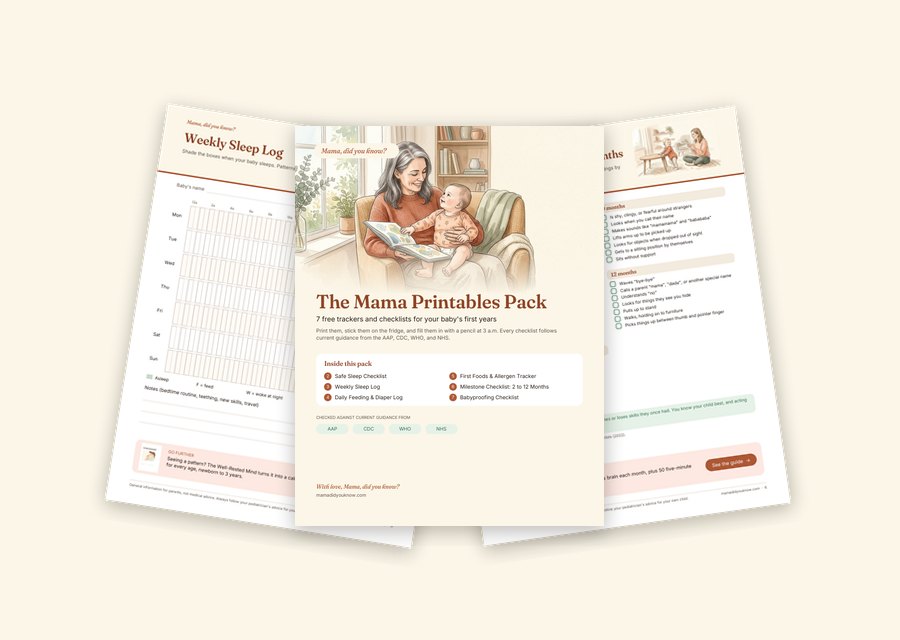
Free download
Free: safe sleep checklist and sleep log
Track naps and night wakings for a week and the pattern shows itself. Part of our free 7-page printables pack.
How can I help my teething baby sleep?
Offer comfort before bed, respond calmly at night, and keep your usual routine. The AAP’s suggestions for sore gums are simple:
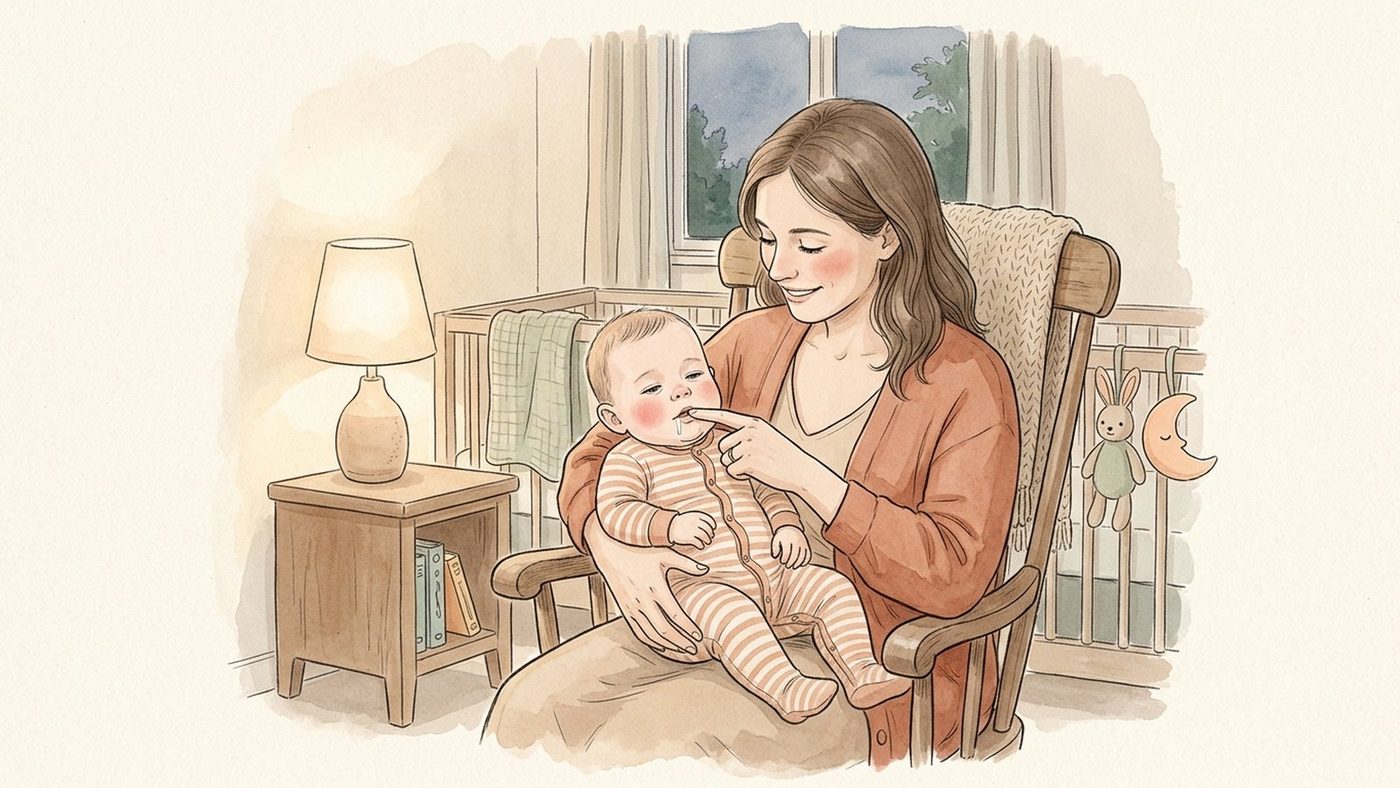
- Rub the gums. Gently massage your baby’s gums with a clean finger as part of the wind-down.
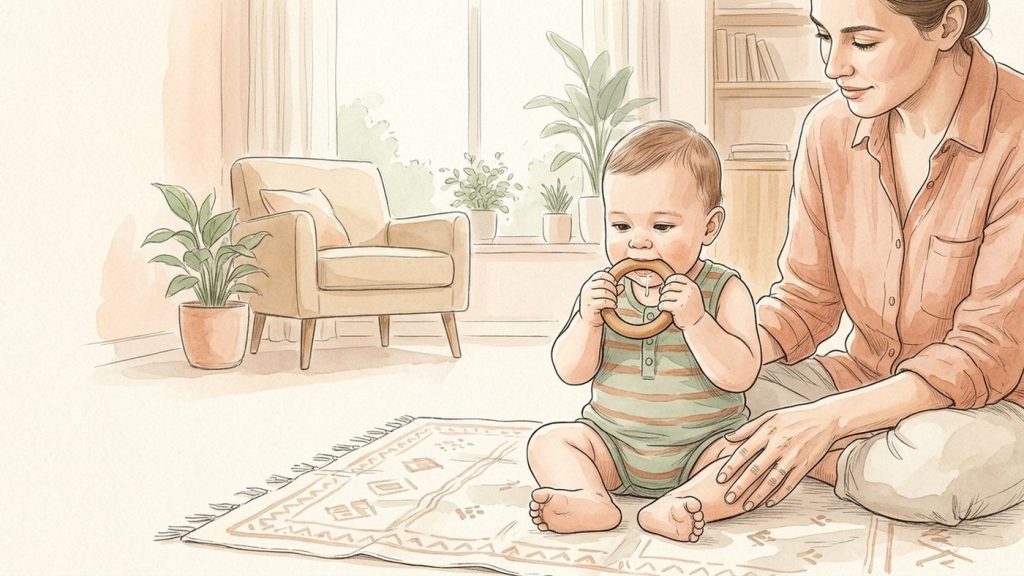
- Offer a firm rubber teething ring during the bedtime routine. The AAP and FDA warn that frozen teethers can get too hard, so chill rather than freeze, and avoid liquid-filled ones. Never give a teether in the crib or tie one around your baby’s neck.
- Wipe away drool. A dry chin helps prevent irritated skin that can add to discomfort.
- Keep the bedtime routine the same. Same order, same sleep space, same cues. Predictability helps babies settle even when they’re a bit uncomfortable.
- Respond at night, briefly. Comfort, a cuddle, or a feed if your baby is hungry, then back in the crib on their back. Keep lights low.
- Ask before using pain relief. If your baby seems to be in real pain, ask your pediatrician or pharmacist whether a pain reliever is appropriate. Doses are based on weight and age.
For the full list of teething signs and remedies, see our main teething symptoms and remedies guide.
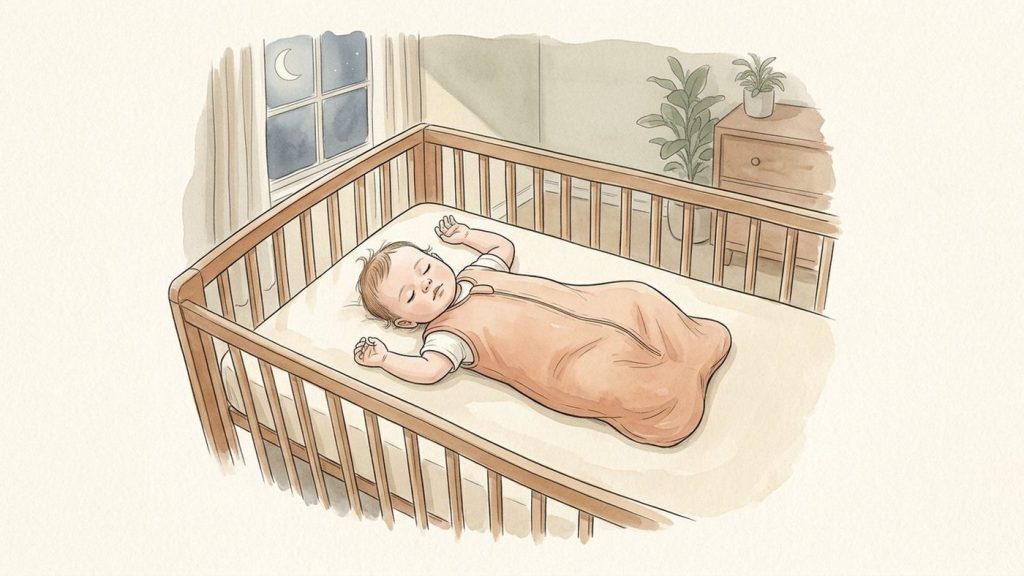
Don’t use teething gels to numb the gums: the AAP says never to use them, and the FDA says benzocaine products shouldn’t be used for teething pain in children because they can be dangerous. Homeopathic teething tablets provide no benefit, according to the AAP. Amber or other teething necklaces and bracelets don’t relieve pain and have caused choking and strangulation, so never let your baby wear one, especially to sleep. Keep the crib bare: no teethers, toys, or bottles.
Will teething undo sleep training or create new habits?
A few nights of extra comfort won’t undo everything. It’s fine to respond more during a genuinely rough patch. The risk is when “teething” becomes the explanation for weeks of night waking, and new habits, like long rocking sessions or extra night feeds, settle in after the tooth has arrived.
A practical approach many families use: give extra comfort for the few days around a visible tooth, then return to your usual way of settling once it’s through. If you’ve used a sleep training method, the same approach works after the tooth arrives; see does sleep training work for what the evidence says.
Avoid putting your baby to bed with a bottle to soothe sore gums. The AAP advises against letting babies fall asleep with a bottle, because milk pooling around new teeth can lead to tooth decay. Once the first tooth is in, start brushing twice a day with a smear of fluoride toothpaste about the size of a grain of rice.
Call your pediatrician if your baby:
- has a temperature of 38.3°C (101°F) or higher, which is probably not from teething; for babies under 3 months, call for any temperature of 38°C (100.4°F) or higher
- has vomiting, diarrhea, a rash beyond the face, a cough, or is pulling at an ear during a cold
- is refusing to drink, has far fewer wet diapers, or seems very unwell
- has been waking much more for more than a week with no tooth appearing
Call your local emergency number if your baby has trouble breathing, is very hard to wake, or is limp. Our guide to baby fever: when to call the doctor has more detail.
Frequently asked questions
Do teething babies sleep more or less?
Research links teething to more wakefulness for a few days, not more sleep. If your baby is unusually sleepy, hard to wake, or floppy, call your pediatrician, as that’s not a teething symptom.
Is teething pain worse at night?
It may seem that way because there are fewer distractions at night. There’s no good research showing teething pain itself is worse at night.
Which teeth hurt the most?
Many parents feel molars are hardest, but the studies didn’t compare individual teeth. Each tooth’s window seems to be short.
Can teething cause a fever?
Teething may cause a slight rise in temperature, but not a true fever. The AAP says a temperature over 38.3°C (101°F) is probably from something else, so contact your pediatrician.
Should I give my baby pain medicine before bed when teething?
Don’t give it routinely. Ask your pediatrician or pharmacist first, and dose only by your baby’s weight and age if they say it’s appropriate.
Sources
- Macknin ML, Piedmonte M, Jacobs J, Skibinski C (2000). Symptoms associated with infant teething: a prospective study. Pediatrics 105(4 Pt 1):747–752. pubmed.ncbi.nlm.nih.gov
- Wake M, Hesketh K, Lucas J (2000). Teething and tooth eruption in infants: a cohort study. Pediatrics 106(6):1374–1379. pubmed.ncbi.nlm.nih.gov
- American Academy of Pediatrics, HealthyChildren.org. Teething: 4 to 7 Months. healthychildren.org
- US Food and Drug Administration. Safely Soothing Teething Pain in Infants and Children. fda.gov
- American Academy of Pediatrics, HealthyChildren.org. How to Keep Your Sleeping Baby Safe: AAP Policy Explained. healthychildren.org