
Short answer: Constipation is common when babies start solids, because their diet is changing, and most cases settle at home. A few days between soft poops can be normal; real constipation means hard, dry, pebble-like stools that are painful or difficult to pass. Fiber-rich foods like puréed prunes, pears, peaches, and plums, small sips of water with meals from 6 months, and plenty of movement usually help.
When Adam started solids, his diapers changed almost overnight, and I wondered what was normal. Here is what I found.
Key takeaways
- Texture matters more than the count: a soft poop every few days can be normal; hard, pellet-like poop that hurts is not.
- Straining isn’t always constipation: a young baby who grunts, cries, and goes red, then passes a soft stool, is usually just learning how to poop.
- What helps: fruits and vegetables (especially prunes and pears), whole grains, sips of water with meals from 6 months, and bicycle legs or tummy massage.
- What to skip: laxatives, suppositories, mineral oil, and home remedies unless your doctor advises them, and never honey before 12 months.
- Call the doctor for a swollen belly with vomiting, blood in the stool, poor weight gain, fever, or constipation in the first weeks of life.
How often should a baby poop on breast milk, formula, and solids?
Normal covers a wide range. In population studies summarized by the Rome IV pediatric experts, babies poop about 3 times a day on average at 4 weeks, slowing to about 1.3 times a day by age 4. Breastfed babies tend to go more often, with softer stools, than formula-fed babies.
- Breastfed, first 6 weeks: the NHS says a breastfed baby from 4 days to 6 weeks old should pass at least 2 yellow poos a day. Fewer than that in the first weeks can mean your baby isn’t getting enough milk.
- Breastfed, after the first month or so: the AAP says breastfed babies may go several days, or even a week, between poops. That’s fine if the poop is soft and your baby is growing well.
- Formula-fed: the AAP says these babies usually poop at least once most days, though 1 to 2 days between poops can happen.
- Eating solids: there’s no official number for the first months of solids. Among children aged 1 to 4, about 97% poop somewhere between 3 times a day and once every other day.
What the research says: the normal ranges come from large population studies and consistent guidance from the AAP, the NHS, and the Rome IV criteria. They are averages, so how the poop looks and how your baby feels matter more than the exact count.
Why do babies get constipated when they start solids?
Because their whole diet is changing. The NHS notes that constipation is often caused by diet and can happen when you start solid foods, usually from too little fiber or too little fluid. The UK’s clinical guideline (NICE) lists weaning and formula changes as typical triggers in babies under 1.
Then a cycle can start. The Rome IV experts explain that a change in diet can bring a dry, hard poop that hurts, and a baby who remembers the pain may hold back the next one, which makes it harder still. Catching it early with simple changes at home usually breaks the cycle.
How can I tell if my baby is really constipated?
Look at the poop, not just the calendar. The NHS and NICE describe constipation in babies as:
- dry, hard, lumpy, or pellet-like poos (“rabbit droppings”)
- straining or obvious pain when pooing, sometimes with a little blood from a hard stool
- fewer than 3 poos a week (NICE notes this rule doesn’t apply to exclusively breastfed babies after 6 weeks)
- a firm tummy, smelly wind, a smaller appetite, or more fussiness than usual
Doctors use the Rome IV criteria to diagnose ongoing (functional) constipation: at least two signs for a month or more, such as 2 or fewer poops a week, hard or painful poops, very large poops, or holding poop in.
Straining on its own is different. The AAP says it isn’t necessarily alarming, even when a baby cries or goes red in the face. If the poop that comes out is soft, your baby isn’t constipated.
Some healthy babies under 9 months strain, scream, and turn red or purple for 10 to 20 minutes before passing a perfectly soft poop. Doctors call this infant dyschezia. It happens because the baby hasn’t yet learned to relax the pelvic floor while pushing. A Dutch study found it in about 4% of 1-month-olds. It usually fades on its own within a few weeks, and laxatives aren’t needed.
What can I feed a constipated baby?
Fruits, vegetables, beans, and whole grains, with the “P” fruits leading the way. The NHS says apples, pears, and prunes are particularly good for constipation, and Seattle Children’s lists peas, beans, apricots, prunes, peaches, pears, and plums as helpful high-fiber baby foods.
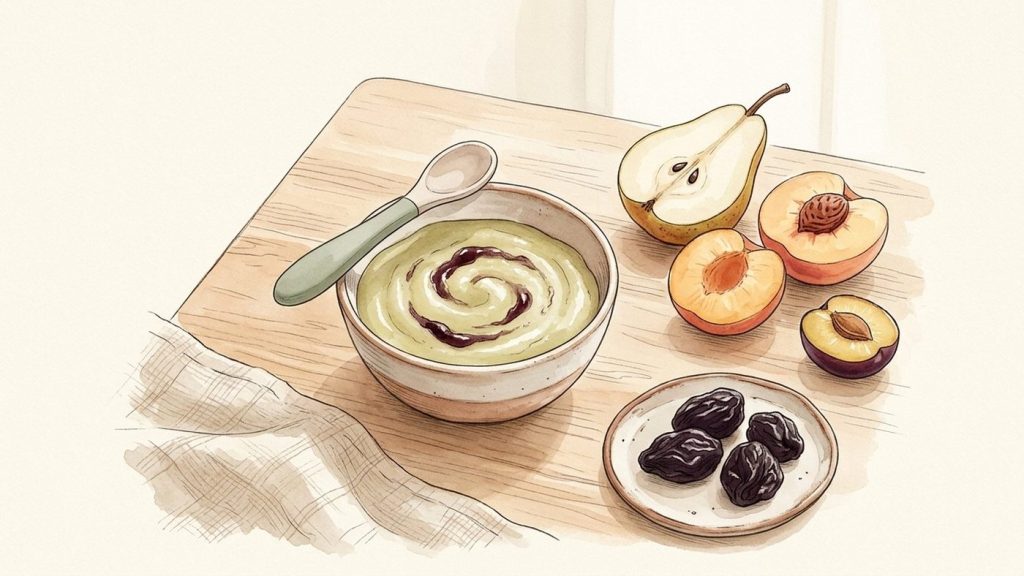
Prunes have a double effect. They contain fiber, and they’re rich in sorbitol, a natural sugar alcohol that draws water into the bowel and softens stool. A review of prune research found about 14.7 g of sorbitol per 100 g of prunes and concluded that it likely explains their laxative effect. Pears, plums, and peaches bring fiber and water too.
A simple first try: breakfast oatmeal stirred with mashed pear and a spoon of prune purée. It can feel almost too simple, but it’s exactly what the guidance suggests trying first.
| Food | Why it helps | How to serve, 6–9 months | How to serve, 9–12 months and up |
|---|---|---|---|
| Prunes | Fiber plus sorbitol | Smooth purée, or soaked and blended into oatmeal or yogurt | Soaked until soft, then finely chopped. Never whole or dry. |
| Pears | Fiber and water | Ripe pear purée, or soft-cooked strips | Very ripe pear in thin slices, or grated. Not hard raw chunks. |
| Plums and peaches | Fiber and water | Peeled, pitted, and puréed or mashed | Ripe, peeled, soft slices with the pit removed |
| Apricots | Fiber | Stewed and puréed | Soft-stewed and chopped; soak dried apricots, then chop finely |
| Peas, beans, and lentils | Fiber (plus iron) | Puréed, or mashed well | Mashed or flattened between your fingers, never whole and firm |
| Oats and whole-grain cereals | Fiber | Smooth oatmeal or infant oat cereal | Thicker oatmeal, whole-grain toast strips, soft whole-wheat pasta |
| Vegetables (broccoli, sweet potato, squash) | Fiber and water | Soft-cooked and puréed, or soft finger-length pieces | Soft-cooked pieces your baby can squash with their gums |
Offer a variety rather than piling on one food. NICE advises against adding unprocessed bran to children’s food, because it can cause bloating and gas and reduce the absorption of some nutrients.
The CDC lists uncooked dried fruit, pieces of hard raw fruit, and whole grain kernels as choking hazards. Soak and chop or purée dried fruit, cook or ripen fruit until it squashes easily, and always seat your baby upright and stay with them while they eat. Our guide to gagging vs. choking covers safe shapes and sizes.
If you’d like fiber-friendly meals planned for you, The Well-Fed Mind has 260 month-by-month recipes with fruits, vegetables, beans, and whole grains in textures that fit each stage.
What else helps a constipated baby besides food?
Fluids, movement, and a little patience. The 2014 ESPGHAN and NASPGHAN guideline recommends normal fiber intake and normal physical activity, and its 2026 update adds age-appropriate water to that foundation.
- Offer water with meals from 6 months. The AAP says babies 6 to 12 months need only about 4–8 oz (120–240 ml) of water a day, offered in small sips from a cup. Under 6 months, no extra water is needed. See our guide on when babies can drink water.
- Keep milk feeds going. Breast milk or formula is still the main drink until 12 months. If you use formula, the NHS says to make it exactly as the packet says, because too much powder can cause constipation and dehydration.
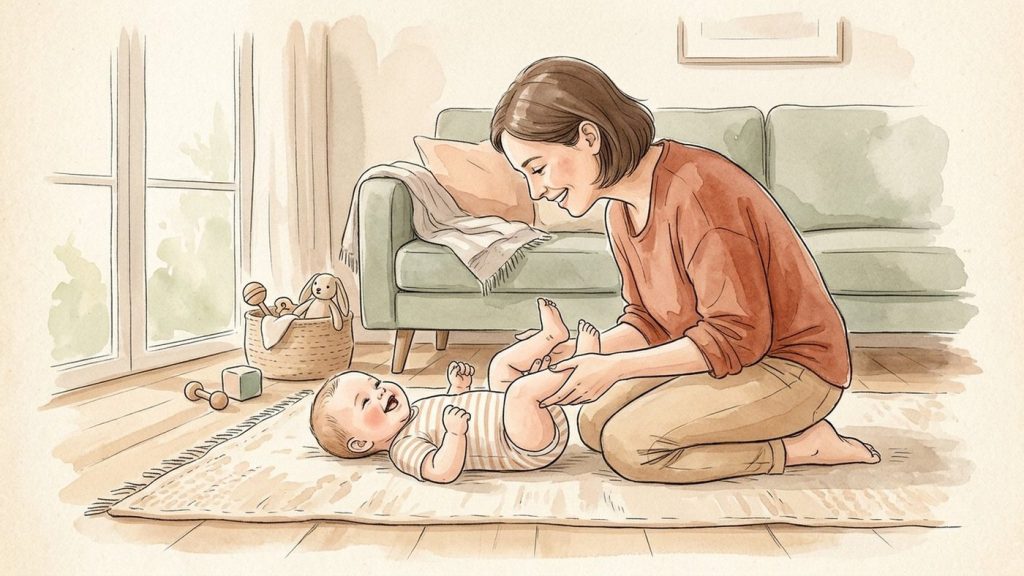
- Try bicycle legs. The NHS suggests lying your baby on their back and gently moving their legs as if riding a bicycle.
- Give a gentle tummy massage. If your baby is comfortable lying down, the NHS recommends a gentle massage of the tummy.
- Get moving every day. Floor play, rolling, crawling, and tummy time count as the normal activity the guidelines recommend.
- Give it a few days. The NHS says to speak to your health visitor or GP if things don’t improve after a few days.
What the research says: fruit, fiber, fluids, and movement are the first steps in every major guideline, but they rest mostly on expert opinion, not on large trials in babies. The Rome IV experts note that good trials of diet changes or laxatives in infants and toddlers are still lacking, and the 2026 guideline update found major evidence gaps for many common treatments. If these safe first steps don’t work, see your doctor; it isn’t a failure on your part.
What should I avoid giving a constipated baby?
Anything medicinal, unless your baby’s doctor recommends it. Quebec’s public health guide is clear: never give your baby a laxative or fiber supplement without medical advice.
- Laxatives and stool softeners: a doctor may prescribe one if food changes aren’t enough, but the type and dose depend on your baby’s age and weight.
- Mineral oil: a 2018 expert review advises against it for babies, because it can be breathed into the lungs and cause a type of pneumonia. The 2026 guideline also warns against routine use, noting side effects are more common in children under 3.
- Suppositories, enemas, and rectal stimulation: only if your doctor says so. For babies with normal straining, experts advise avoiding rectal stimulation, which can teach a baby to wait for help before pooing.
- Honey: never before 12 months, in any form, because of the risk of infant botulism. Read more in our guide on whether babies can have honey.
- Corn syrup: an old-fashioned remedy, not a safe shortcut. Nemours KidsHealth notes that corn syrups might contain botulism-causing bacteria, though a link hasn’t been proved, and advises checking with your doctor before giving any to a baby.
- Other home remedies: oils, teas, herbal products, or sugar water aren’t part of any official guidance for babies, so ask your doctor first.
When should I call the doctor about baby constipation?
Most constipation after starting solids is harmless. But NICE says children with certain “red flag” signs need a doctor’s assessment rather than routine constipation treatment.
Call your pediatrician right away, or seek urgent care, if your baby:
- hasn’t pooped and is vomiting, or has a swollen, hard belly
- has blood in the poop, or very thin, ribbon-like poop
- has a fever, or seems very unwell or floppy
- has constipation together with poor feeding, a weak cry, or drooping eyelids, which can be signs of infant botulism
- is under 1 month old and breastfed and not pooping much, or is under 8 weeks and hasn’t pooped for 2 or 3 days
Make an appointment if your baby has had constipation since birth or the first few weeks of life, isn’t gaining weight well, strains for more than 10 minutes without passing anything, or if hard poops keep coming back despite changes at home.
Frequently asked questions
How long can a baby go without pooping after starting solids?
There’s no single number. What matters is that the poop is soft and comes out without pain. NICE and the NHS treat fewer than 3 poos a week as one sign of constipation, though NICE excludes exclusively breastfed babies older than 6 weeks. If your baby is uncomfortable or the poop is hard, talk to your doctor.
Can I give my baby prune juice for constipation?
Ask your pediatrician first. The AAP and the CDC say babies under 12 months shouldn’t have fruit juice. Still, some pediatricians suggest a small amount of prune, pear, or apple juice for constipation, since these contain sorbitol: the AAP’s parent site mentions a little apple or pear juice, and Seattle Children’s care guide gives amounts by age, with prune juice only after 3 months. Puréed prunes offer sorbitol plus fiber, without the juice.
Does iron-fortified formula cause constipation?
No. In a UK trial of 493 nine-month-olds, babies given iron-fortified formula had no more digestive problems than babies given cow’s milk, and Quebec’s public health guide says the iron in commercial formula does not cause constipation. Babies need that iron, so don’t switch to a low-iron formula.
Should I switch my baby’s formula?
Not without talking to your doctor. Experts warn that frequent formula changes are a common problem when babies have tummy troubles. For constipation that doesn’t respond to usual treatment, a doctor may suggest a 2- to 4-week trial without cow’s milk protein, but that’s a medical decision, not a first step.
Will my baby need medicine?
Most babies with constipation after starting solids don’t. If food and fluid changes aren’t enough, your doctor may prescribe a gentle laxative such as polyethylene glycol, which the 2026 ESPGHAN and NASPGHAN guideline recommends as the main treatment for ongoing constipation in children. Only use it at the dose your doctor gives.
Sources
- Tabbers MM, DiLorenzo C, Berger MY, et al. (2014). Evaluation and treatment of functional constipation in infants and children: evidence-based recommendations from ESPGHAN and NASPGHAN. J Pediatr Gastroenterol Nutr 58(2):258–274. doi.org
- Gordon M, de Geus A, Boruta M, et al. (2026). ESPGHAN/NASPGHAN guidelines for treatment of functional constipation in children aged 0–18 years. J Pediatr Gastroenterol Nutr. doi.org
- Benninga MA, Faure C, Hyman PE, St James Roberts I, Schechter NL, Nurko S (2016). Childhood Functional Gastrointestinal Disorders: Neonate/Toddler (Rome IV). Gastroenterology 150(6):1443–1455. doi.org
- American Academy of Pediatrics, HealthyChildren.org. Infant Constipation. healthychildren.org
- American Academy of Pediatrics, HealthyChildren.org. Where We Stand: Fruit Juice; and Choose Water for Healthy Hydration. healthychildren.org (juice); healthychildren.org (water)
- NHS Best Start in Life. Constipation (breastfeeding) and Constipation and bottle feeding. nhs.uk (breastfeeding); nhs.uk (bottle feeding)
- NHS. Constipation in children. nhs.uk
- National Institute for Health and Care Excellence (NICE). Constipation in children and young people: diagnosis and management (CG99). nice.org.uk
- Salvatore S, Abkari A, Cai W, et al. (2018). Review shows that parental reassurance and nutritional advice help to optimise the management of functional gastrointestinal disorders in infants. Acta Paediatr 107(9):1512–1520. pmc.ncbi.nlm.nih.gov
- Stacewicz-Sapuntzakis M, Bowen PE, Hussain EA, Damayanti-Wood BI, Farnsworth NR (2001). Chemical composition and potential health effects of prunes: a functional food? Crit Rev Food Sci Nutr 41(4):251–286. doi.org
- Seattle Children’s Hospital. Constipation (care guide, Schmitt Pediatric Guidelines). seattlechildrens.org
- Institut national de santé publique du Québec, From Tiny Tot to Toddler. Constipation in babies and children. inspq.qc.ca
- CDC. Foods and Drinks to Avoid or Limit; and Choking Hazards (infant and toddler nutrition). cdc.gov (avoid or limit); cdc.gov (choking)
- Nemours KidsHealth. Infant Botulism. kidshealth.org
- Singhal A, Morley R, Abbott R, Fairweather-Tait S, Stephenson T, Lucas A (2000). Clinical safety of iron-fortified formulas. Pediatrics 105(3):e38. doi.org