Short answer: Do the same four calm steps, in the same order, every night: a bath or wash, lotion and pajamas, a quiet book or song in dim light, then lights out within about 30 minutes of the bath. In a randomized trial, toddlers aged 18 to 36 months on this routine fell asleep faster, woke less often, and slept longer stretches within two weeks. The sameness matters more than the exact steps.
Adam isn’t a toddler yet, but our little bath, book, and song routine is already the calmest part of our day. Here’s how to keep it working into the toddler years.
Key takeaways
- Four steps: wash, comfort, quiet, lights out. Twenty to forty minutes is plenty.
- Every night counts: in a study of over 10,000 children, the more nights a week families did a routine, the better children slept.
- Keep the last hour dim and screen-free, and add tooth brushing to the routine.
- Give it a week of doing it exactly the same way before you judge it.
What is the 4-step bedtime routine from the research?
It’s the routine tested in a 2009 trial of 405 families led by sleep researcher Jodi Mindell. For toddlers, it had three steps before lights out, and lights out came within 30 minutes of the end of the bath. Here it is as a four-step plan, with tooth brushing added, as the AAP recommends:
- Wash. A short, warm bath, or a quick wash of face and hands on non-bath nights.
- Comfort. Lotion or a gentle massage, pajamas, and teeth brushed.
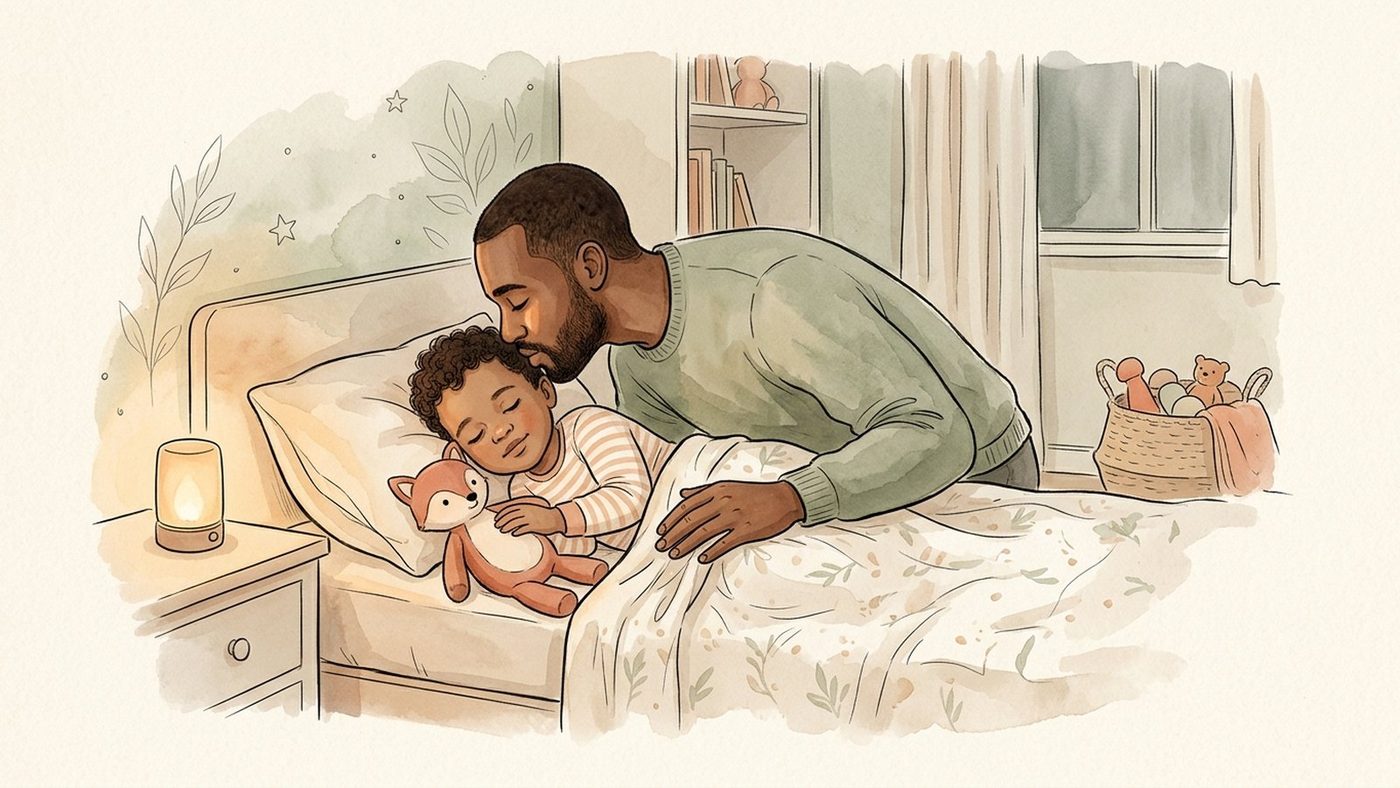
- Quiet. Cuddles, a lullaby, or a book in dim light, in the bedroom.
- Lights out. Into the crib or bed, with a short goodnight phrase, within about 30 minutes of the bath.
If your toddler still has milk before bed, move it early in the routine, before the bath or book, so the last thing before sleep is the bed, not the bottle.

Does a bedtime routine really work for toddlers?
Yes, in the trials so far it helped, and quickly. In the 2009 trial, 199 of the families had toddlers aged 18 to 36 months. After a baseline week, half did the routine for two weeks and half carried on as usual. Here’s what changed for toddlers in the routine group, from mothers’ sleep diaries:
| Measure | Before | After 2 weeks |
|---|---|---|
| Time to fall asleep | 21.9 minutes | 16.1 minutes |
| Night wakings | 1.0 a night | 0.5 a night |
| Time awake at night | 13.3 minutes | 9.3 minutes |
| Longest sleep stretch | 8.0 hours | 8.9 hours |
Mothers’ moods improved too, and the group without a new routine didn’t change. Babies aged 7 to 18 months in the same trial saw similar gains.
What the research says: one randomized trial (405 families) supports a nightly routine, and a survey of over 10,000 mothers in 14 countries found that more routine nights went with better sleep. Both studies were funded by a baby-products company, relied on mothers’ reports, and the trial lasted only three weeks. A major sleep medicine review also lists positive routines among supported treatments. The routine costs nothing and has no known downsides.
How long should a toddler bedtime routine be?
About 20 to 40 minutes. Long routines tend to drift and invite negotiation; one US parenting program specifically steered families away from routines longer than 45 minutes. What matters most is doing it often. In the large 2015 study, earlier bedtimes, faster sleep, fewer night wakings, and more total sleep were all linked to how many nights a week the routine happened, yet about half of mothers did one less than every night.
My baby is only 7 months old, but we already do a short version: bath, pajamas, one book, and into the crib. It’s as much a signal for me that the day is winding down as it is for the baby.
What time should my toddler go to bed?
Pick a time that fits their sleep needs and keep it steady. The WHO recommends 11 to 14 hours of sleep in 24 hours, including naps, for ages 1 to 2, and 10 to 13 hours at ages 3 to 4, with regular sleep and wake-up times. Count back from your toddler’s usual wake time. The AAP suggests setting regular bedtimes and not waiting for eye-rubbing and yawning, and notes that even 15 to 20 minutes earlier can make a big difference.
Our sleep chart by age shows typical totals and naps, and our guide to wake windows explains how nap timing affects bedtime.
The AAP has its own three-word bedtime routine: Brush, Book, Bed. For children under 3, it recommends brushing with a smear of fluoride toothpaste the size of a grain of rice.
Do screens and lights before bed matter?
They seem to, so keep the last hour screen-free and dim. The AAP advises avoiding screens other than video chat under 18 months, and the WHO recommends no screen time for 1-year-olds and no more than an hour a day at age 2. Studies link evening screen use to poorer sleep in young children, though they show a link rather than proof of cause.
Light itself matters too. In a small lab study of 10 preschoolers, an hour of bright light before bed cut their melatonin, the body’s sleep hormone, by 88%. That light was much brighter than a typical lamp, but switching to soft, low lamps for the last hour is an easy step.
If you’d like the whole plan in one place, The Well-Rested Mind walks through the routine and every research-tested sleep method, with a printable routine card for every caregiver.

What if my toddler stalls or keeps calling out?
Build the requests into the routine, then keep responses calm and boring. Make a “last call” the final step: one drink of water, one bathroom trip, one more hug. For children around 3 and older, a “Bedtime Pass” can help: your child gets one card that buys one short request, and after it’s used, any getting up gets a calm, silent walk back to bed. In one small study, it ended bedtime resistance in all four 3-year-olds tested.
If night wakings are the bigger problem, read does sleep training work for the methods with the most evidence.
Talk to your pediatrician if your toddler:
- snores most nights, or pauses or gasps while breathing in sleep
- has very restless sleep or seems uncomfortable in the legs at night
- has frequent or long night terrors, or sleep problems that don’t improve after a few weeks of a consistent routine
Frequently asked questions
Does my toddler need a bath every night?
No. The bath was part of the tested routine, but a quick wash of face and hands works on other nights. Keep the order and the timing the same.
What if we miss a night?
That’s fine. Research links more routine nights with better sleep, so aim for most nights, but one late night out won’t undo it. Go back to the usual steps the next evening.
Should every caregiver do the same routine?
Yes, as closely as possible. Write the four steps down and keep them where a partner, grandparent, or sitter can see them. The steps matter less than the sameness.
Is a night-light OK?
Yes. If your toddler wants one, choose a dim, warm-colored light, or leave the door slightly open to a soft hallway light.
Sources
- Mindell JA, et al. (2009). A nightly bedtime routine: impact on sleep in young children and maternal mood. Sleep 32(5):599–606. pmc.ncbi.nlm.nih.gov
- Mindell JA, et al. (2015). Bedtime routines for young children: a dose-dependent association with sleep outcomes. Sleep 38(5):717–722. pmc.ncbi.nlm.nih.gov
- Mindell JA, et al. (2006). Behavioral treatment of bedtime problems and night wakings in infants and young children. Sleep 29(10):1263–1276. pubmed.ncbi.nlm.nih.gov
- American Academy of Pediatrics, HealthyChildren.org. Brush, Book, Bed. healthychildren.org
- World Health Organization (2019). To grow up healthy, children need to sit less and play more. who.int
- Akacem LD, Wright KP Jr, LeBourgeois MK (2018). Sensitivity of the circadian system to evening bright light in preschool-age children. Physiological Reports 6(5):e13617. pmc.ncbi.nlm.nih.gov
- Freeman KA (2006). Treating bedtime resistance with the bedtime pass: a systematic replication and component analysis with 3-year-olds. Journal of Applied Behavior Analysis 39(4):423–428. pmc.ncbi.nlm.nih.gov