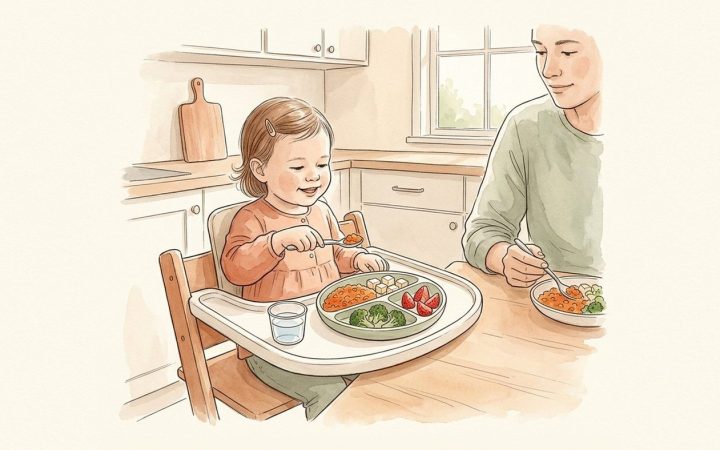
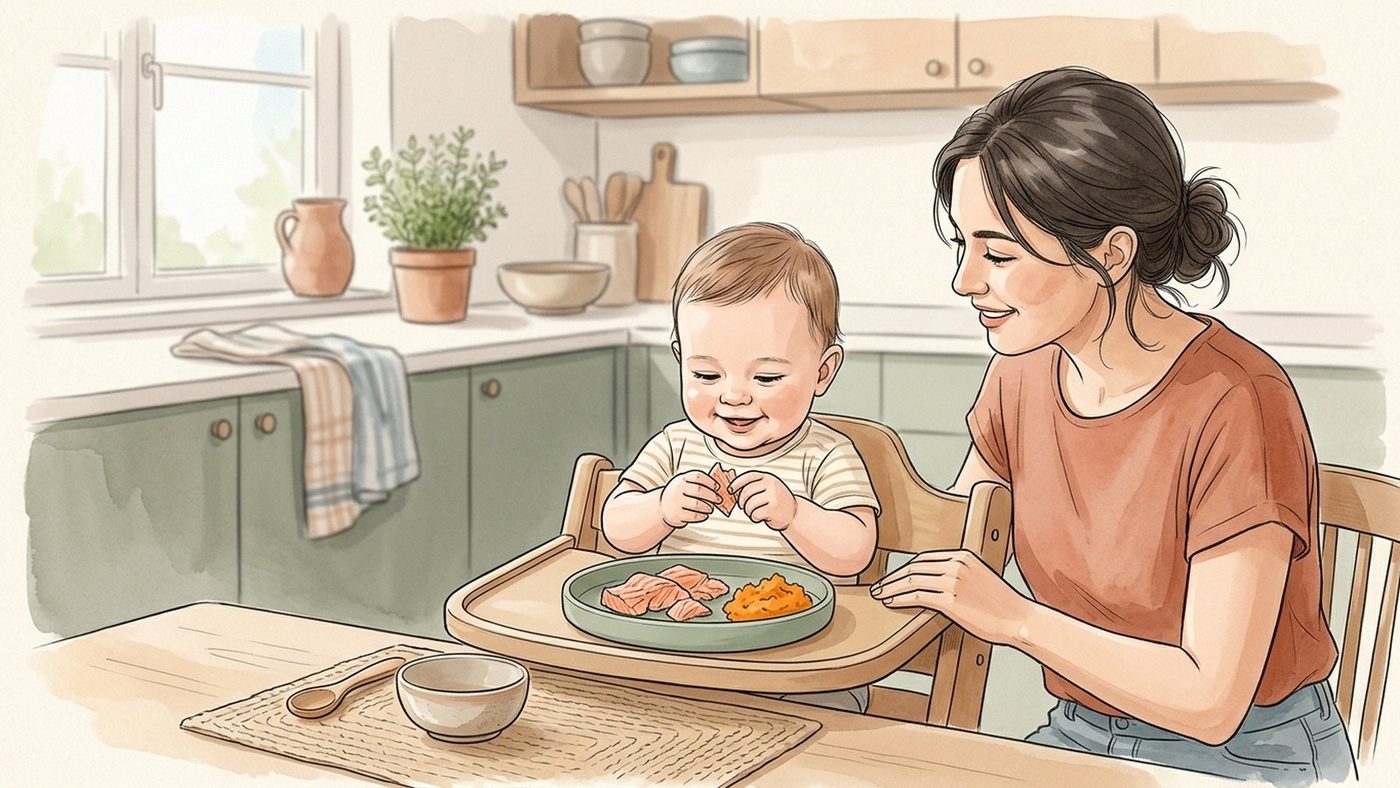
Short answer: Yes. Babies can eat fish once they start solids, usually around 6 months, as long as it’s well cooked, boneless, and soft. Choose low-mercury fish from the FDA and EPA “Best Choices” list, like salmon, cod, pollock, sardines, and canned light tuna. For children aged 1 to 3, the FDA advises 2 servings a week of about 1 ounce (28 g) each, and avoiding high-mercury fish such as shark, swordfish, king mackerel, and bigeye tuna.
Key takeaways
- When: fish can be one of your baby’s early foods from about 6 months. The AAP says delaying allergenic foods like fish doesn’t prevent allergy.
- Which: stick to the FDA’s “Best Choices,” the lowest-mercury fish, for babies and young children.
- How much: for ages 1 to 3, two servings a week of about 1 oz (28 g). There’s no official serving size under age 1.
- Tuna: canned light tuna is a Best Choice. Albacore (white) tuna has more mercury and is on the “Good Choices” list instead.
When can babies eat fish?
From the start of solids, usually around 6 months. The CDC lists soft, small pieces of fish among the protein foods for babies 6 to 12 months old. The AAP’s guidance on starting solids says that within a few months of starting, a baby’s daily diet should include a variety of foods including fish, and that there’s no evidence that waiting past 4 to 6 months to introduce allergenic foods prevents food allergy.
Fish is worth getting in early. The FDA says fish provide key nutrients that support a child’s brain development, including omega-3 fats (DHA and EPA), iron, and choline, plus iron and zinc for the immune system, along with protein, vitamin B12, vitamin D, and selenium. That makes it a great partner to the other foods in our guide to iron-rich foods for babies.
Fish and shellfish are common food allergens, so offer them the same way as other allergenic foods: a small amount on its own day, at home, when your baby is well, and then keep offering it regularly. If your baby has severe eczema or another food allergy, ask your pediatrician first. Our post on introducing peanut walks through the same approach.
Which fish are safest for babies?
Fish lowest in mercury. The FDA and EPA sort fish into three groups based on mercury levels, and say children should eat from the “Best Choices” list. Here’s a simplified version of the chart:
| FDA group | Examples | For babies and young children |
|---|---|---|
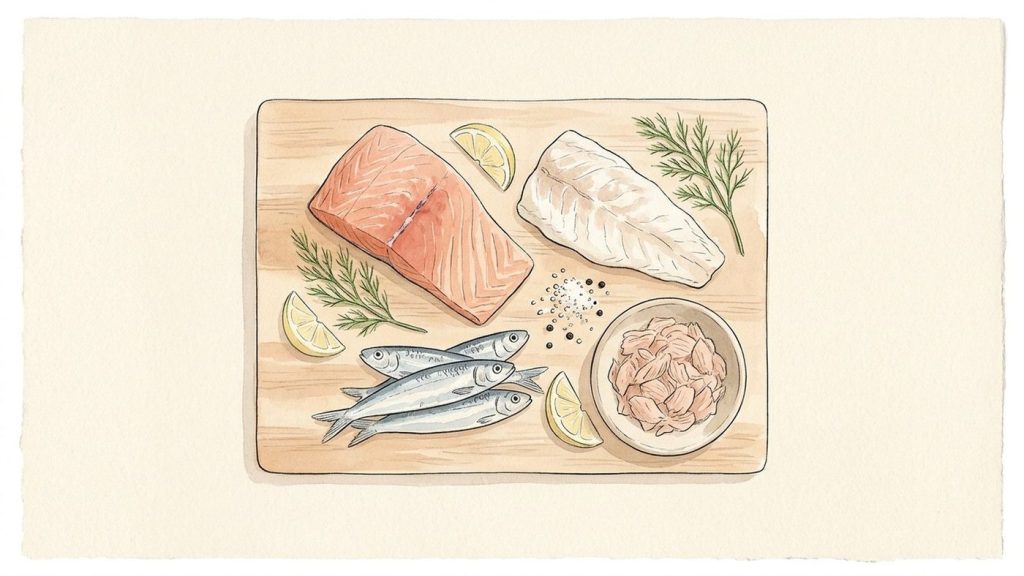
| Best Choices (lowest mercury) | Salmon, cod, pollock, haddock, tilapia, sardines, anchovies, Atlantic mackerel, trout (freshwater), sole, flounder, catfish, herring, canned light tuna (including skipjack), shrimp, crab, scallops | Use these. Two servings a week for ages 1 to 3 |
| Good Choices (more mercury) | Albacore or white tuna (canned and fresh), yellowfin tuna, halibut, mahi mahi, grouper, snapper, Chilean sea bass, rockfish, striped bass | Not part of the FDA’s advice for children; save for occasionally when older |
| Choices to Avoid (highest mercury) | Shark, swordfish, king mackerel, marlin, orange roughy, bigeye tuna, tilefish from the Gulf of Mexico | Avoid |
The NHS gives similar advice in the UK: all babies and children under 16 should avoid shark, swordfish, and marlin, because mercury can affect the development of a child’s nervous system.
Oily fish like salmon, sardines, trout, herring, and Atlantic mackerel are especially rich in omega-3 fats, and they’re all on the Best Choices list. Salmon is a popular first fish because it’s soft, flaky, and easy to find boneless.
How much fish can a baby or toddler eat?
For children aged 1 to 11, the FDA advises 2 servings a week from the Best Choices list, with serving size growing with age:
- Ages 1 to 3: about 1 oz (28 g) per serving
- Ages 4 to 7: about 2 oz (57 g)
- Ages 8 to 10: about 3 oz (85 g)
- Age 11: about 4 oz (113 g)
The FDA notes that the Dietary Guidelines for Americans suggest higher amounts for some children, but says those extra servings should come only from the lowest-mercury fish on the Best Choices list.
For babies under 1, the FDA chart doesn’t give a serving size. A sensible approach is to offer small amounts, a few soft flakes or a spoonful mixed into another food, a couple of times a week, from the Best Choices list. Your baby’s appetite will guide the rest.
What the research says: the FDA and EPA advice is based on measured mercury levels in commercial fish and on research showing that fish nutrients support brain development, while mercury at high levels can harm the developing nervous system. The exact serving sizes are designed as safe averages rather than tested limits, and you may see slightly different numbers on older pages. The direction is consistent: low-mercury fish, regularly, in small portions.
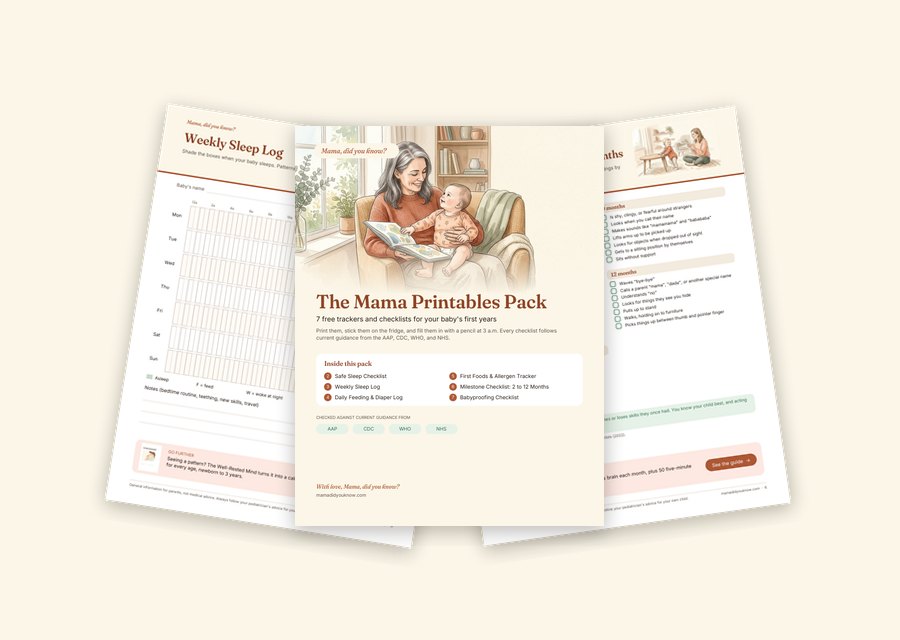
Free download
Free: first foods and allergen tracker
Tick off each allergen and new food, with space for reactions, plus a feeding and diaper log. Part of our free 7-page printables pack.
Can babies eat canned tuna?
Yes, canned light tuna is fine. The FDA lists canned light tuna, including skipjack, as a Best Choice. Albacore, sometimes labeled “white” tuna, has more mercury and sits on the Good Choices list, which isn’t part of the FDA’s advice for children. If you buy tuna for your baby, choose light.
A few more tips for canned fish:
- Pick fish packed in water and labeled no salt added or low sodium, then drain it well. Babies need very little salt, as we explain in can babies have salt.
- Canned salmon and sardines can contain soft, edible bones that mash easily and add calcium. Mash them very well or remove them if you’re unsure.
- Count canned fish toward the 2 servings a week, along with fresh and frozen fish.
If you’re also thinking about metals in other baby foods, see our guide to heavy metals in baby food.
What are easy ways to serve fish to babies and toddlers?
Mixing fish into foods your baby already likes is the easiest start. Some ideas that work at different stages:
- 6 to 9 months: flaked salmon or cod mashed into sweet potato, squash, or avocado; a smooth fish and potato mash loosened with breast milk or formula.
- 9 to 12 months: soft homemade fish cakes made with mashed potato and egg; small soft flakes your baby can pick up; fish stirred into pasta or rice.
- Toddlers: salmon or tuna mixed with mashed avocado or yogurt on toast fingers; mild fish tacos with soft tortillas; baked fish strips with a yogurt dip.
Don’t worry if fish is rejected the first few times. It often takes several tries before a new taste is accepted, so keep offering it calmly alongside familiar foods. Whether you spoon-feed or let your baby self-feed, our comparison of baby-led weaning vs purées can help you choose textures.
How do I prepare fish for a baby?
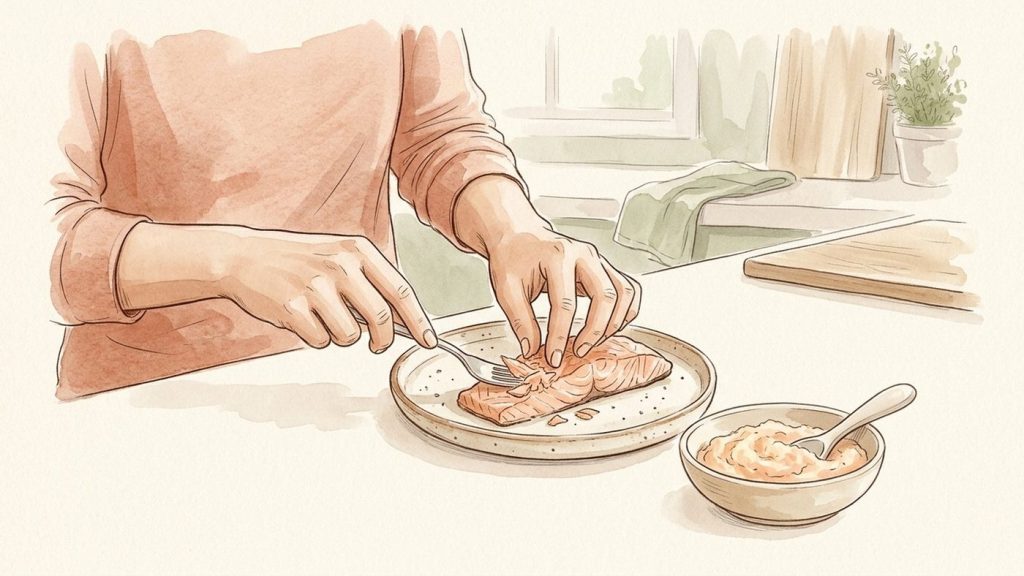
Cook it fully, check for bones, and serve it soft. These steps work whether you’re spoon-feeding or doing baby-led weaning:
- Choose a Best Choice fish. Fresh, frozen, or canned all work. Boneless fillets make life easier.
- Cook it through. Bake, steam, or poach until the flesh is opaque and flakes easily with a fork, or reaches 63°C (145°F) on a food thermometer.
- Check carefully for bones. Run your fingers through the cooked fish and flake it into small pieces so you can feel and remove any bones.
- Match the texture to your baby. Mash or purée it with breast milk, formula, or a vegetable for younger babies. For finger feeding, offer soft flakes or a soft, finger-sized strip.
- Skip added salt and sauces. A squeeze of lemon or a little unsalted butter or oil is plenty.
- Stay with your baby while they eat. Seat them upright and watch every bite. Our gagging vs choking guide explains what’s normal.
Don’t give babies or young children raw or lightly cooked fish or shellfish, such as sushi, raw oysters, clams, or mussels; the NHS warns that raw or lightly cooked shellfish increases the risk of food poisoning. Fish sticks and breaded fish are often salty and can be hard to chew, so homemade is better. If family or friends catch fish locally, the FDA says to check local fish advisories first, and if there’s no advisory, eat only one serving that week and no other fish.
Stop feeding and call your pediatrician if your baby develops hives, redness around the mouth, vomiting, or unusual fussiness after eating fish or shellfish. Talk to your pediatrician before introducing fish if your baby has severe eczema or another known food allergy.
Call your local emergency number right away if your baby has trouble breathing, wheezing, swelling of the lips, tongue, or face, repeated vomiting, or becomes pale, floppy, or unusually sleepy after eating. These can be signs of a serious allergic reaction.
Frequently asked questions
Can babies eat salmon?
Yes. Salmon is on the FDA’s Best Choices list, rich in omega-3 fats, and soft enough to mash or flake. Cook it fully and check for bones.
Can babies eat shrimp and other shellfish?
Shrimp, crab, scallops, and clams are on the Best Choices list. Shellfish is a common allergen, so introduce it like other allergenic foods, always fully cooked, and chop it finely since whole shrimp can be a choking risk.
Is it OK to give my toddler fish more than twice a week?
The FDA says the Dietary Guidelines suggest higher amounts for some children, but any extra should come only from the lowest-mercury Best Choices fish.
Do babies need fish oil supplements?
Most babies don’t need them if they eat fish regularly and drink breast milk or formula. Ask your pediatrician before giving any supplement.
What if my family doesn’t eat fish?
That’s fine. Other foods provide protein, iron, and zinc, and your pediatrician can advise on omega-3s. A vegetarian toddler diet can still cover all the key nutrients with a little planning.
Sources
- US Food and Drug Administration and Environmental Protection Agency. Advice about Eating Fish. fda.gov
- US Environmental Protection Agency. Choose Fish and Shellfish Wisely. epa.gov
- American Academy of Pediatrics, HealthyChildren.org. Starting Solid Foods. healthychildren.org
- Centers for Disease Control and Prevention. Foods and Drinks to Encourage. cdc.gov
- NHS. Foods to avoid giving babies and young children. nhs.uk
- US Food and Drug Administration. Food Allergies: What You Need to Know. fda.gov