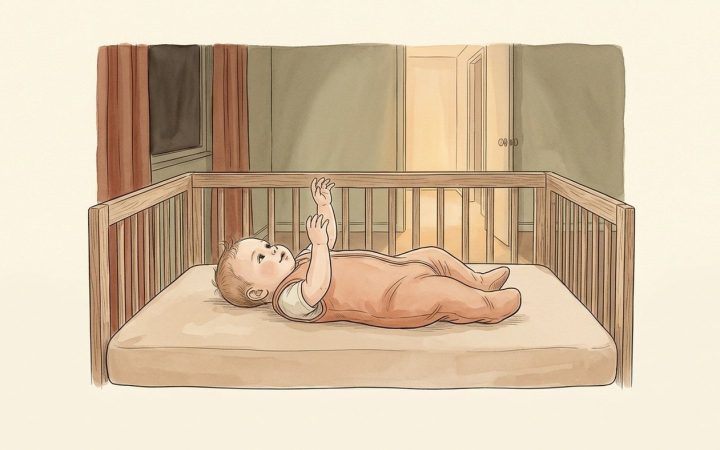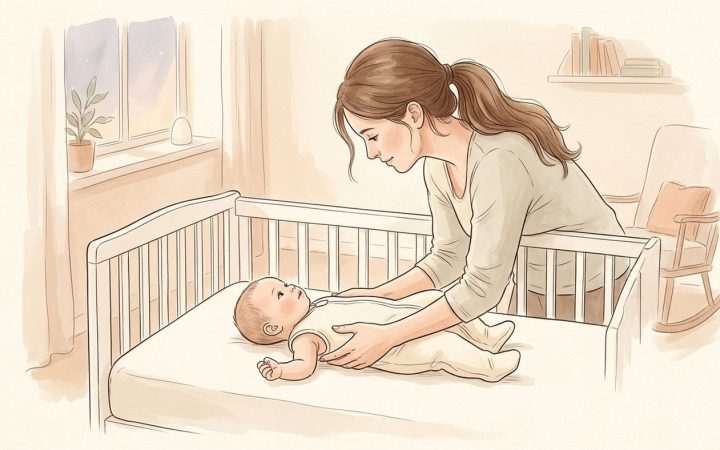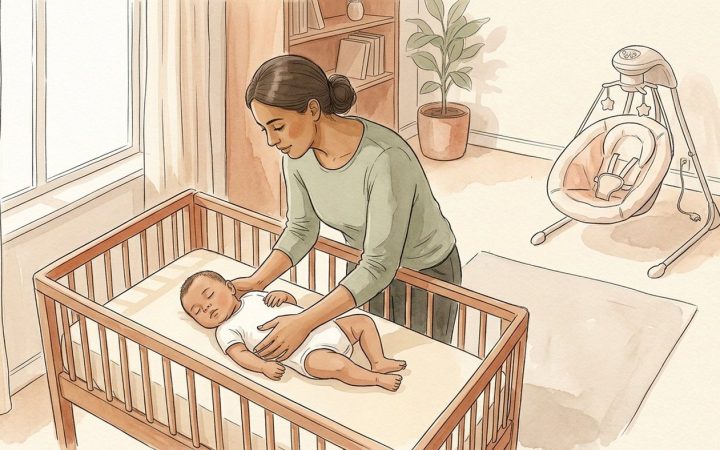

Short answer: Aim for a room of about 16–20°C (61–68°F), dress your baby in about one layer more than you’d wear to be comfortable, and use a well-fitting, non-weighted sleep sack instead of loose blankets. Skip hats indoors. Then check the back of the neck or chest: if it’s hot or sweaty, remove a layer; if it feels cool, add one.
Our hallway thermostat and Adam’s room never seem to agree, so I bought a cheap room thermometer and stopped guessing. This is the guidance I use to decide what he wears each night.
Key takeaways
- Room temperature: UK safe-sleep guidance recommends 16–20°C (61–68°F). The AAP doesn’t give a number but warns against overheating.
- Layers: the AAP’s rule of thumb is one layer more than you’re wearing.
- Check the right spot: feel the chest or back of the neck. Cool hands and feet are normal.
- No hats, no weighted products, no loose blankets: babies lose heat through their heads, and weighted or loose bedding adds risk.
- TOG charts vary by brand: follow the label on your own sleep sack rather than a generic chart.
What temperature should a baby’s room be for sleep?
Between about 16 and 20°C (61–68°F). That range comes from the UK’s Lullaby Trust and the NHS, which both suggest checking it with a room thermometer rather than guessing. The American Academy of Pediatrics doesn’t set a specific room temperature, but its safe sleep guidance is clear that overheating can increase the risk of SIDS.
Many US homes sit warmer than that, at 70°F (21°C) or more, especially in winter with the heating on. That doesn’t mean your baby is in danger. It just means they need fewer layers. The Lullaby Trust also says keeping the heating on all night is rarely needed, and if you do, to keep it low and the crib away from radiators, heaters, and direct sunlight.
How should I dress my baby for sleep at different temperatures?
Fewer layers as the room gets warmer, and one extra layer or a warmer sleep sack as it gets cooler. The Lullaby Trust deliberately doesn’t publish an exact clothing or TOG chart, because every product insulates differently and layers trap heat in different ways. So treat the table below as a starting point built from its guidance and the AAP’s one-extra-layer rule, then adjust to how your baby actually feels.
| Room temperature | A reasonable starting point | Notes |
|---|---|---|
| Below 16°C (61°F) | Long-sleeved bodysuit and footed sleeper, plus a warmer (higher TOG) sleep sack | Add clothing or a higher TOG, never a blanket on top of a sleep sack |
| 16–20°C (61–68°F) | Footed sleeper (or bodysuit and pajamas) plus a lightweight sleep sack | The range UK guidance recommends |
| 20–22°C (68–72°F) | Footed sleeper or bodysuit plus a light sleep sack, or a sleeper alone | Typical US heated room; check the neck often at first |
| 22–24°C (72–75°F) | Short- or long-sleeved bodysuit plus a very light sleep sack, or a light sleeper alone | Lower TOG; fewer layers |
| Above 24°C (75°F) | Short-sleeved bodysuit, or just a diaper in real heat | The Lullaby Trust says a vest or just a diaper is fine in very hot weather |
A sleep sack is the safest way to add warmth, because it can’t cover your baby’s face the way a loose blanket can. Choose a non-weighted one that fits well around the neck and shoulders so your baby can’t slip down inside it. The Lullaby Trust notes that most are sized by weight, not age. If your baby is still swaddled, our guide on when to stop swaddling explains when to switch to an arms-free sack.

What does TOG mean on a sleep sack?
TOG is a measure of how warm a fabric is, and the higher the number, the warmer the product. Lighter sacks have a low TOG for warm rooms; padded ones have a higher TOG for cool rooms. The Lullaby Trust advises following your sleep sack manufacturer’s own TOG guide, since that’s what the product was designed and tested for.
That’s also why online TOG charts disagree with each other. Brands map their ratings to slightly different temperature bands. Two practical points from the Lullaby Trust are worth knowing:
- TOGs don’t add up neatly. Two 1.0 TOG sleep sacks layered together aren’t the same as one 2.0 TOG sack. Air trapped between layers makes them warmer, so avoid doubling up.
- A doubled blanket counts as two. If you’re using light bedding instead of a sack, folding it over doubles the warmth.
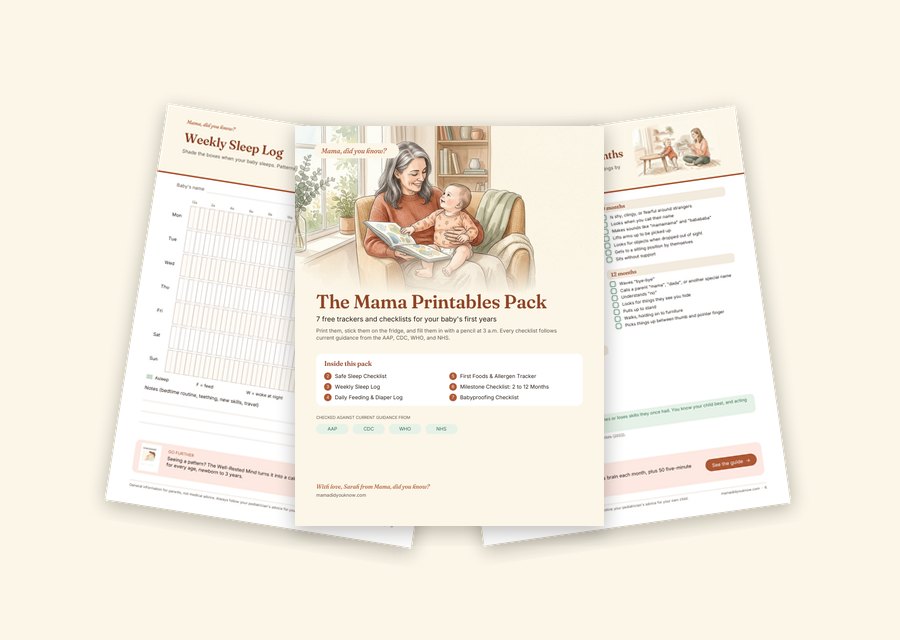
Free download
Free: safe sleep checklist and sleep log
Track naps and night wakings for a week and the pattern shows itself. Part of our free 7-page printables pack.
How do I know if my baby is too hot or too cold at night?
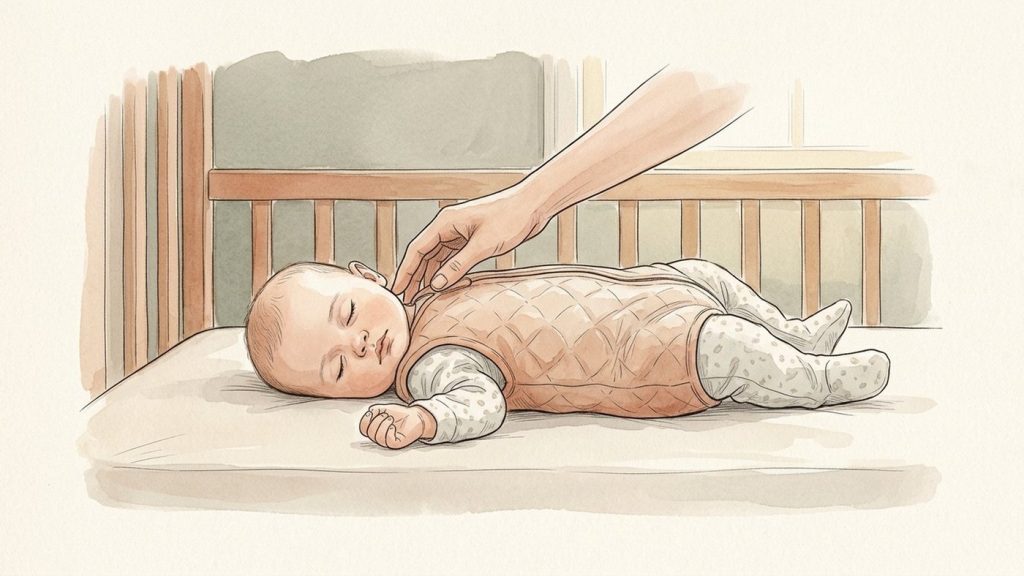
Feel the chest or the back of the neck. The Lullaby Trust says your baby’s hands and feet will usually be cooler, and that’s normal, so they aren’t a good guide. Here’s how to check and adjust:
- Check the room first. A simple room thermometer near the crib, away from heaters and windows, tells you where you’re starting.
- Dress one layer more than you. If you’re comfortable in a T-shirt and pajama pants, a sleeper plus a light sleep sack is roughly one layer more.
- Check after 20 minutes or so. Slide two fingers to the back of your baby’s neck or onto their chest.
- Too warm? Hot or sweaty skin, damp hair, flushed cheeks, or fast breathing mean remove a layer.
- Too cool? If the chest or neck feels cool, add a layer of clothing or switch to a warmer sleep sack. Don’t add a blanket.
A sweaty head on its own isn’t always a sign of overheating. Babies’ heads can sweat during deep sleep even when the rest of them is comfortable. Our post on baby head sweating while sleeping covers that in detail.
Why does overheating matter for safe sleep?
Because babies who get too hot have a higher risk of SIDS. The AAP, the NHS, and the Lullaby Trust all say this. One of the studies that shaped this advice was a 1990 case-control study in southwest England, published in the BMJ. It found that heavy wrapping with clothing and bedding and tummy sleeping were each independently linked to sudden unexpected infant death, particularly in babies older than about 10 weeks.
What the research says: the link between overheating and SIDS comes from observational studies, which can show an association but not prove cause. It’s consistent enough that every major safe-sleep body includes it. What’s much less certain is any exact temperature-to-clothing formula. No study has tested specific TOG bands, which is why official bodies give a range and a rule of thumb rather than a precise chart.
Should my baby wear a hat or socks to sleep?
No hat. The AAP says to skip hats indoors once you’re home from the hospital, and the Lullaby Trust explains that babies lose heat through their heads, so a covered head can make them overheat. The NHS adds that hats and extra layers should come off as soon as you come indoors or get into a car, even if it means waking your baby.
Socks or a footed sleeper are fine if the room is cool, since they don’t cover the head or face. Remember that cool feet alone don’t mean your baby is cold.
Whatever the temperature, place your baby on their back, on a firm, flat surface, with only a fitted sheet. Don’t use weighted sleep sacks, swaddles, or blankets; the AAP and the Lullaby Trust both advise against them. Never use a hot water bottle or electric blanket for a baby. Loose blankets aren’t recommended in the first year, as we explain in when can a baby sleep with a blanket.
How should I dress my baby for sleep with a fever?
Lightly, and no more than usual. The Lullaby Trust says not to wrap an unwell baby up more than normal, even if they seem shivery. Extra layers make it harder for them to cool down. Dress them in their usual light layers, keep the room comfortable, and offer feeds. Our guide to baby fever and when to call the doctor explains which temperatures need a call.
Call your pediatrician or local emergency number if:
- your baby is under 3 months and has a temperature of 38°C (100.4°F) or higher
- your baby is very hot and floppy, hard to wake, or breathing fast or with effort
- your baby feels cold and isn’t warming up with an extra layer, or looks pale or blotchy
- you’re worried that your baby seems unwell
Frequently asked questions
How should I dress my baby for sleep in a 70°F room?
70°F is about 21°C, slightly warmer than the UK’s recommended range. A footed sleeper plus a light sleep sack, or a sleeper alone, is a reasonable start. Check the back of the neck and remove a layer if it’s sweaty.
What about a 75°F room?
75°F is about 24°C, which is warm for sleep. A short-sleeved bodysuit, possibly with a very light sleep sack, is usually plenty. In real heat, a diaper alone is fine.
How do I dress my baby for sleep without a sleep sack?
Use layers of clothing instead, like a bodysuit under a footed sleeper. The Lullaby Trust says a firmly tucked-in, lightweight blanket is an option in the UK, but the AAP advises keeping soft bedding out of the crib in the first year, so clothing layers are the simpler choice.
Are cold hands a sign my baby is cold?
Not on their own. Babies’ hands and feet are usually cooler than the rest of them. Check the chest or the back of the neck instead.
Can I use a fan in my baby’s room?
Yes. The Lullaby Trust says a fan can help in hot weather, as long as it isn’t pointed directly at your baby. See our guide to babies in a heatwave for more.
Sources
- The Lullaby Trust. How to dress your baby for sleep. lullabytrust.org.uk
- The Lullaby Trust. Baby room temperature. lullabytrust.org.uk
- NHS. Sudden infant death syndrome (SIDS). nhs.uk
- American Academy of Pediatrics, HealthyChildren.org. How to Keep Your Sleeping Baby Safe: AAP Policy Explained. healthychildren.org
- Moon RY, Carlin RF, Hand I, et al. (2022). Sleep-Related Infant Deaths: Updated 2022 Recommendations for Reducing Infant Deaths in the Sleep Environment. Pediatrics. pubmed.ncbi.nlm.nih.gov
- Fleming PJ, Gilbert R, Azaz Y, et al. (1990). Interaction between bedding and sleeping position in the sudden infant death syndrome: a population based case-control study. BMJ. pmc.ncbi.nlm.nih.gov
- The Lullaby Trust. Hot weather. lullabytrust.org.uk