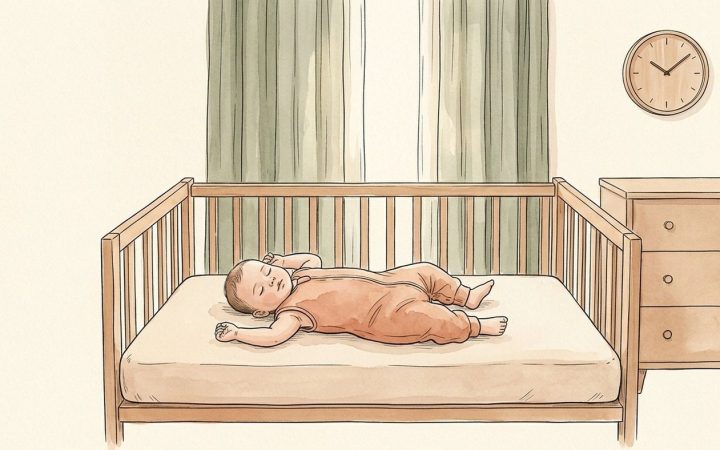
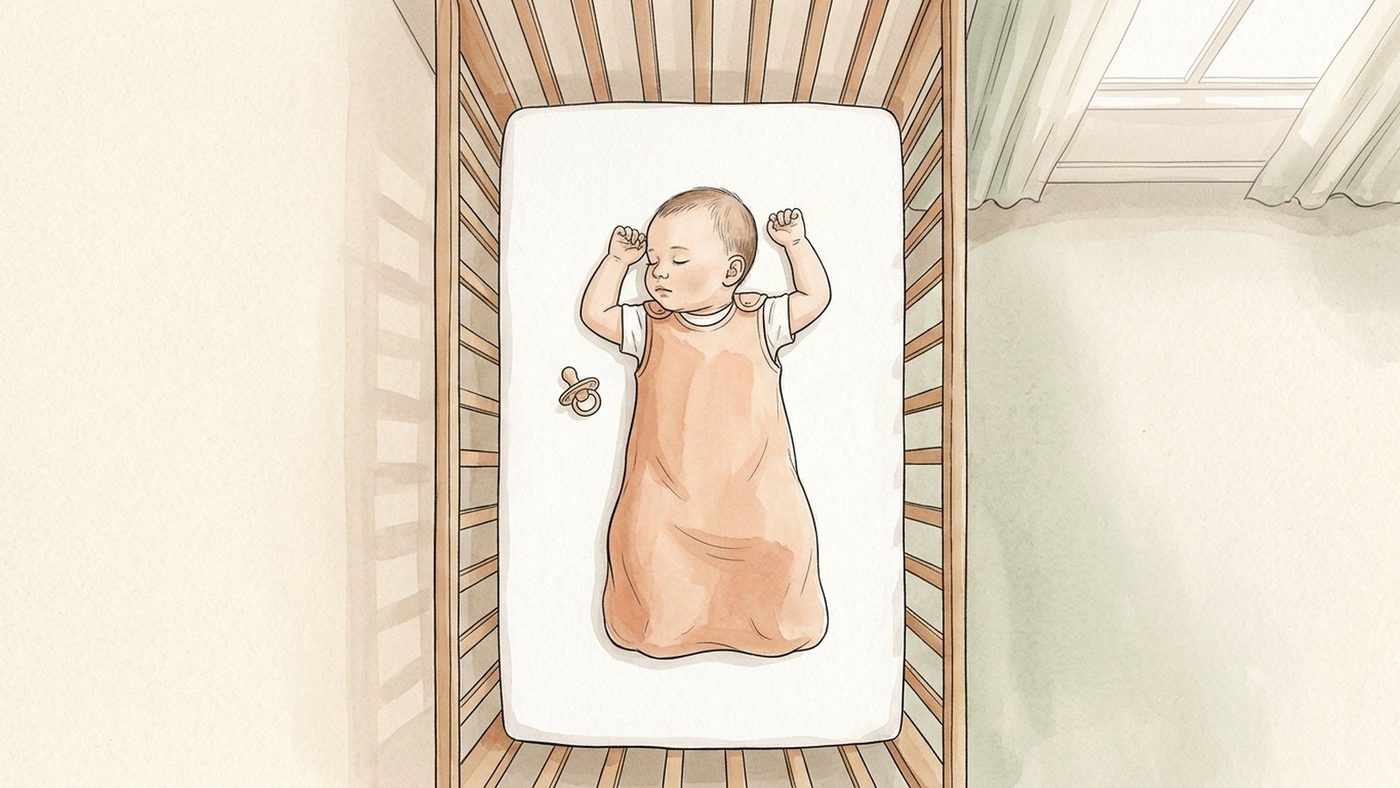
Short answer: Yes, it’s safe and even recommended to offer your baby a pacifier at bedtime and naps. The American Academy of Pediatrics says pacifiers lower the risk of SIDS even if they fall out after your baby is asleep, so you don’t need to put it back in. If you’re breastfeeding, wait until feeding is well established, usually about 3 to 4 weeks. Never attach a pacifier to clothing, a cord, or a stuffed toy during sleep.
Key takeaways
- Offer it at every sleep: the AAP and Safe to Sleep both recommend a pacifier at naps and at night to lower SIDS risk.
- No need to reinsert: the protection seems to come from falling asleep with it. If it falls out, leave it.
- Breastfeeding first: wait until breastfeeding is going well, usually about 3 to 4 weeks. Formula-fed babies can start any time.
- Keep it simple: no clips, cords, or attached stuffed animals in the crib, and never coat it in honey or anything sweet.
Is it safe for my baby to sleep with a pacifier at night?
Yes. Using a pacifier at sleep is one of the AAP’s official recommendations for lowering the risk of sudden infant death syndrome (SIDS). The AAP’s 2022 safe sleep policy lists it alongside back sleeping, a bare crib, room sharing, and breastfeeding. The NIH’s Safe to Sleep campaign says the same: offer your baby a pacifier for naps and at night once they’re feeding well.
The main evidence comes from a 2005 meta-analysis in Pediatrics that pooled case-control studies of SIDS. Babies who used a pacifier at their last sleep had a much lower risk, with odds of SIDS about 60% lower after adjusting for other factors. The authors estimated that for every 2,733 babies who use a pacifier when put down to sleep, one SIDS death could be prevented.
Safe to Sleep adds that pacifiers seem especially helpful for formula-fed babies. Thumb or finger sucking hasn’t been shown to have the same effect.
What the research says: the link between pacifier use at sleep and lower SIDS risk is consistent across case-control studies, which is why the AAP recommends it. But there are no randomized trials, and nobody knows exactly why pacifiers help. Theories include easier arousal from sleep and keeping the airway open. Because it’s an association, a pacifier works best as one layer of protection on top of every other safe sleep rule, not as a replacement for them.
Should I put the pacifier back in when it falls out?
No, you don’t need to. The AAP and Safe to Sleep both say that if the pacifier falls out after your baby falls asleep, you don’t have to put it back in. The protective effect holds even when it drops out early in the sleep.
That’s good news for tired parents. You don’t need to set alarms or hover over the crib. If your baby wakes up and wants it, it’s fine to give it back, but there’s no safety reason to replace it while they sleep. Safe to Sleep also says not to force it: if your baby doesn’t want a pacifier, that’s OK.
Some babies wake up crying when the pacifier falls out and can’t settle without it. That’s a sleep habit question rather than a safety one, and we cover it further down.
How do I use a pacifier safely at night?
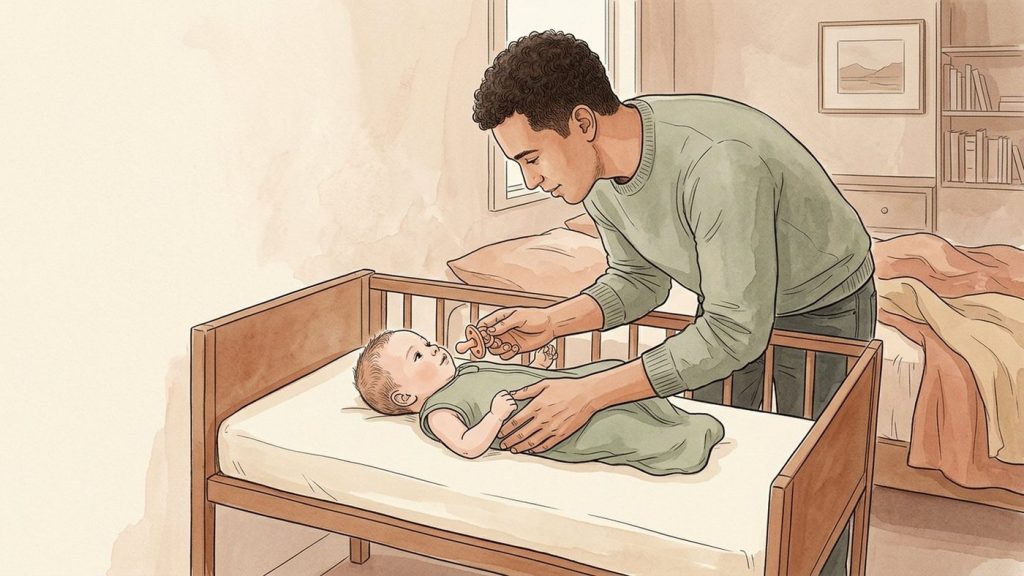
Follow these steps, based on guidance from the AAP and Safe to Sleep:
- Offer it as you lay your baby down. Place your baby on their back in a bare crib or bassinet, then offer the pacifier.
- Use a one-piece pacifier. The AAP suggests a one-piece model with a soft nipple, since some two-piece designs can come apart. Check it often and throw it out if it’s cracked, sticky, or torn.
- Don’t attach anything. No pacifier clips, ribbons, or cords, and no pacifiers sewn onto stuffed animals or blankets. These are strangulation and suffocation risks in the crib.
- Keep it plain. Never dip it in honey, sugar, or juice. Honey isn’t safe for babies under 1 at all, as we explain in can babies have honey.
- Let it fall out. No reinserting needed once your baby is asleep.
- Keep it clean. The AAP suggests sterilizing pacifiers often until about 6 months, then washing with soap and rinsing in clean water.
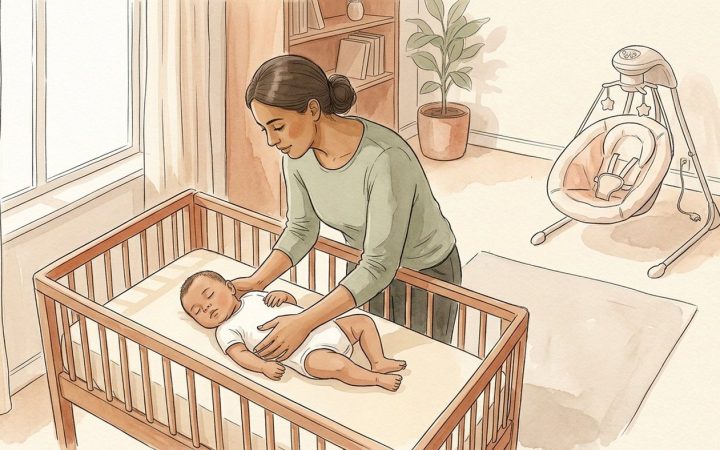
A pacifier doesn’t replace the other safe sleep basics. Place your baby on their back for every sleep, alone in a crib or bassinet with a firm, flat mattress and only a fitted sheet. No pillows, bumpers, blankets, or soft toys, and no “pacifier holder” plush toys in the crib. Room share, but don’t bed share, for at least the first 6 months.
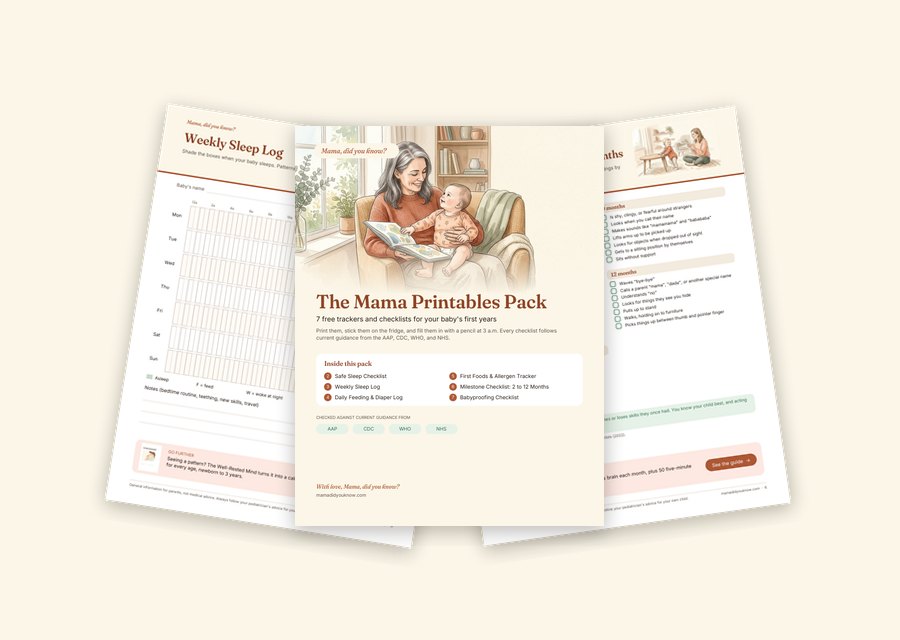
Free download
Free: safe sleep checklist and sleep log
Track naps and night wakings for a week and the pattern shows itself. Part of our free 7-page printables pack.
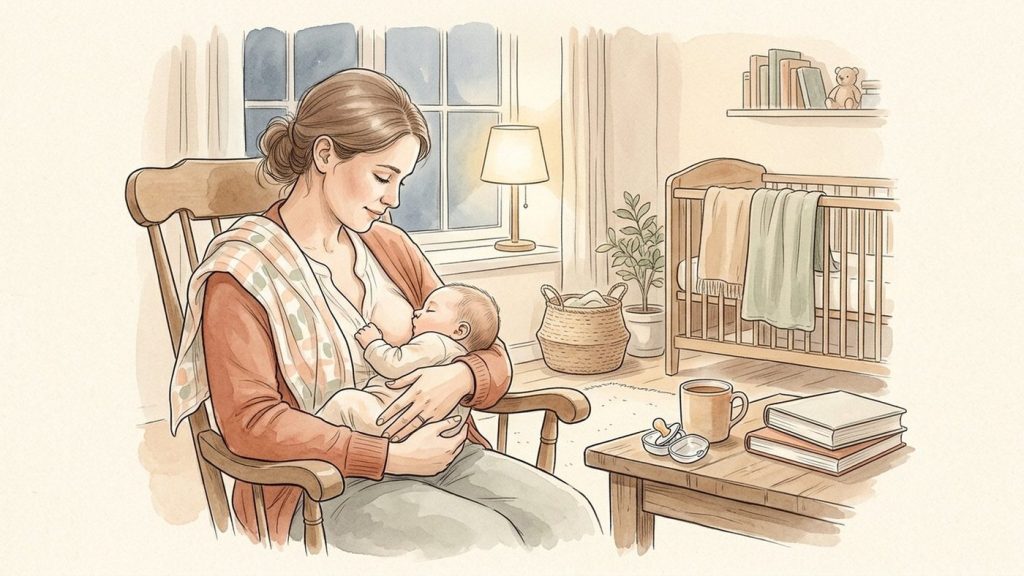
Will a pacifier at night affect breastfeeding?
Probably not once breastfeeding is going well. The AAP advises waiting until breastfeeding is established, which it says usually takes about 3 to 4 weeks. Safe to Sleep says to wait until it’s well established, based on your pediatrician’s guidance.
The worry is that a pacifier could replace feeds and lower milk supply. But a 2016 Cochrane review of randomized trials, covering more than 1,300 healthy full-term breastfed babies, found that pacifier use made no significant difference to how many babies were exclusively or partly breastfed at 3 and 4 months. The review noted that evidence on early breastfeeding difficulties is lacking, so if you’re struggling with latch or supply, talk to a lactation consultant before adding a pacifier.
Even with a pacifier, keep feeding on cue. A hungry baby who’s offered a pacifier instead of a feed can end up underfed, which is worth watching in the early weeks.
What if my baby wakes every time the pacifier falls out?
This is very common, and you have a few options. Many babies eventually learn to find and replace the pacifier themselves as their hand skills improve, often in the second half of the first year. Until then, some parents choose to replace it once or twice a night. Others try these approaches:
- Remove it as your baby gets drowsy but before they’re fully asleep, so they finish falling asleep without it. Some babies accept this; others protest.
- Let older babies practice finding it. Place it in your baby’s hand during the day and guide it to their mouth.
- Put two or three pacifiers in one corner of the crib once your baby can reach for them. This is a common parent tip rather than official advice, so keep the rest of the crib bare.
Remember that waking briefly during the night is normal at every age. Our baby sleep chart by age shows what to expect, and if your older baby is waking a lot at 8 to 10 months, see 8-month sleep regression or teething.
When should my baby stop using a pacifier at night?
There’s no single cutoff, and experts weigh different things. On one side, SIDS risk is highest in the first 6 months and falls after that, so the safety benefit shrinks over the first year. On the other side, there are two reasons to cut back later:
- Ear infections. In a Finnish trial published in Pediatrics in 2000, families who were coached to limit pacifier use in children aged 7 to 18 months saw 29% fewer ear infections. The researchers concluded that restricting pacifiers to the moments when a child is falling asleep helped prevent ear infections. Using it just for sleep is a good middle ground.
- Teeth. The AAP says strong sucking past about age 2 to 4 may affect the shape of the mouth or how the teeth line up. If the habit stops before permanent teeth come in, the bite often corrects itself.
For many families, that means a pacifier for sleep through the first year, then gradually limiting it during the toddler years. Our guide on when to take away the pacifier covers how to do it gently.
Talk to your pediatrician if:
- breastfeeding is difficult, your baby isn’t gaining weight well, or has fewer wet diapers
- your baby has frequent ear infections and uses a pacifier a lot
- you notice white patches in the mouth that don’t wipe away, which can be thrush
- your toddler’s teeth seem to be pushing forward or not meeting, and they still suck a pacifier often
If a pacifier breaks and your baby is choking or struggling to breathe, call your local emergency number.
Frequently asked questions
Can a newborn sleep with a pacifier?
Yes, if formula-fed. If breastfed, the AAP suggests waiting until breastfeeding is established, usually about 3 to 4 weeks, then offering it at sleep.
Should I use the pacifier only at night?
Using it for naps and night sleep gives the SIDS benefit. Limiting it to sleep times as your baby gets older may also lower the risk of ear infections.
Are pacifier clips safe at night?
No. Clips, cords, and attached stuffed animals should never be used during sleep, because of strangulation and suffocation risks.
My baby refuses the pacifier. Should I keep trying?
You can offer it again later, but don’t force it. Safe to Sleep says it’s fine if your baby doesn’t want one. The other safe sleep steps protect them.
Can my baby choke on a pacifier while sleeping?
A sound, one-piece pacifier of the right size is designed not to be swallowed. Check it regularly and replace it at the first sign of wear, since a damaged nipple can tear off.
Sources
- Moon RY, Carlin RF, Hand I, et al. (2022). Sleep-Related Infant Deaths: Updated 2022 Recommendations for Reducing Infant Deaths in the Sleep Environment. Pediatrics. pubmed.ncbi.nlm.nih.gov
- American Academy of Pediatrics, HealthyChildren.org. How to Keep Your Sleeping Baby Safe: AAP Policy Explained. healthychildren.org
- American Academy of Pediatrics, HealthyChildren.org. Baby Pacifiers & Thumb Sucking: What Parents Need to Know. healthychildren.org
- NIH, Eunice Kennedy Shriver National Institute of Child Health and Human Development. Safe to Sleep: Ways to Reduce Baby’s Risk. safetosleep.nichd.nih.gov
- Hauck FR, Omojokun OO, Siadaty MS (2005). Do pacifiers reduce the risk of sudden infant death syndrome? A meta-analysis. Pediatrics. pubmed.ncbi.nlm.nih.gov
- Jaafar SH, et al. (2016). Effect of restricted pacifier use in breastfeeding term infants for increasing duration of breastfeeding. Cochrane Database of Systematic Reviews. pubmed.ncbi.nlm.nih.gov
- Niemelä M, et al. (2000). Pacifier as a risk factor for acute otitis media: a randomized, controlled trial of parental counseling. Pediatrics. pubmed.ncbi.nlm.nih.gov